
Four Treasures Reference Database
Record No. 28889
The emerald vernicle of the Vatican
Journal Article
King, C.W. (1870) The emerald vernicle of the Vatican. Archaeological Journal, Vol. 27, No. 1, pp. 181–190.
ISBN/ISSN: 0066-5983 | DOI: https://doi.org/10.1080/00665983.1870.10851483 | Sinkankas/Born No.: NIS/NIB | RWHL
Close Abstract
Hide Keywords
Copy Reference
gems, glyptic, engraved gems, agate, cameo, intaglio, shell, ancient gems, Rome, Greece, ancient jewelry, rings
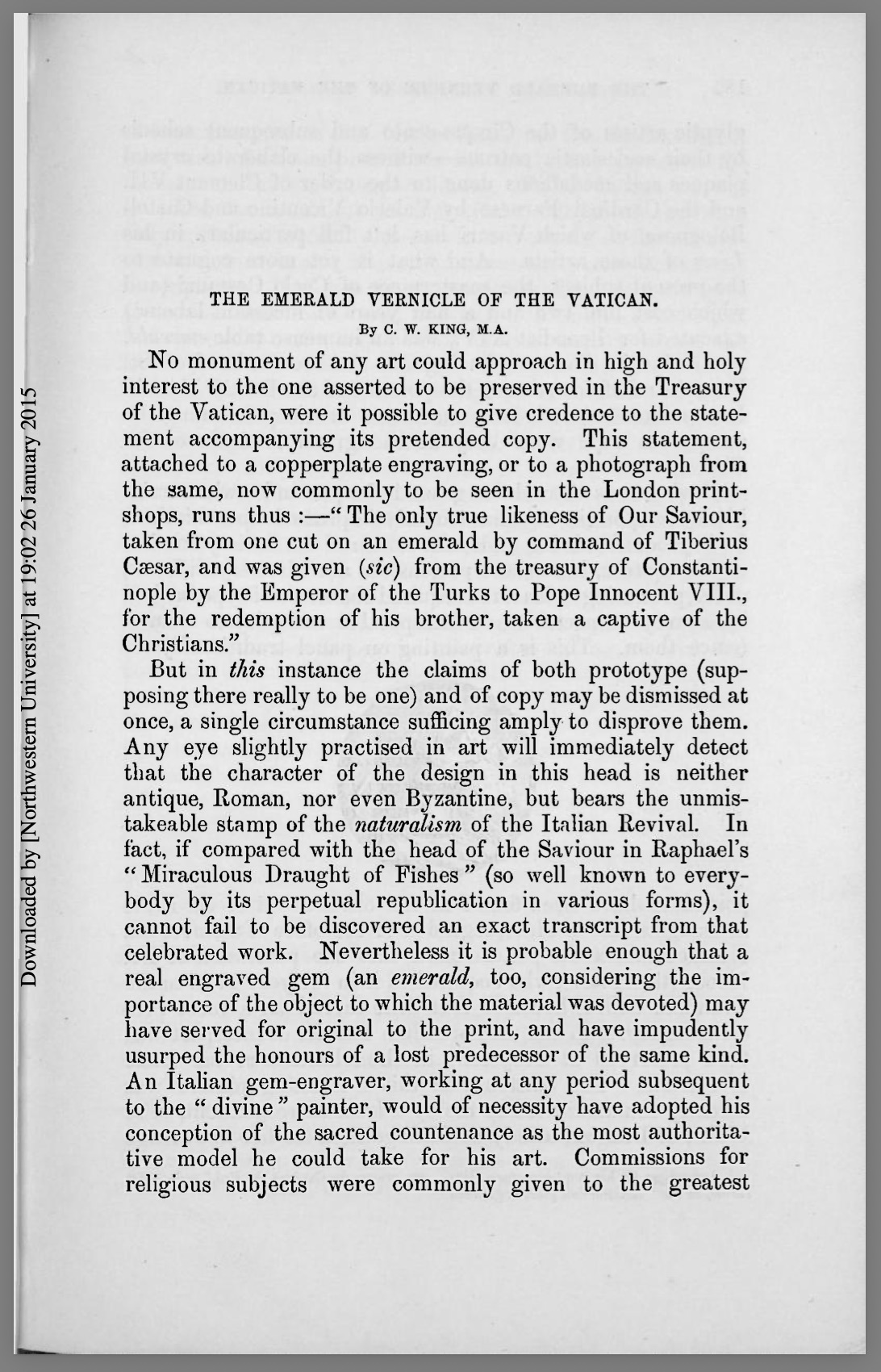
No monument of any art could approach in high and holy interest to the one asserted to be preserved in the Treasury of the Vatican, were it possible to give credence to the statement accompanying its pretended copy. This statement, attached to a copperplate engraving, or to a photograph from the same, now commonly to be seen in the London print-shops, runs thus:—“The only true likeness of Our Saviour, taken from one cut on an emerald by command of Tiberius Cæsar, and was given from the treasury of Constantinople by the Emperor of the Turks to Pope Innocent VIII., for the redemption of his brother, taken a captive of the Christians.” But in this instance the claims of both prototype (supposing there really to be one) and of copy may be dismissed at once, a single circumstance sufficing amply to disprove them. Any eye slightly practised in art will immediately detect that the character of the design in this head is neither antique, Roman, nor even Byzantine, but bears the unmistakable stamp of the naturalism of the Italian Revival. In fact, if compared with the head of the Saviour in Raphael’s Miraculous Draught of Fishes (so well known to everybody by its perpetual republication in various forms), it cannot fail to be discovered an exact transcript from that celebrated work. Nevertheless it is probable enough that a real engraved gem (an emerald, too, considering the importance of the object to which the material was devoted) may have served for original to the print, and have impudently usurped the honours of a lost predecessor of the same kind. An Italian gem-engraver, working at any period subsequent to the “divine” painter, would of necessity have adopted his conception of the sacred countenance as the most authoritative model he could take for his art. Commissions for religious subjects were commonly given to the greatest glyptic artists of the Cinquecento and subsequent schools by their ecclesiastic patrons—witness the elaborate crystal plaques and medallions done to the order of Clement VII. and the Cardinal Farnese by Valerio Vicentino and Castel Bolognese, of which Vasari has left full particulars in his Lives of those artists. And what is yet more cognate to the present subject, the masterpiece of Carlo Costanzi (and which cost him two and a half years of incessant labour) executed for Benedict XIV., was an immense table emerald, two inches in diameter, having for obverse the head of St. Peter in relief, for reverse the portrait of the Pontiff himself. It was intended to adorn the morse or clasp fastening the sumptuous cope worn only at the grand festivals of the Church.