
Four Treasures Reference Database
Record No. 28900
Talismans and amulets: Mediaeval talismans
Journal Article
King, C.W. (1869) Talismans and amulets: Mediaeval talismans. Archaeological Journal, Vol. 26, No. 1, pp. 225–235.
ISBN/ISSN: 0066-5983 | DOI: https://doi.org/10.1080/00665983.1869.10851444 | Sinkankas/Born No.: NIS/NIB | RWHL
gems, glyptic, engraved gems, agate, cameo, intaglio, shell, ancient gems, Rome, Greece, ancient jewelry, rings
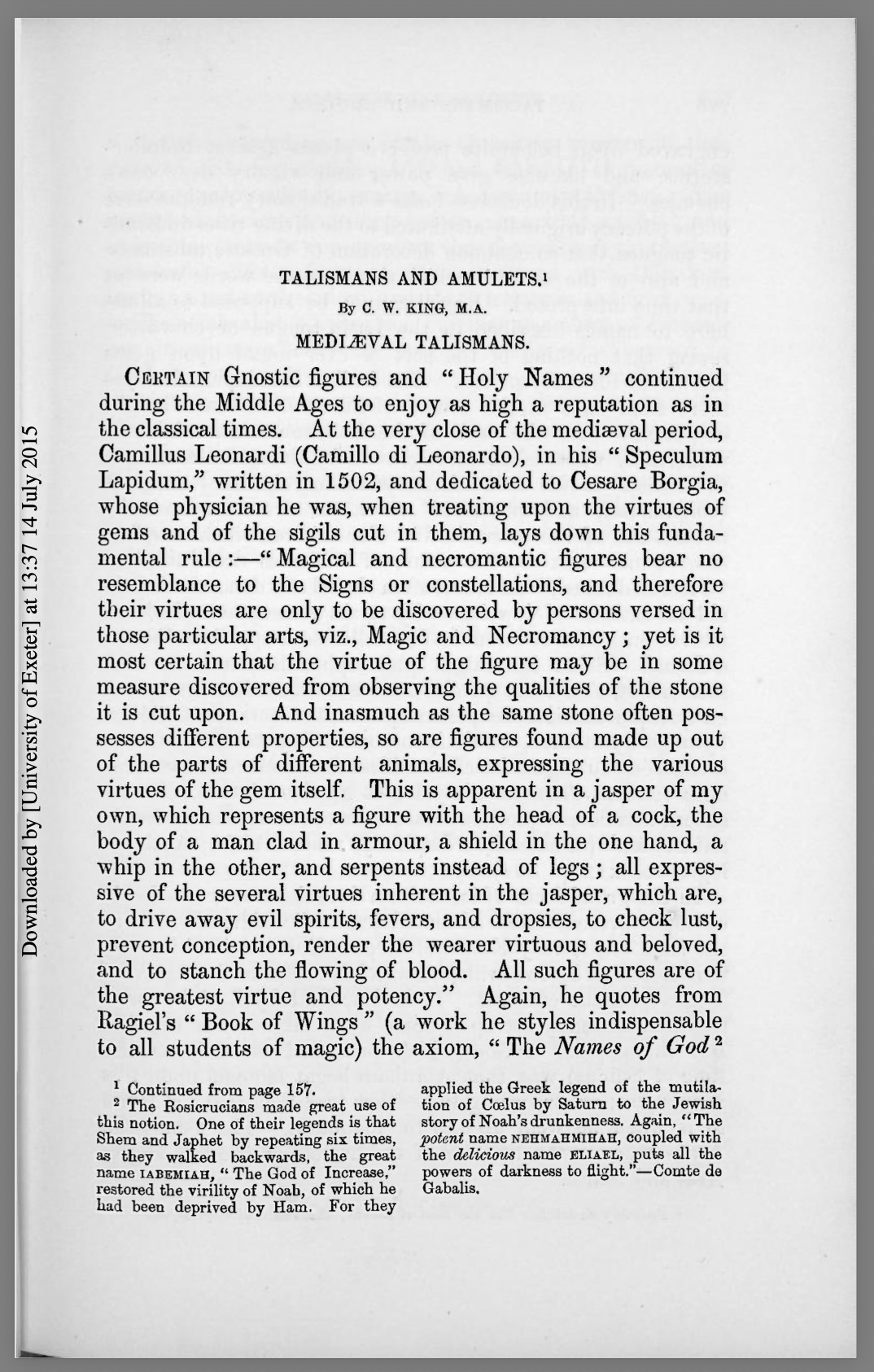
Certain Gnostic figures and “Holy Names” continued during the Middle Ages to enjoy as high a reputation as in classical times. At the very close of the mediaeval period, Camillus Leonardi (Camillo di Leonardo), in his Speculum Lapidum, written in 1502, and dedicated to Cesare Borgia, whose physician he was, when treating upon the virtues of gems and of the sigils cut in them, lays down this fundamental rule:—“Magical and necromantic figures bear no resemblance to the Signs or constellations, and therefore their virtues are only to be discovered by persons versed in those particular arts, viz., Magic and Necromancy; yet it is most certain that the virtue of the figure may be in some measure discovered from observing the qualities of the stone it is cut upon. And inasmuch as the same stone often possesses different properties, so are figures found made up out of the parts of different animals, expressing the various virtues of the gem itself. This is apparent in a jasper of my own, which represents a figure with the head of a cock, the body of a man clad in armour, a shield in the one hand, a whip in the other, and serpents instead of legs; all expressive of the several virtues inherent in the jasper, which are, to drive away evil spirits, fevers, and dropsies, to check lust, prevent conception, render the wearer virtuous and beloved, and to stanch the flowing of blood. All such figures are of the greatest virtue and potency.”