
Four Treasures Reference Database
Record No. 28901
Talismans and amulets: Medicinal amulets and rings and prophylactics
Journal Article
King, C.W. (1869) Talismans and amulets: Medicinal amulets and rings and prophylactics. Archaeological Journal, Vol. 26, No. 1, pp. 149–157.
ISBN/ISSN: 0066-5983 | DOI: https://doi.org/10.1080/00665983.1869.10851443 | Sinkankas/Born No.: NIS/NIB | RWHL
gems, glyptic, engraved gems, agate, cameo, intaglio, shell, ancient gems, Rome, Greece, ancient jewelry, rings
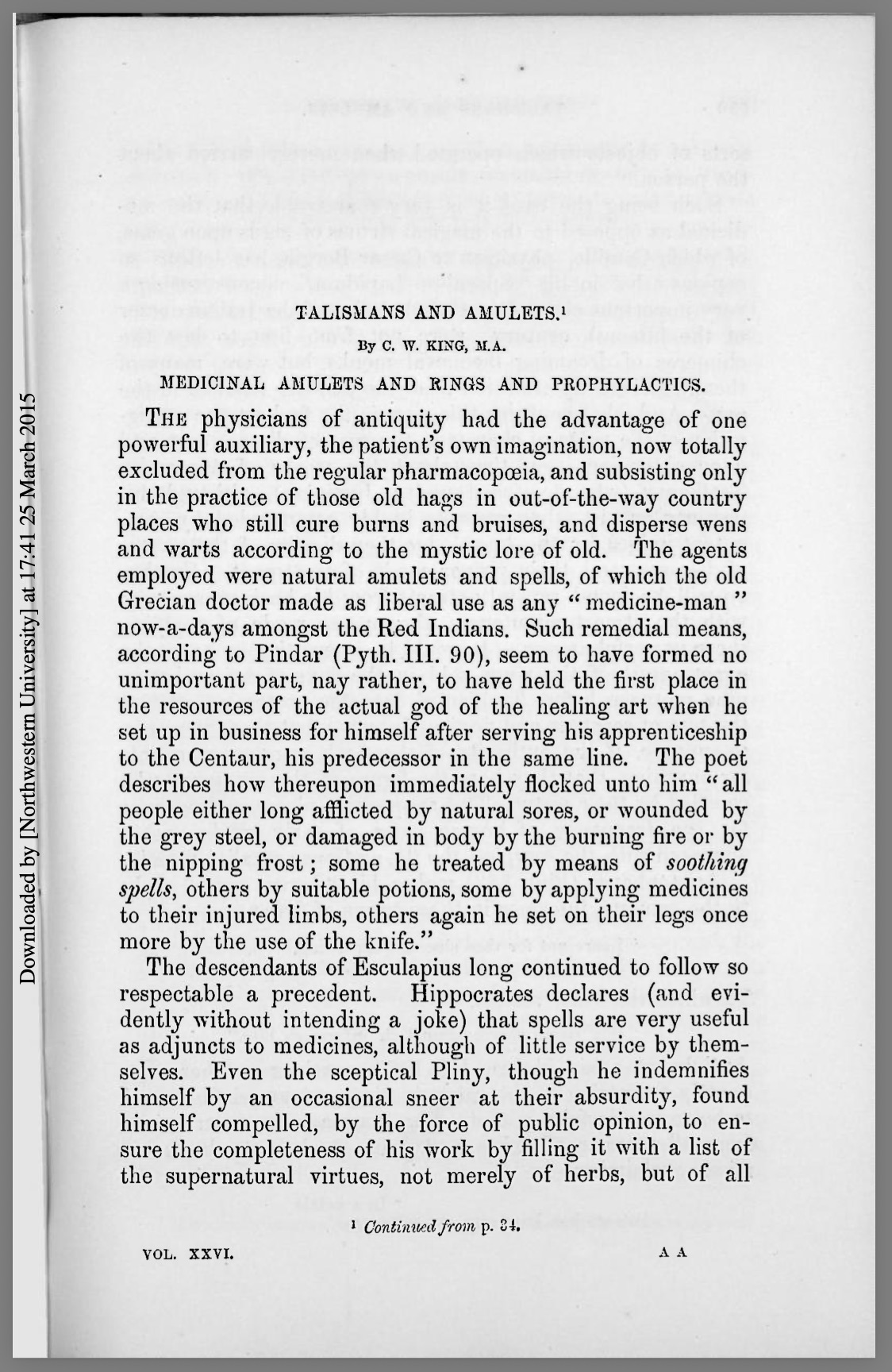
The physicians of antiquity had the advantage of one powerful auxiliary, the patient’s own imagination, now totally excluded from the regular pharmacopoeia, and subsisting only in the practice of those old hags in out-of-the-way country places who still cure burns and bruises, and disperse wens and warts according to the mystic lore of old. The agents employed were natural amulets and spells, of which the old Grecian doctor made as liberal use as any “medicine-man” nowadays amongst the Red Indians. Such remedial means, according to Pindar (Pyth. III. 90), seem to have formed no unimportant part, nay rather, to have held the first place in the resources of the actual god of the healing art when he set up in business for himself after serving his apprenticeship to the Centaur, his predecessor in the same line. The poet describes how thereupon immediately flocked unto him “all people either long afflicted by natural sores, or wounded by the grey steel, or damaged in body by the burning fire or by the nipping frost; some he treated by means of soothing spells, others by suitable potions, some by applying medicines to their injured limbs, others again he set on their legs once more by the use of the knife.”