
Four Treasures Reference Database
Record No. 28906
On the use of antique gems in the Middle Ages
Journal Article
King, C.W. (1865) On the use of antique gems in the Middle Ages. Archaeological Journal, Vol. 22, No. 1, pp. 118–133.
ISBN/ISSN: 0066-5983 | DOI: https://doi.org/10.1080/00665983.1865.10851312 | Sinkankas/Born No.: NIS/NIB | RWHL
Close Abstract
Hide Keywords
Copy Reference
gems, engraved gems, agate, chalcedony, quartz, cameos, itaglios, turquoise, sard, onyx, coral, amethyst, glyptic
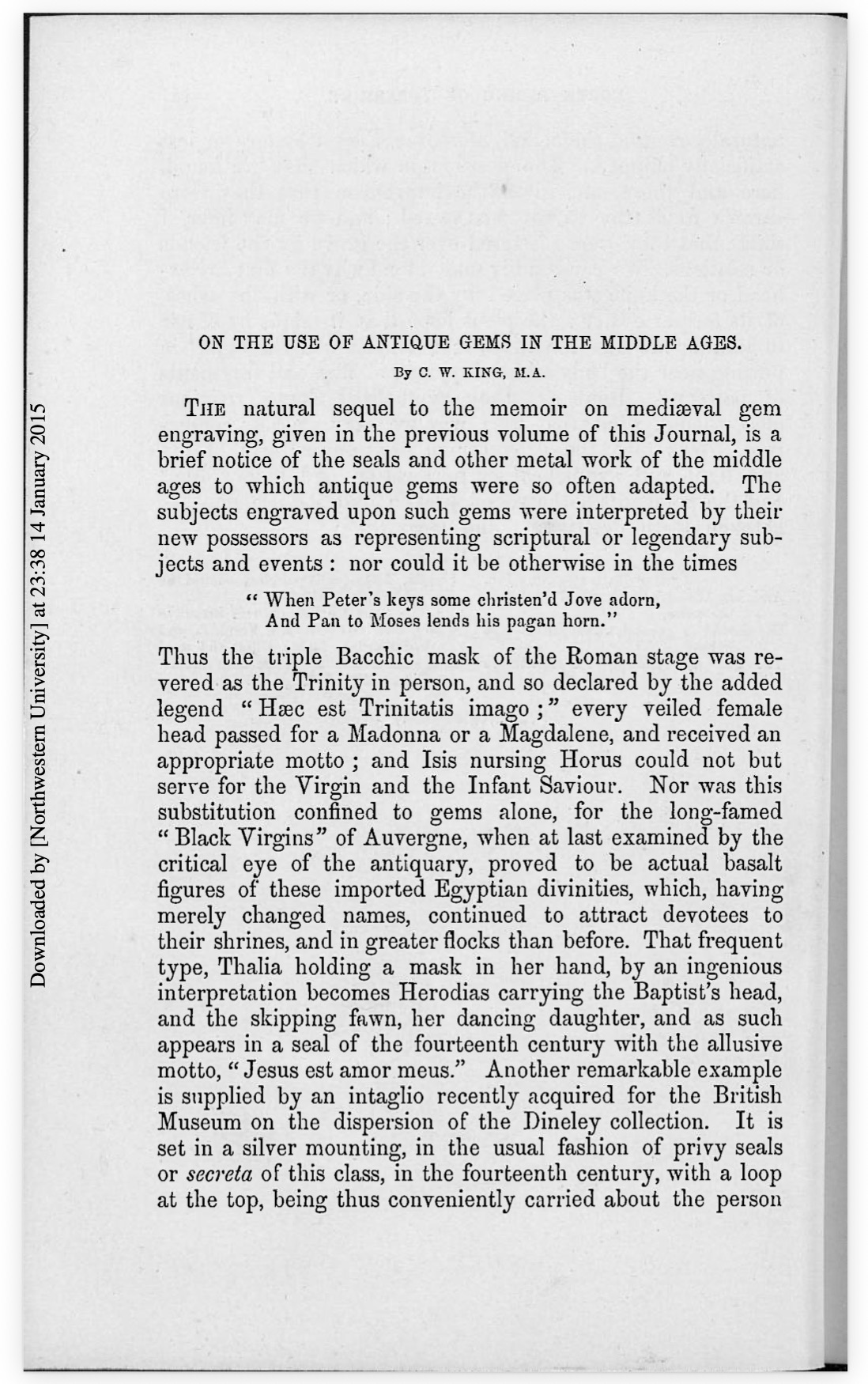
King examines the survival and reuse of ancient Greek and Roman engraved gems during the Middle Ages, describing how classical intaglios and cameos were incorporated into rings, seals, reliquaries, crosses, church plate, and other precious objects. He discusses the ways medieval owners interpreted pagan subjects, frequently assigning Christian meanings to classical figures and scenes whose original significance had been forgotten or misunderstood. Particular attention is given to antique gems employed as personal and official seals, where new inscriptions were often added to adapt ancient images to contemporary purposes, as well as to examples preserved in ecclesiastical treasuries. King also considers the magical and medicinal virtues attributed to certain engraved stones and the influence of lapidary traditions upon their medieval use. The paper demonstrates how antique gems were valued throughout the Middle Ages not simply as remnants of classical art, but as precious, symbolic, devotional, and sometimes talismanic objects that acquired meanings quite different from those intended by their original engravers.