
Four Treasures Reference Database
Record No. 28915
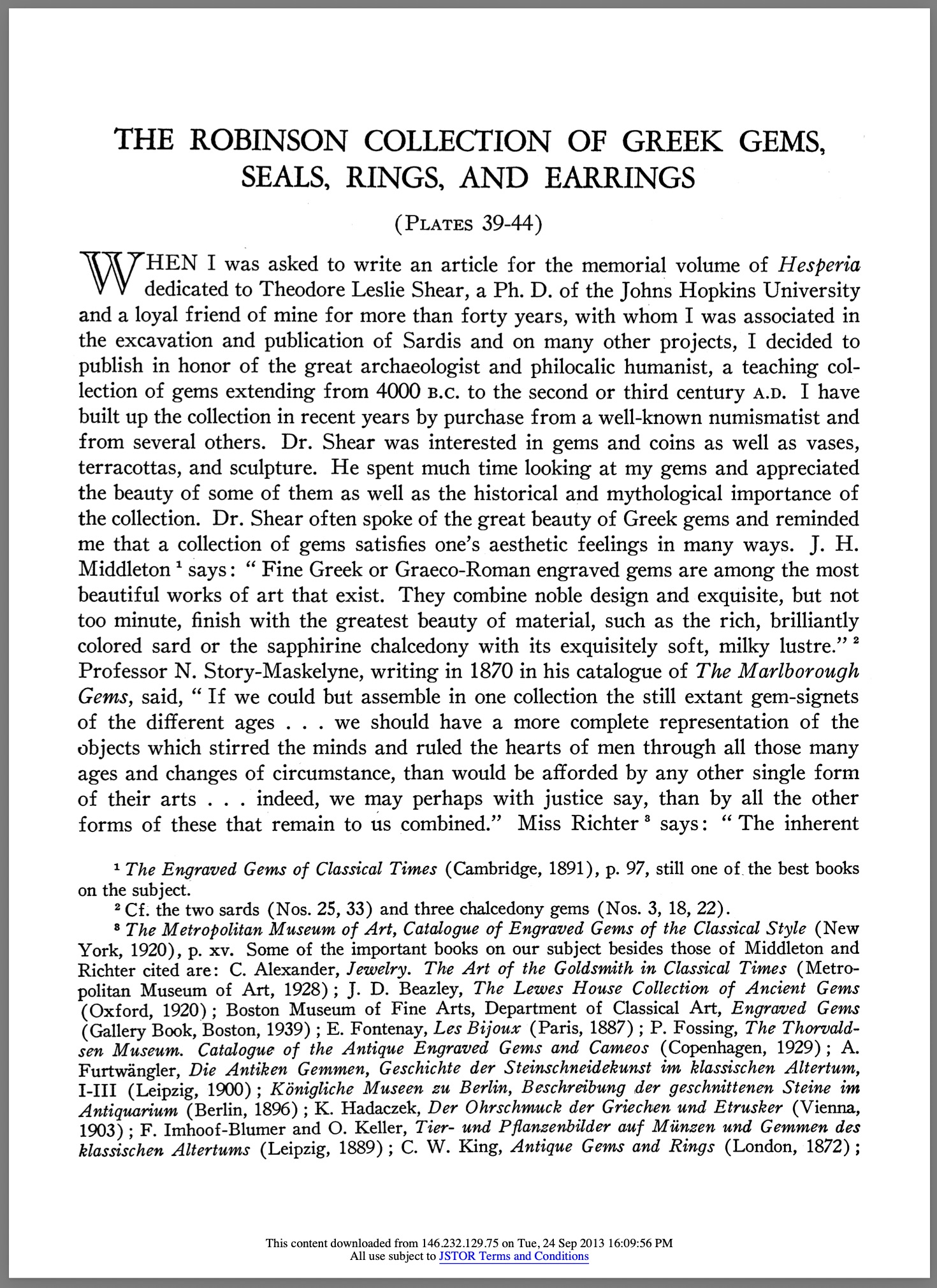
The Robinson Collection of Greek gems, seals, rings, and earrings
Journal Article
Robinson, D.M. (1949) The Robinson Collection of Greek gems, seals, rings, and earrings. Hesperia Supplements, Vol. 8, pp. 305–480.
gems, glyptic, engraved gems, agate, cameo, intaglio, shell, ancient gems, Rome, Greece, ancient jewelry, rings
When I was asked to write an article for the memorial volume of Hesperia dedicated to Theodore Leslie Shear, a Ph.D. of the Johns Hopkins University and a loyal friend of mine for more than forty years, with whom I was associated in the excavation and publication of Sardis and on many other projects, I decided to publish in honor of the great archaeologist and philocalic humanist, a teaching collection of gems extending from 4000 B.C. to the second or third century A.D. I have built up the collection in recent years by purchase from a well-known numismatist and from several others. Dr. Shear was interested in gems and coins as well as vases, terracottas, and sculpture. He spent much time looking at my gems and appreciated the beauty of some of them as well as the historical and mythological importance of the collection. Dr. Shear often spoke of the great beauty of Greek gems and reminded me that a collection of gems satisfies one’s aesthetic feelings in many ways. J. H. Middleton says: “Fine Greek or Graeco-Roman engraved gems are among the most beautiful works of art that exist. They combine noble design and exquisite, but not too minute, finish with the greatest beauty of material, such as the rich, brilliantly colored sard or the sapphirine chalcedony with its exquisitely soft, milky lustre.” Professor N. Story-Maskelyne, writing in 1870 in his catalogue of The Marlborough Gems, said, “If we could but assemble in one collection the still extant gem-signets of the different ages … we should have a more complete representation of the objects which stirred the minds and ruled the hearts of men through all those many ages and changes of circumstance, than would be afforded by any other single form of their arts … indeed, we may perhaps with justice say, than by all the other forms of these that remain to us combined.” Miss Richter says: “The inherent beauty of the material, with its rich and varied colors, its lustre and brilliance, gives us pleasure at first sight. The hard and durable quality of the stones has made for unusually good preservation, so that we can appreciate in many cases the artist’s work in its original state—a rare opportunity in classical art. Moreover, the smallness and preciousness of the gems invited exquisite workmanship, and in certain periods when the art was at a high level the achievements in this field were very notable. The best ancient gem engravers combined extreme minuteness and accuracy of detail with a largeness and simplicity of style that are indeed remarkable. A gem engraving of this class possesses the nobility and dignity of a marble or bronze sculptural work, though it is often confined to the space of less than half an inch square.” These are samples of modern aesthetic criticism, and the ancients themselves attached immense importance to seals, rings, gems, and other jewelry.