
Four Treasures Reference Database
Record No. 28918
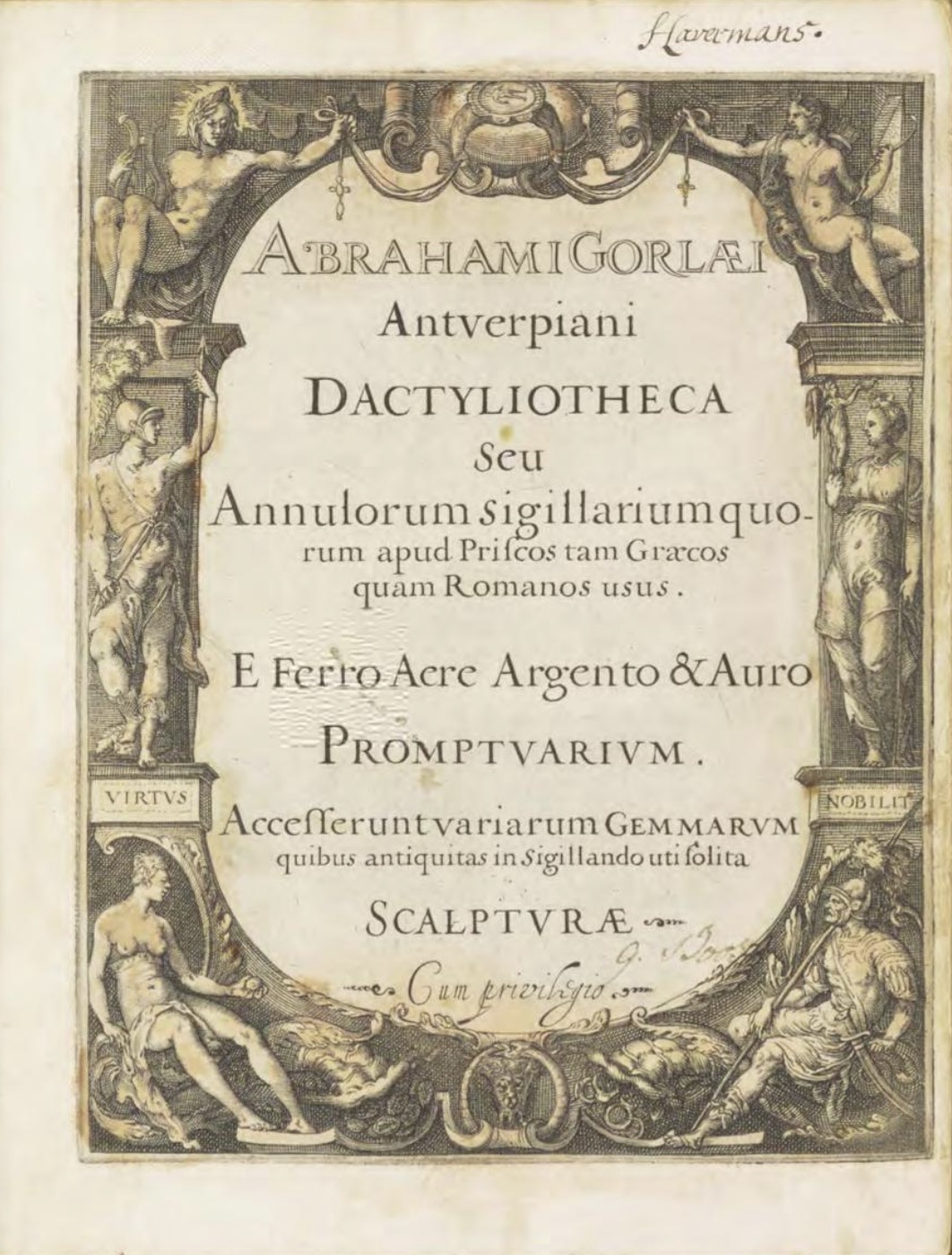
Dactyliotheca
Collection of Rings and Engraved Gems
Book
Gorlaeus, A. (1601) Dactyliotheca. [Collection of Rings and Engraved Gems] Antwerp, 137 leaves
Sinkankas/Born No.: 2470; NIB | Language: in Latin | RWHL
gems, engraved gems, agate, chalcedony, quartz, cameos, itaglios, turquoise, sard, onyx, coral, amethyst, glyptic
Sinkankas: Concerning the date of this work, Adolf Furtwängler, Die antiken Gemmen, 3, 403, gives the first edition as 1599, which is the date of a letter by Everard Vorst in the preliminaries, but inasmuch as the author’s dedication is dated 1601, and a reprint shows this date in its engraved title, this should be the first edition date. The date of 1601 is also given by Pierre-Jean Mariette, Traité, 1, p. 252, 267–71, 453. Charles William King, Antique Gems and Rings, 1, 464, states that this “is the earliest work on this special subject that has come to my knowledge. It gives copper-plates, carefully but stiffly drawn, of 126 rings and 148 unset gems. The second edition, 1609, contains the same number of rings, but the gems are increased to 172. After Gorlaeus’ death, in the same year at Delft, his cabinet was purchased of his heirs by our James I for the Prince of Wales, but was dispersed on the sale of the royal gallery under the Commonwealth, and many of the gems were recognized by me amongst the Arundel. A third edition was brought out by Gronovius, Leyden, 1695, with the former plates re-engraved and fantastically arranged, and many new ones added, including all from ‘Macarii Apistopistus,’ bringing up the number of rings to 216, of the gems to 682.” Furtwängler, ibid., notes that “Gorlaeus was a zealous collector … who published the first ‘Dactyliotheca,’ the foreword of the first edition dated 1599. After a short prologue there follows 126 rings and 148 unset stones in very mediocre engravings. A second, somewhat enlarged edition appeared in 1609 at Delft. The gems went to England, and later, in part, into the Arundel collection. As insignificant as this work appears to us, the famous Gronovius still found it worthwhile to issue a new edition in 1695 in Leyden with his commentary and additional equally bad plates. The work was reprinted in 1707.” Vinet 1609 states that the principal value of the work was “to fix attention of savants to an important branch of illustrated antiquity.” Friedrich Henkel, Römischen Fingerringe, 1, p. xvi–xvii, believes the rings to be of contemporary manufacture but does not question the authenticity of the gems, stating that the collection of antique rings assembled by the antiquary J. H. Jeidels, Frankfurt, contained many examples from the Gorlaeus collection, as determined from an examination as it is housed in the Kunstgewerbeschule in Pforzheim. See also Brunet II, 1671; Graesse III, 120; Goodland 242. Mariette, cited above, also gives extended remarks on Gorlaeus and his book.