
Four Treasures Reference Database
Record No. 28935
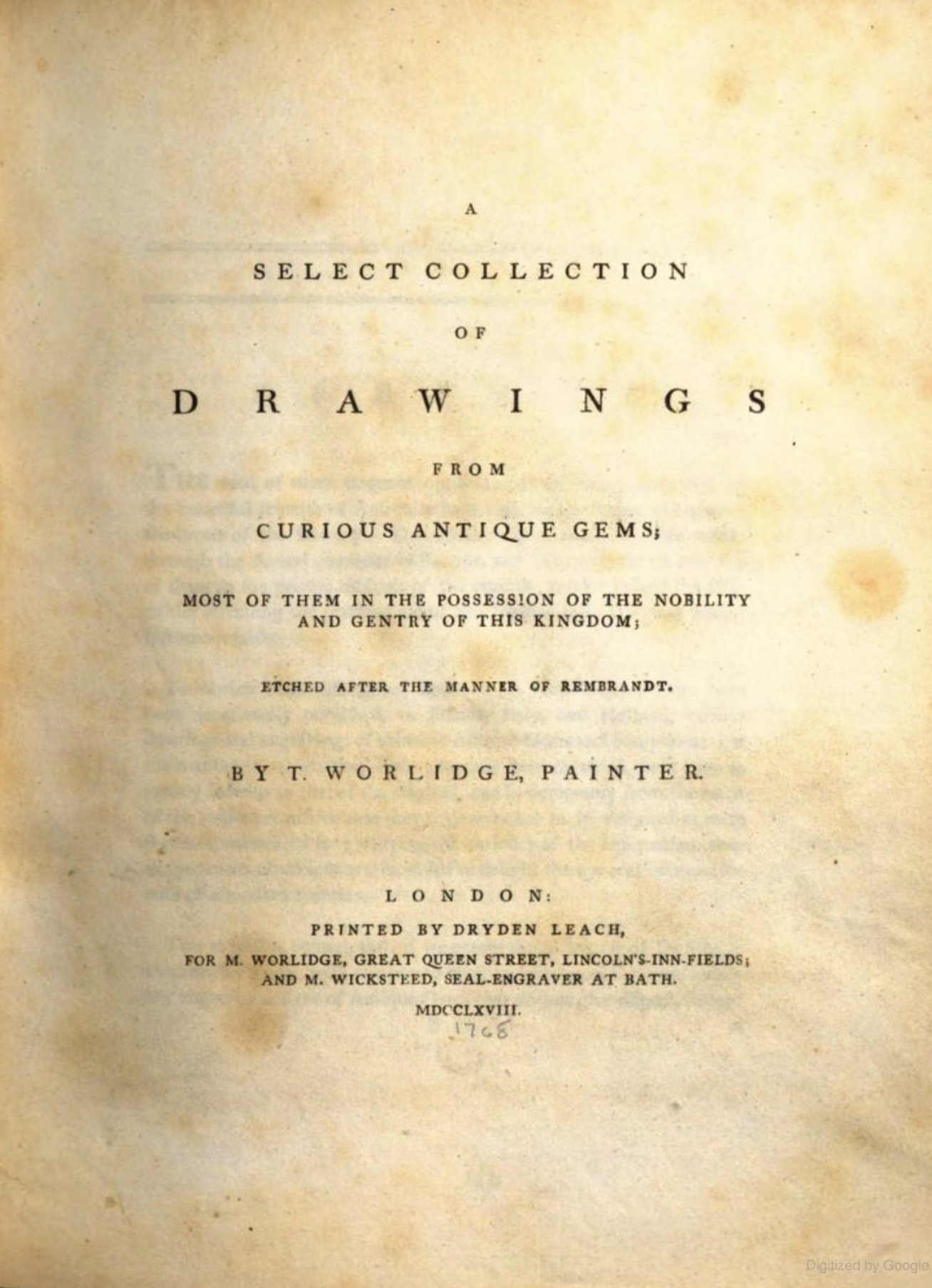
A select collection of drawings from curious antique gems, most of them in the possession of the nobility and gentry of this kingdom, etched after the manner of Rembrandt
Book
Worlidge, T. (1768) A select collection of drawings from curious antique gems, most of them in the possession of the nobility and gentry of this kingdom, etched after the manner of Rembrandt. Bath, Dryden Leach, 182 etchings
Sinkankas/Born No.: 7331; NIB | RWHL
gems, glyptic, engraved gems, agate, cameo, intaglio, shell, ancient gems, Rome, Greece, ancient jewelry, rings
Sinkankas: According to the Dictionary of National Biography, Thomas Worlidge’s final work was a series of 182 etchings of antique gems (three of the plates being duplicates). The series was issued in parts, some apparently as early as 1754, although Worlidge died before its completion. It was finished by his pupils William Grimaldi and George Powle and published by his widow in 1768, printed on satin and offered at the substantial price of eighteen guineas per copy. The original publication bore the title A Select Collection of Drawings from Curious Antique Gems. Both Charles William King (Antique Gems and Rings, I, p. 469) and Adolf Furtwängler (Die antiken Gemmen, III, p. 418) assign the dates 1754–1757 to the work, perhaps because Worlidge’s engraved self-portrait, showing him etching the bust known as Pomfret’s Cicero with a portrait of his second wife Mary on an easel behind him, is dated 1754. The bibliographical history is exceptionally complex. The DNB states that the original edition contained no letterpress, but that between 1768 and 1780 a small number of copies were issued with accompanying text. After 1780 a new quarto edition, deceptively retaining the date 1768, appeared in two volumes with letterpress and sold for five guineas per volume. Some authorities differ substantially. William Thomas Lowndes regarded the so-called 1768 quarto edition as an antedated post-1780 reprint, while noting that true 1768 copies were printed on satin and lacked text. Other evidence suggests the existence of prospectuses dated 1766 and issues published by Dryden Leach. The work was later partially reissued as Antique Gems, Etched by T. Worlidge on Copper Plates, in the Possession of Sheffield Grace, Esq. (London, 1823). Lowndes collated the complete work as containing 180 gem plates, together with a portrait of Worlidge and a Medusa frontispiece, plus occasionally an unnumbered supplemental plate of Hercules and the Nemean lion. In 1967, Sinkankas examined a luxurious first-edition copy printed on pale gold satin, each plate mounted on large paper measuring approximately 33 × 24 cm. Although often described as rare, the Zazoffs noted in Gemmensammler (1983, p. 179) that the publication was widely distributed through subscription, attracting patrons including the King and Queen of England, and consequently is not particularly rare despite its imposing appearance and complicated publishing history.