
Four Treasures Reference Database
Record No. 28947
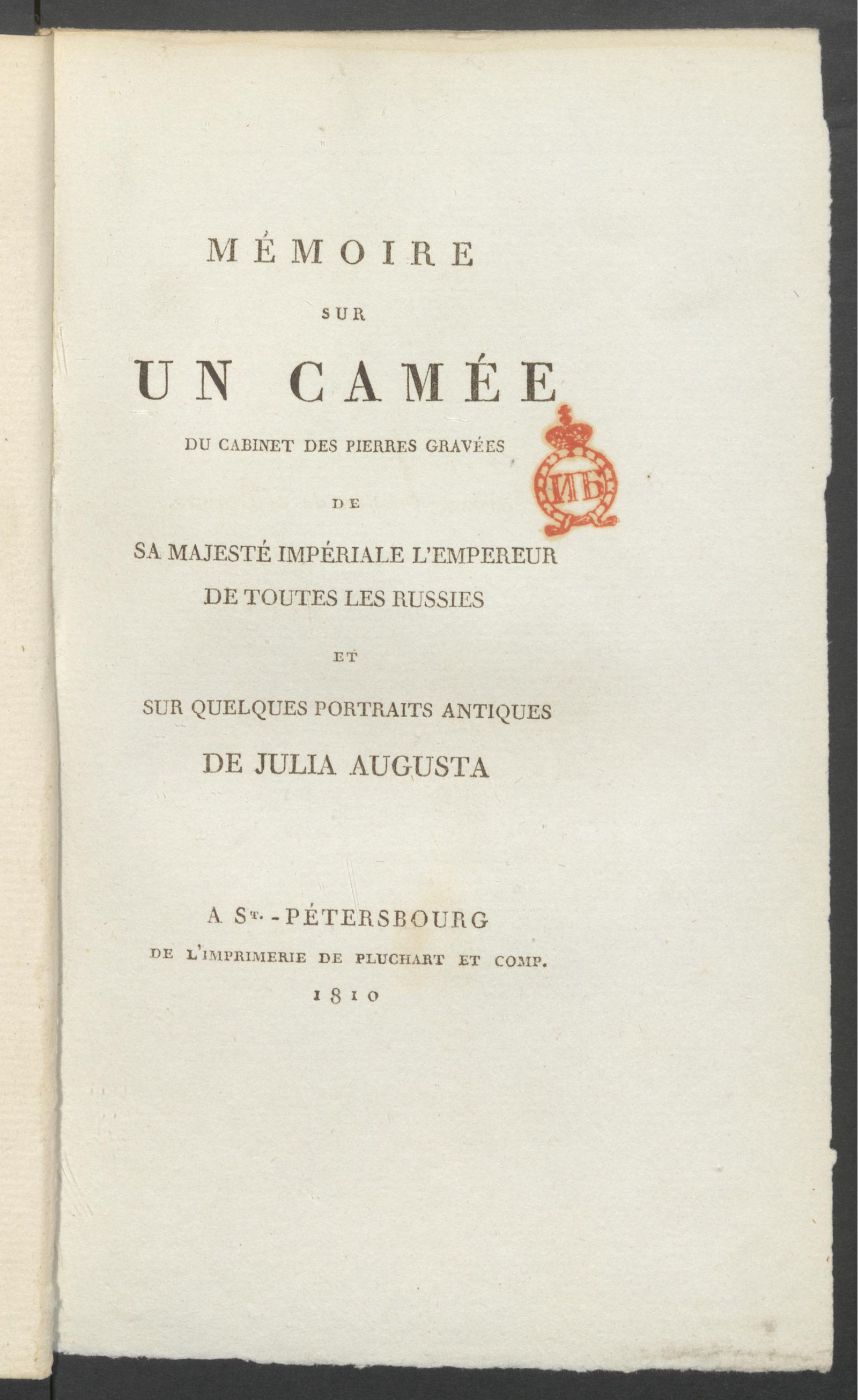
Memoire sur un Camée du Cabinet des Pierres Gravées de l'Empereur de toutes les Russies et sur Quelques Portraits Antiques Julia Augusta
Memoir on a Cameo in the Cabinet of Engraved Stones of the Emperor of All the Russias and on Several Ancient Portraits of Julia Augusta
Book
Koehler, H.C.E., von (1810) Memoire sur un Camée du Cabinet des Pierres Gravées de l'Empereur de toutes les Russies et sur Quelques Portraits Antiques Julia Augusta. [Memoir on a Cameo in the Cabinet of Engraved Stones of the Emperor of All the Russias and on Several Ancient Portraits of Julia Augusta] St. Petersburg, Pluchart, 101 pp.
Sinkankas/Born No.: 3487–3489; NIB | Language: in French | not seen
gems, glyptic, engraved gems, agate, cameo, intaglio, shell, ancient gems, Rome, Greece, ancient jewelry, rings
Yegor Yegorovich Köhler (1765–1837/1838), a historian, archaeologist, and connoisseur of classical antiquities, was a native of Saxony who worked in Russia from 1790 onward. From 1795 he served at the Imperial Hermitage, where he soon became curator of the numismatic cabinet and the collection of engraved gems and cameos. He later became a member of the St. Petersburg Academy of Sciences and numerous European learned societies. Through his studies of the Hermitage and private collections, as well as scholarly journeys throughout Europe and the northern Black Sea region, Köhler became one of the first specialists in the study of precious museum objects of ancient origin or executed by modern craftsmen in the classical style. Köhler’s writings on this subject are gathered in a composite volume (konvolut), assembled by an owner or publisher from separately issued publications and/or manuscripts (alligata) bound together in a single tome. The volume comes from the library of the Russian general, statesman, and diplomat of Dutch origin, Count Pyotr Kornilievich Suchtelen (Jan Pieter van Suchtelen, 1751–1836), who was no less renowned as a bibliophile. The book is bound in a half-leather binding characteristic of Suchtelen’s copies: a spine of red morocco with elegant gilt tooling and burgundy morocco onlays, boards covered with embossed paper and stained orange, and endpapers of marbled “stormont” paper. The copy bears the Count’s engraved armorial bookplate with his motto. The works included in the volume contain detailed descriptions of unique gems—carved semi-precious stones bearing portrait or figural representations. The author was particularly accomplished in the study of cameos, miniature gems carved in relief. The art of cameo carving (glyptic art) traces its history to ancient Greece and reached its zenith in the sixteenth and seventeenth centuries, when such precious objects became an indispensable component of the art collections of the European nobility. In Russia, the collecting of cameos began through the interest of Empress Catherine II, when the “Northern Semiramis” herself and her closest associates began acquiring the finest examples of glyptic art for their palace and private collections. The Hermitage collection of cameos was rightly regarded as exemplary. Sinkankas: Discusses at great length the identity and significance of the figures on the great cameo known as the Apotheosis of Augustus in the Bibliothèque nationale de France, Paris, while also citing extensively the writings of other scholars who had studied this engraved gem. The remainder of the text, by far the smaller portion, is devoted to a cameo of Julia Augusta, illustrated on the frontispiece plate and recently acquired for the Hermitage collection in St. Petersburg, together with other engraved gems depicting Julia in various collections. The second plate illustrates another portrait of Julia, preserved in Vienna, while the third, folding plate reproduces the magnificent Apotheosis of Augustus cameo at full size.