
Four Treasures Reference Database
Record No. 28978
Colour terms in Shang oracle bone inscriptions
Journal Article
Tao, W. (1996) Colour terms in Shang oracle bone inscriptions. Bulletin of the School of Oriental and African Studies, University of London, Vol. 59, No. 1, pp. 63–101.
ISBN/ISSN: 0041977X, 14740699 | Sinkankas/Born No.: NIS/NIB | RWHL
gems, color, color science, color harmony, color design, color composition, color in China, etymology, cultural differences, GRUE, oracle bones
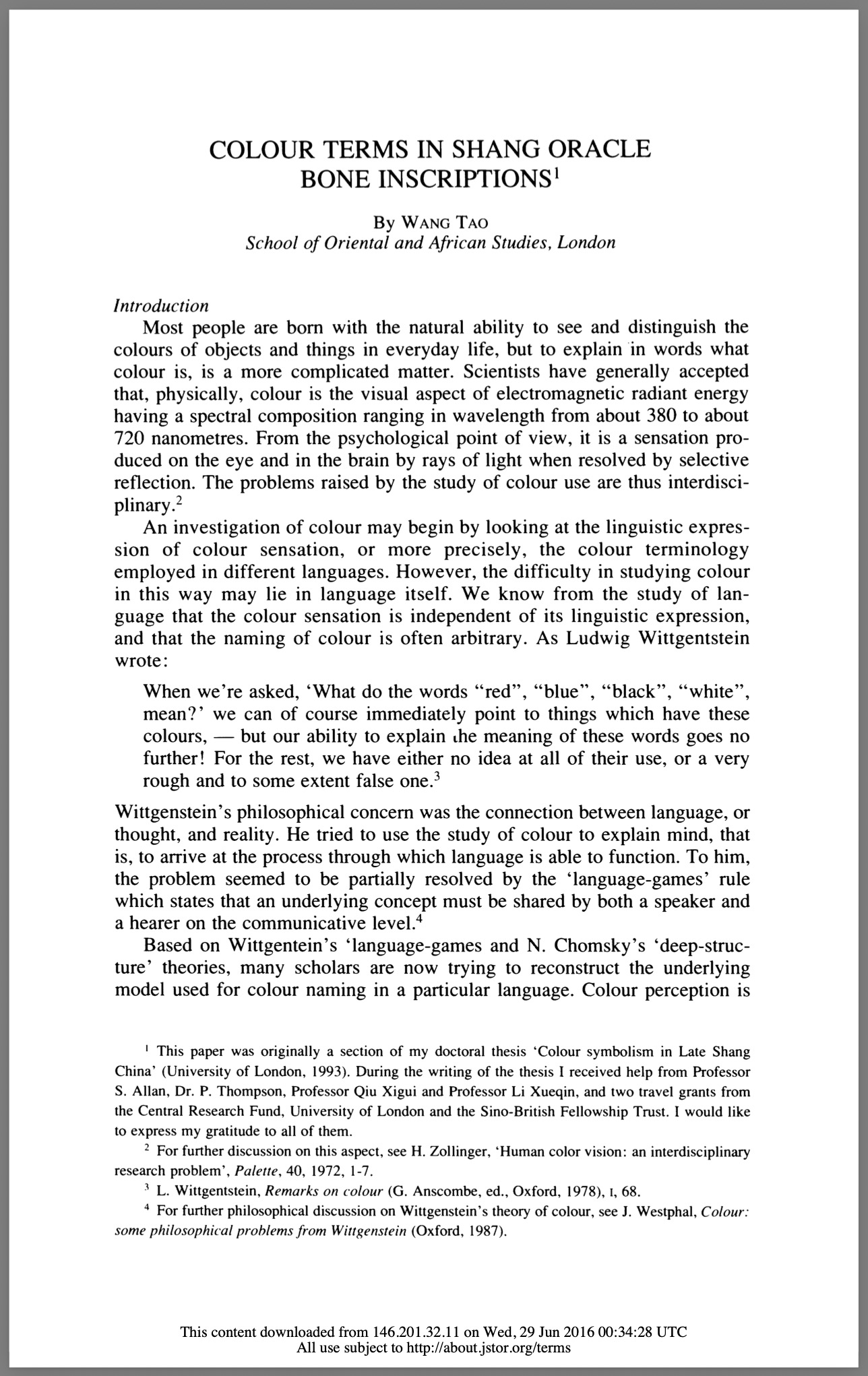
Most people are born with the natural ability to see and distinguish the colours of objects and things in everyday life, but to explain in words what colour is, is a more complicated matter. Scientists have generally accepted that, physically, colour is the visual aspect of electromagnetic radiant energy having a spectral composition ranging in wavelength from about 380 to about 720 nanometres. From the psychological point of view, it is a sensation produced on the eye and in the brain by rays of light when resolved by selective reflection. The problems raised by the study of colour use are thus interdisciplinary. An investigation of colour may begin by looking at the linguistic expression of colour sensation, or more precisely, the colour terminology employed in different languages. However, the difficulty in studying colour in this way may lie in language itself. We know from the study of language that the colour sensation is independent of its linguistic expression, and that the naming of colour is often arbitrary. As Ludwig Wittgenstein wrote: When we’re asked, “What do the words ‘red’, ‘blue’, ‘black’, ‘white’ mean?” we can of course immediately point to things which have these colours, but our ability to explain the meaning of these words goes no further! For the rest, we have either no idea at all of their use, or a very rough and to some extent false one. Wittgenstein’s philosophical concern was the connection between language, or thought, and reality. He tried to use the study of colour to explain mind, that is, to arrive at the process through which language is able to function. To him, the problem seemed to be partially resolved by the “language-games” rule, which states that an underlying concept must be shared by both a speaker and a hearer on the communicative level.