
Four Treasures Reference Database
Record No. 28994
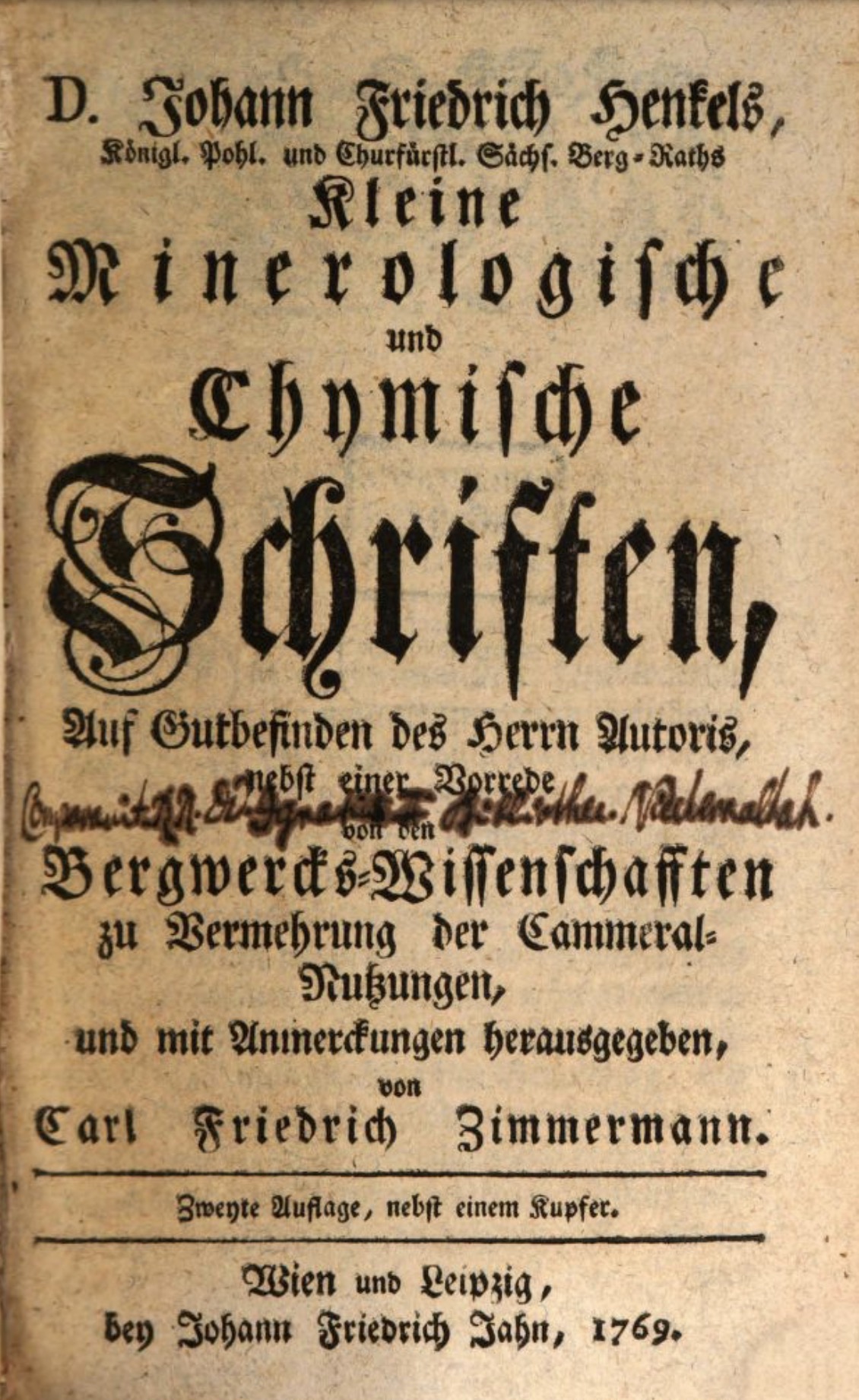
Kleine Mineralogische und Chymische Schrifften. Auf Gutbefinden des Herrn Autoris. Nebst einer Vorrede von den Bergwercks-Wissenschafften zu Vermehrung der Cammeral-Nutzungen, und mit Anmerckungen herausgegeben von Carl Friedrich Zimmermann
D. Johann Friedrich Henkel’s, Royal Polish and Electoral Saxon Mining Councillor, Small Mineralogical and Chemical Writings. Published with the approval of the author, together with a preface on the mining sciences for the increase of cameral (state fiscal) revenues, and with annotations by Carl Friedrich Zimmermann
Book
Henkel, J.F. (1744) Kleine Mineralogische und Chymische Schrifften. Auf Gutbefinden des Herrn Autoris. Nebst einer Vorrede von den Bergwercks-Wissenschafften zu Vermehrung der Cammeral-Nutzungen, und mit Anmerckungen herausgegeben von Carl Friedrich Zimmermann. [D. Johann Friedrich Henkel’s, Royal Polish and Electoral Saxon Mining Councillor, Small Mineralogical and Chemical Writings. Published with the approval of the author, together with a preface on the mining sciences for the increase of cameral (state fiscal) revenues, and with annotations by Carl Friedrich Zimmermann] Dresden, Friedrich Henkel, 619 pp.
Sinkankas/Born No.: 2883–2884 | Language: in German | RWHL
gems, gemology, history of gemology, gem testing, mineralogy, early mineralogy, jasper, topaz, amber, gem formation
Sinkankas: Henkel presents his views on the formation of minerals, including coral and gemstones, with extensive annotations by Zimmermann. He recognized five modes of formation: (1) congelation, (2) concretion, (3) vegetation (as in coral), (4) crystallization, and (5) petrifaction. Henkel believed that durable minerals—especially gemstones—were composed of minute particles that grew together into structurally continuous masses or crystals, producing transparency while excluding water. He discusses at length, as does Zimmermann, experiments by Robert Boyle, Francis I, and others on the effects of intense heat on gemstones, describing the behavior of diamond, emerald, ruby, and other gems. Additional topics include Saxon fossil resin (pp. 539–553), the celebrated Saxon topaz (pp. 554–565), and a green jasper bearing “hieroglyphic figures” (pp. 607–619), possibly referring to graphic granite. The work is described by John Ferguson in Bibliotheca Chemica (Vol. I, p. 386), which also notes later editions published in 1747 and in Vienna in 1769, together with biographical and bibliographical information on Henkel and his writings.