
Four Treasures Reference Database
Record No. 29
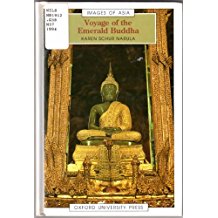
Voyage of the Emerald Buddha
Book
Narula, K.S. (1994) Voyage of the Emerald Buddha. Kuala Lumpur, Oxford Univ. Press, 88 pp.
Sinkankas/Born No.: NIS/NIB | RWHL
Jade, Thailand, India, Cambodia, gems
Karen Schur Narula’s Voyage of the Emerald Buddha, published in Oxford University Press’s Images of Asia series, traces the legendary and historically documented movements of Thailand’s most revered Buddhist image, the Emerald Buddha (Phra Kaeo Morakot), now enshrined in Wat Phra Kaeo within Bangkok’s Grand Palace. Combining Buddhist chronicles, regional history, religious traditions, and art-historical observations, Narula examines the statue’s uncertain origins and its association with political legitimacy, royal authority, and the spread of Theravada Buddhism across South and Southeast Asia. The narrative begins with the royal ceremony in which Thailand’s monarch changes the image’s seasonal garments, describing its elaborate gold ornaments, including a jeweled headdress decorated with sapphires and a robe embellished with rubies. The author then introduces the Chronicle of the Emerald Buddha, a collection of traditions preserved in manuscripts from Thailand, Laos, and Cambodia. According to the legend, the image was created in India through the intervention of the Buddhist sage Nāgasena, assisted by Indra and the celestial craftsman Visukamma, who obtained a magnificent green stone from supernatural guardians. The statue was subsequently transported to Sri Lanka, Burma, Cambodia, and northern Thailand before reaching Laos. Narula emphasizes that this account contains substantial chronological contradictions and supernatural elements that prevent its acceptance as reliable historical evidence. The book’s successive chapters examine the histories of India, Sri Lanka, Burma, Cambodia, Thailand, and Laos, connecting the legendary itinerary with the development of Buddhist sculpture, religious institutions, political alliances, and commercial networks. Of particular gemological interest is the question of the statue’s material and geographical origin. Despite its conventional name, the Emerald Buddha is not fashioned from emerald. Narula identifies the material as jade and specifically suggests nephrite as a possible carving material, although the book provides no analytical evidence establishing its precise mineralogical composition. She considers possible origins in India, Sri Lanka, and northern Thailand, noting the influence of Gandharan, Amaravati, Sinhalese, and Lan Na sculptural traditions. The first securely documented appearance of the image occurred at Chiang Rai in 1434, when a stucco-covered statue was discovered inside a chedi, reportedly following a lightning strike. When the stucco subsequently flaked away, the concealed green stone was revealed. The image was transferred to Lampang, where it remained until 1468, and then to Chiang Mai. In the sixteenth century it passed into Lao possession under King Setthathirat, eventually reaching Vientiane in 1564. There it remained until Siamese forces under Chaophraya Chakri captured the city in 1778 and carried the image to Thonburi. Following the establishment of Bangkok as the capital of the Chakri Dynasty, King Rama I transferred the statue to its present shrine on 22 March 1784. Throughout the narrative, Narula stresses the image’s significance as a palladium whose possession was believed to ensure prosperity, religious protection, and legitimate sovereignty. Numerous photographs, historical illustrations, maps, and examples of Buddhist sculpture document the artistic traditions and monuments associated with its supposed travels. Although primarily a historical and religious study rather than a technical gemological investigation, the book provides useful information on the Emerald Buddha’s possible nephrite composition, uncertain provenance, stylistic characteristics, and the cultural significance of a monumental green gemstone carving within Southeast Asian Buddhism.