
Four Treasures Reference Database
Record No. 29002
Le XII Pietre Pretiose, le quali per ordine di Dio nella Santa Legge adornavano i vestimenti del Sommo Sacerdote. Aggiuntevi il Diamante, le Margarite, e l’Oro, poste da S. Giovanni nell’Apocalisse, in figura della Celeste Gerusalemme: con un sommario dell’altre pietre pretiose. Discorso dell’Alicorno, et delle sue singolarissime virtù. Et della gran bestia detta Alce dagli Antichi
The Twelve Precious Stones Which, by the Command of God in the Holy Law, Adorned the Vestments of the High Priest. With the Addition of the Diamond, Pearls, and Gold, as Placed by Saint John in the Apocalypse as a Figure of the Heavenly Jerusalem; Together with a Summary of the Other Precious Stones. A Discourse on the Unicorn and Its Most Singular Virtues, and on the Great Beast Called the Elk by the Ancients.
Book
Bacci, A. (1587) Le XII Pietre Pretiose, le quali per ordine di Dio nella Santa Legge adornavano i vestimenti del Sommo Sacerdote. Aggiuntevi il Diamante, le Margarite, e l’Oro, poste da S. Giovanni nell’Apocalisse, in figura della Celeste Gerusalemme: con un sommario dell’altre pietre pretiose. Discorso dell’Alicorno, et delle sue singolarissime virtù. Et della gran bestia detta Alce dagli Antichi. [The Twelve Precious Stones Which, by the Command of God in the Holy Law, Adorned the Vestments of the High Priest. With the Addition of the Diamond, Pearls, and Gold, as Placed by Saint John in the Apocalypse as a Figure of the Heavenly Jerusalem; Together with a Summary of the Other Precious Stones. A Discourse on the Unicorn and Its Most Singular Virtues, and on the Great Beast Called the Elk by the Ancients.] Rome, Giouanni Martinelli, 130 pp.
Sinkankas/Born No.: 280 | Language: in Italian | RWHL
gems, engraved gems, agate, chalcedony, quartz, cameos, itaglios, turquoise, sard, onyx, coral, amethyst, glyptic
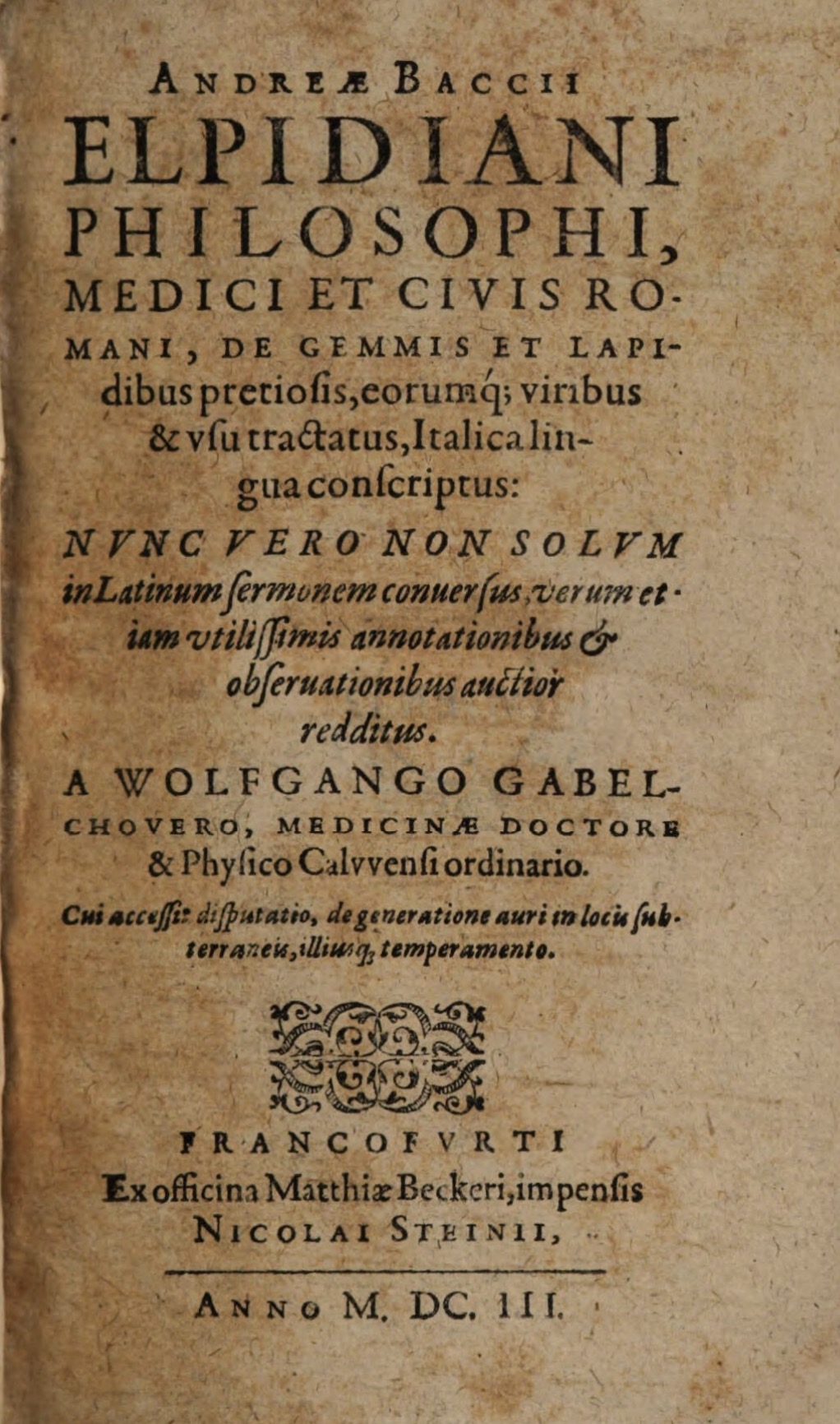
Sinkankas: As can be seen from the contents, only the first 37 pages are devoted to the description and discussion of the twelve gemstones of the High Priest's breastplate, with the remainder treating the unicorn and other fabulous beasts. Of this work, Thorndike, A History of Magic ..., 7, 315-6, states Andrea Bacci, physician to Sixtus V, besides works on baths, poisons, simples and other medical topics, published in 1581 or 1587 in Italian a treatise on the twelve precious stones ... after the similar work of Epiphanius, together with other gems and a discussion of the unicorn and its most singular virtue ... this book contained such assertions as that chrysolite would preserve one from fascination ... gold was marvelous both in its substance and its every quality ... bezoar stones from the New World were more surely derived from animals ... [etc.]" For further comments, see remarks under the 1603 edition below. Odell Shepard's monograph, The Lore of the Unicorn, 1930, p 161-2, which see, notes that Bacci "was a professional student of botany and a physician to the Pope, very erudite but not successful in medical practice, so that he seems to have lived in poverty until the Cardinal Azzolino [sic] Colonna took him into his household. His numerous treatises show a penchant for recondite topics on the border between magic and science. He had far more learning than Marini [referring to a book on the unicorn, published by Andrea Marini in 1566] and a more poetical mind; the total impression that he makes on one who reads several of his works together is that of an Italian and somewhat less humorous Sir Thomas Browne; his thought, however, was not active and trenchant, but absorbent, and he loved mystery more than he did truth." Other assessments of Bacci's character also appear in Thorndike, ibid, 5, 484-5, and, in 6, 315, he notes that "Vecchietti, Biblioteca Picina, lists an edition of 1581, which I have not seen," but other sources do not confirm this and state that the edition of 1587, just described, is the first."