
Four Treasures Reference Database
Record No. 29005
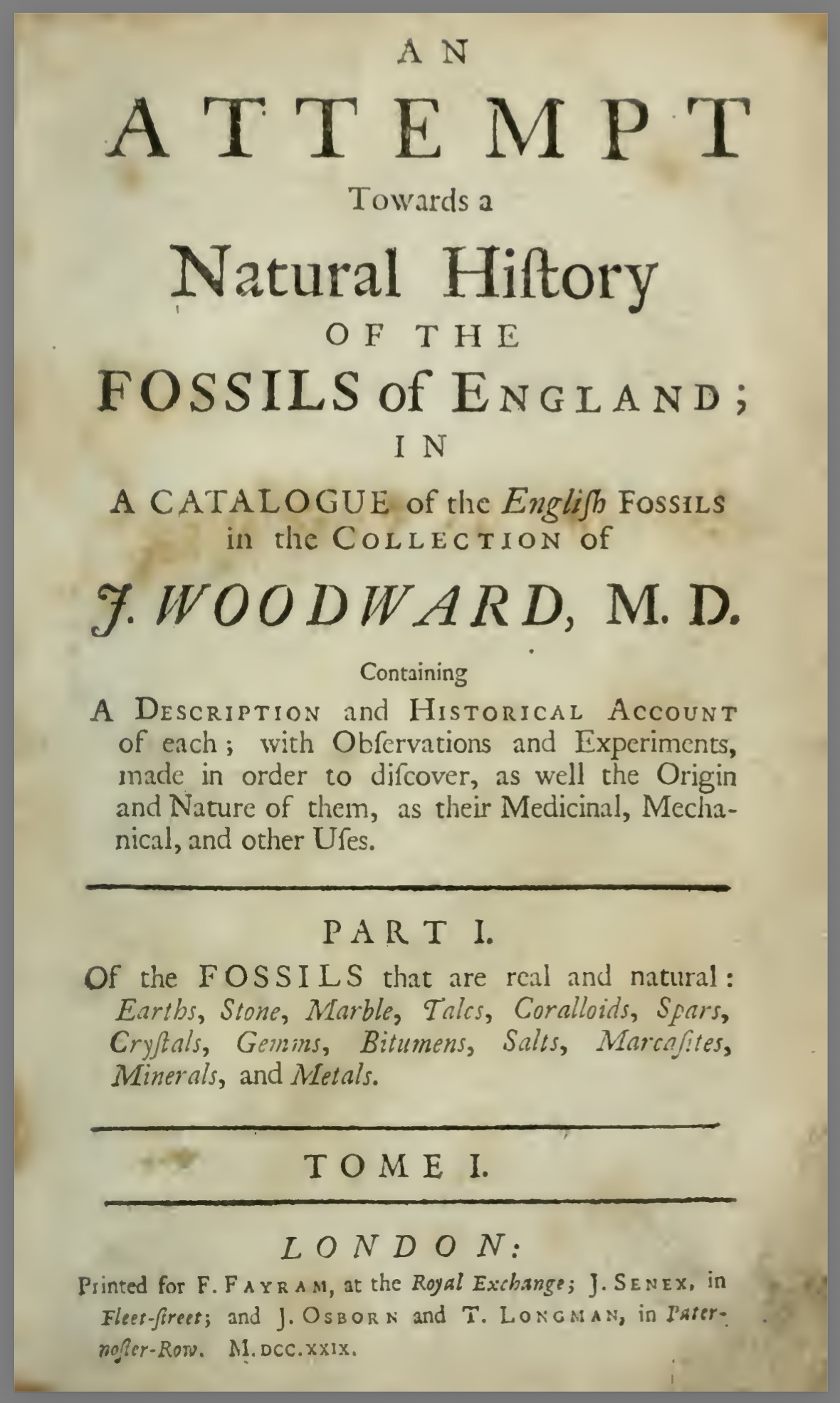
An Attempt Towards a Natural History of the Fossils of England in a Catalogue of the English Fossils in the Collection of J. Woodward
Book
Woodward, J. (1729) An Attempt Towards a Natural History of the Fossils of England in a Catalogue of the English Fossils in the Collection of J. Woodward. London, F. Fayram, 131 pp.
Sinkankas/Born No.: 7325 | RWHL*
gems, corundum, history.1
Sinkankas: The celebrated catalog of Woodward’s collection, both large in size and varied, and “procured from all the known Parts of the Globe, with Trouble and Expence more than sufficient to discourage any other body from attempting a [similar] Work.” In its complexity, we may discover details on thousands of specimens of fossils, minerals, and rocks, whose overall size cannot be appreciated from the pagination alone inasmuch as a very small type was used in its printing, thus compressing an enormous amount of information into a physically small book. Further to be discovered is the fact that Woodward collected everything derived in some way from Earth’s crust, not being above inserting into his cabinet such mundane things as sand, gravel, and pebbles, not to mention a large variety of rocks and animal & vegetable fossils. As in his previous work above, Woodward provides his classification scheme in Tome I upon which he sorted out his specimens, from earths to metallic ores, listing and briefly describing each piece, often with fascinating details and comments, both his own and those taken from other authorities. This first part is followed by a catalog of British fossils, with its own title page, these being “extraneous” or true fossils as we recognize them now. Additional domestic fossils appear in another catalog, again with its own title page, commencing Tome II, with the date of 1723, which appears to be in error inasmuch as the entire work is signed continuously, and suggests an unbroken process of composition in the printer’s shop. Again the specimens are largely minerals and rocks but include a few true fossils. Following this is still another catalog, also with its own title page, listing specimens obtained from abroad, that is, countries of Asia, Africa, the Americas, and various European countries. This comprises a first part and is followed by a second part, with its own title page, on true fossils obtained from overseas sources. The last two parts are additions, again with their own title pages. Taken as a whole, Woodward’s collection was not rich in gem or ornamental stones, but by some diligence one may frequently find references and examples of the same.