
Four Treasures Reference Database
Record No. 29024
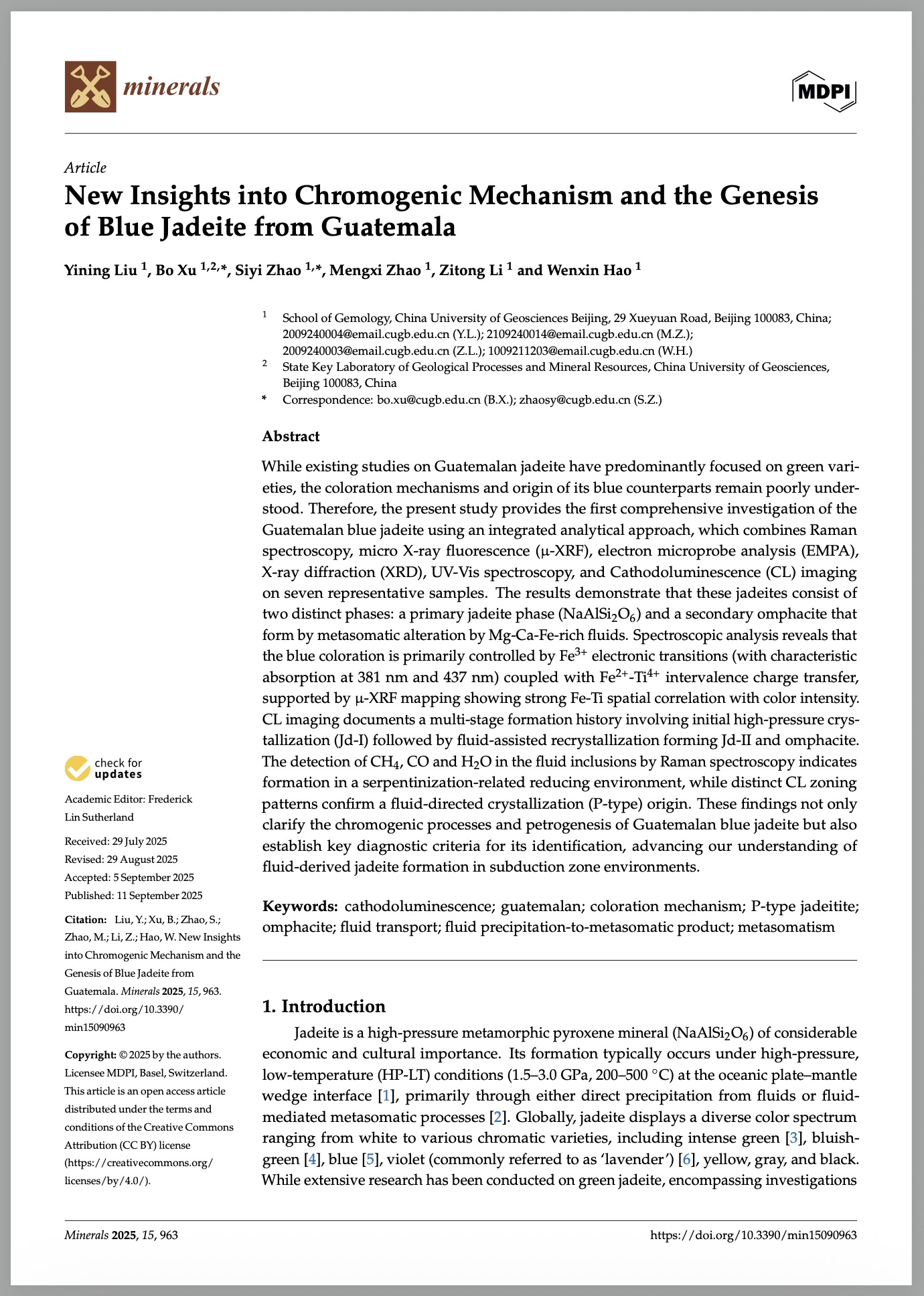
New insights into chromogenic mechanism and the genesis of blue jadeite from Guatemala
Electronic Article
Liu, Y., Xu, B., Zhao, S., Zhao, M., Li, Z. and Hao, W. (2025) New insights into chromogenic mechanism and the genesis of blue jadeite from Guatemala. Minerals, Vol. 15, No. 9, pp. 963
ISBN/ISSN: 2075-163X | Sinkankas/Born No.: NIS/NIB | RWHL*
gems, jade, fei cui, pyroxen jade, jadeite, kosmochlor, Guatemala, cathodoluminescence, guatemalan, cause of color, P-type jadeitite, omphacite, fluid transport, fluid precipitation-to-metasomatic product, metasomatism
While existing studies on Guatemalan jadeite have predominantly focused on green varieties, the coloration mechanisms and origin of its blue counterparts remain poorly understood. Therefore, the present study provides the first comprehensive investigation of the Guatemalan blue jadeite using an integrated analytical approach, which combines Raman spectroscopy, micro X-ray fluorescence (µ-XRF), electron microprobe analysis (EMPA), X-ray diffraction (XRD), UV-Vis spectroscopy, and cathodoluminescence (CL) imaging on seven representative samples. The results demonstrate that these jadeites consist of two distinct phases: a primary jadeite phase (NaAlSi₂O₆) and a secondary omphacite that forms by metasomatic alteration by Mg-Ca-Fe-rich fluids. Spectroscopic analysis reveals that the blue coloration is primarily controlled by Fe³⁺ electronic transitions (with characteristic absorption at 381 nm and 437 nm) coupled with Fe²⁺-Ti⁴⁺ intervalence charge transfer, supported by µ-XRF mapping showing strong Fe-Ti spatial correlation with color intensity. CL imaging documents a multi-stage formation history involving initial high-pressure crystallization (Jd-I) followed by fluid-assisted recrystallization forming Jd-II and omphacite. The detection of CH₄, CO, and H₂O in the fluid inclusions by Raman spectroscopy indicates formation in a serpentinization-related reducing environment, while distinct CL zoning patterns confirm a fluid-directed crystallization (P-type) origin. These findings not only clarify the chromogenic processes and petrogenesis of Guatemalan blue jadeite but also establish key diagnostic criteria for its identification, advancing our understanding of fluid-derived jadeite formation in subduction zone environments.