
Four Treasures Reference Database
Record No. 29084
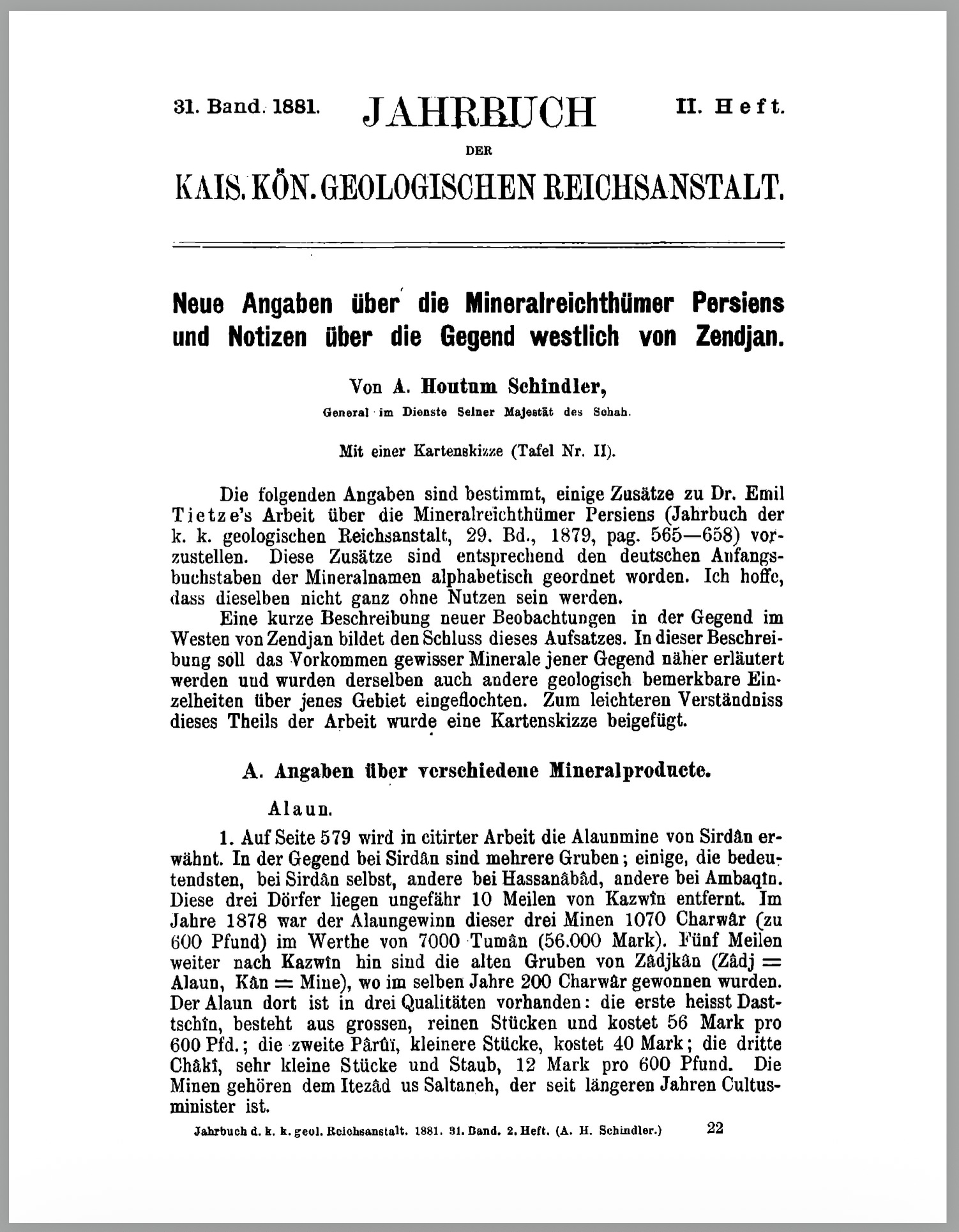
Neue Angaben über die Mineralreichthümer Persiens und Notizen über die Gegend westlich von Zendjan
New details on the mineral resources of Persia and notes on the area west of Zendjan
Journal Article
Houtum-Schindler, A. (1881) Neue Angaben über die Mineralreichthümer Persiens und Notizen über die Gegend westlich von Zendjan. [New details on the mineral resources of Persia and notes on the area west of Zendjan] Jahrbuch der Kaiserlich-Königlichen Geologischen Reichsanstalt, Vol. 31, No. 2, pp. 169–190.
Sinkankas/Born No.: NIS/NIB | Language: in German | RWHL
gems, turquoise, Iran, Persia, Nishapur
Houtum-Schindler supplements Emil Tietze’s earlier survey of the mineral resources of Persia with observations gathered largely from his own travels, first treating individual mineral products and then giving a more detailed geological account of the country west of Zendjan. He records occurrences and, where available, mining methods, production, prices, trade, and local uses of alum, lead, borax, iron ores, edible and refractory clays, gold, gypsum, coal, kaolin, copper, magnesia, manganese, marble, naphtha, porphyry, mercury, rock salt, turquoise, silver, surmeh, and emery. Of particular gemological importance is his account of turquoise. In Kerman Province he notes several occurrences in northwest–southeast-trending volcanic ranges, including abandoned mines near Mo Aspan and Shehr-i Babek and recently discovered pale turquoise veins on the Cheheltan Mountains. At Nishapur he states that turquoise occurs in an iron-rich clay silicate containing microscopic grains of free quartz; the host rock changes from pale yellow near the surface to dark brown or blackish with depth. In 1876, 266 shafts were operating there, and production remained substantial: according to a Meshed turquoise merchant, material worth 240,000 marks annually went to Russia, 80,000 marks to Tehran, and another 80,000 marks was sold in Meshed, with additional exports to Constantinople, Baghdad, and the Persian Gulf. Houtum-Schindler also describes important gold occurrences, distinguishing gold-bearing iron-rich limestone at Kavend from barren quartz veins and documenting ancient workings and auriferous alluvium. His account west of Zendjan examines the relationships among limestones, green schists, granites, gneisses, volcanic rocks, conglomerates, gypsum, and mineralized veins, with observations on gold, silver, copper, lead, iron, alum, kaolin, mercury, and other resources. The paper combines economic mineralogy with field geology and provides unusually detailed evidence for the location, condition, exploitation, and commerce of Persian mineral deposits in the late nineteenth century.