
Four Treasures Reference Database
Record No. 29086
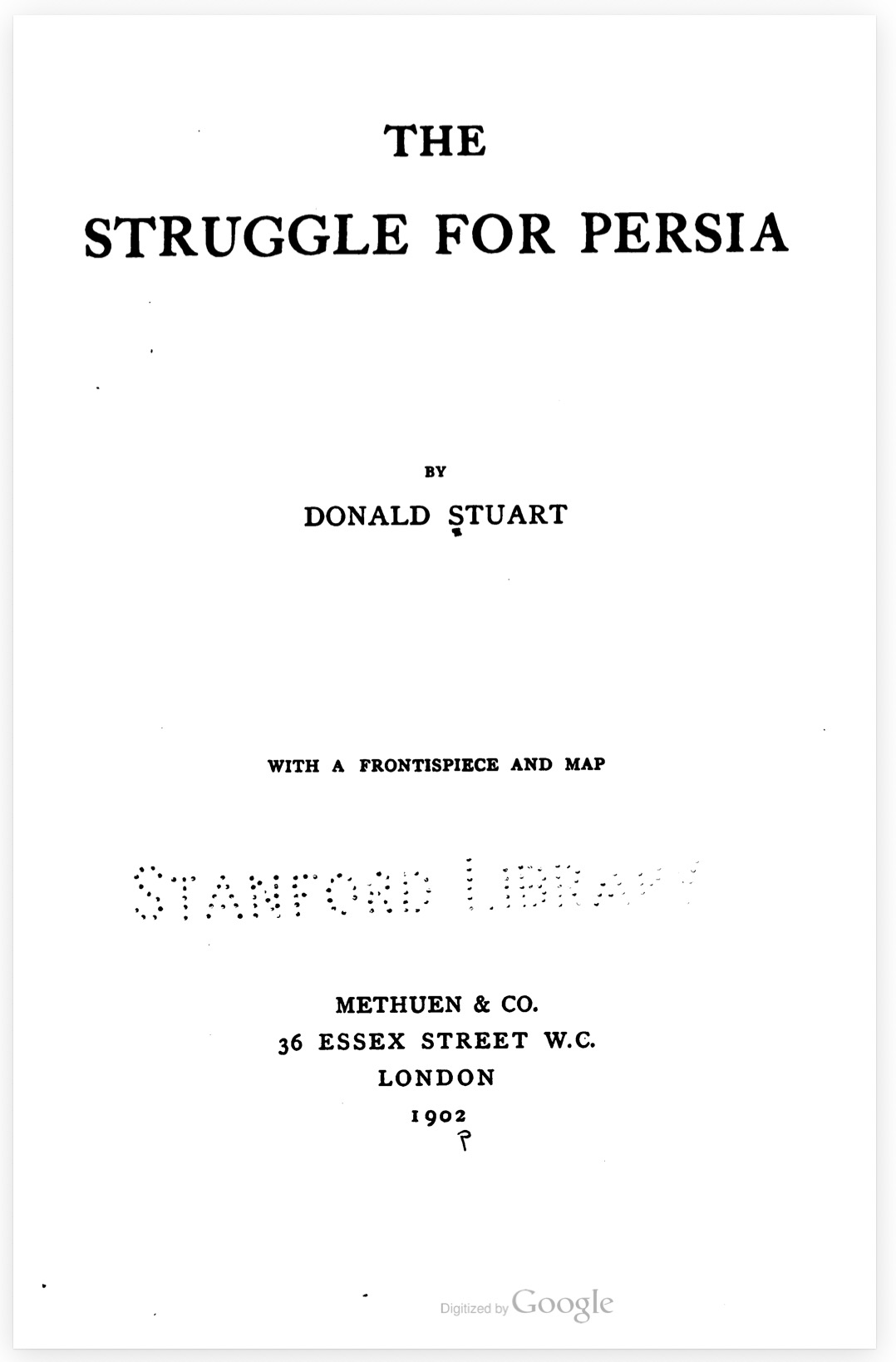
The Struggle for Persia
Book
Stuart, D. (1902) The Struggle for Persia. London, Methuen, 336 pp.
Sinkankas/Born No.: NIS/NIB | RWHL
gems, turquoise, Iran, Persia, Nishapur
Stuart devotes much of his chapter on Meshed and Bushire to a detailed description of the Nishapur turquoise mines, drawing explicitly on information supplied by General Schindler. He locates the mines in the Bâr-i-Meidan district northwest of Nishapur and describes their geography, villages, population, individual workings, mining conditions, production, classification, cutting, valuation, and trade. Numerous named mines are discussed, including workings that were dangerous, flooded, poorly ventilated, collapsed, or exhausted, together with differences in the quality and color stability of their turquoise. Of particular gemological interest is his description of material from the Sar-i-Reîsh and Anjîrî mines, which could possess an attractive color while moist but faded on drying, becoming greenish, spotted, or eventually nearly white. Such stones were reportedly shipped to Europe in damp earthenware vessels, and Stuart attributes declining European confidence in turquoise and falling prices partly to the influx of this unstable material. He contrasts these deposits with the Khâkî workings in accumulated mine debris and alluvium, which were then producing many of the finest stones, including valuable ring-quality turquoise. Mining employed picks, crowbars, and increasingly gunpowder, although blasting was considered detrimental because it shattered turquoise that older hand-working methods might have recovered intact. Stuart gives an unusually detailed contemporary classification of Nishapur turquoise into three commercial categories: Angushtarî, comprising fine, stable-colored stones suitable for rings and sold individually; Bârkhaneh, divided into grades and sold by weight; and Arabî, encompassing inferior pale, greenish, spotted, or otherwise undesirable material. Deep sky blue was most prized, but value also depended upon shape, freedom from flaws, permanence of color, and an indefinable quality termed zât, which Stuart compares with the “water” of a diamond or the luster of a pearl. He describes several traditional cuts, including the high peikânî form reserved for fine deep-colored stones, cabochons, and flat slabs, and notes the practice of disguising flaws in large stones with gold scrollwork or strategically positioned inscriptions. The account also traces the commercial chain from miners through village Rîsh-i-Safîds and commission agents to Meshed dealers and ultimately European markets, particularly Moscow, showing how a stone could increase enormously in value after cutting and successive resale. Annual production from the mines, mountains, and surface diggings is estimated at 25,000 tomans at mine value, perhaps tripling by the time the turquoise reached its final purchasers. Stuart’s chapter thus provides an exceptionally detailed early twentieth-century account of Nishapur turquoise mining, quality grading, color stability, cutting, valuation, marketing, and the economic organization of the trade.