
Four Treasures Reference Database
Record No. 29090
Persian turquoise: The ancient treasure of Neyshabur
Journal Article
Shirdam, B., Shen, A.H., Yang, M.X., Mokhtari, Z. and Fazliani, H. (2021) Persian turquoise: The ancient treasure of Neyshabur. Gems & Gemology, Vol. 57, No. 3, Fall, pp. 240–257.
gems, turquoise, Iran, Persia, Nishapur
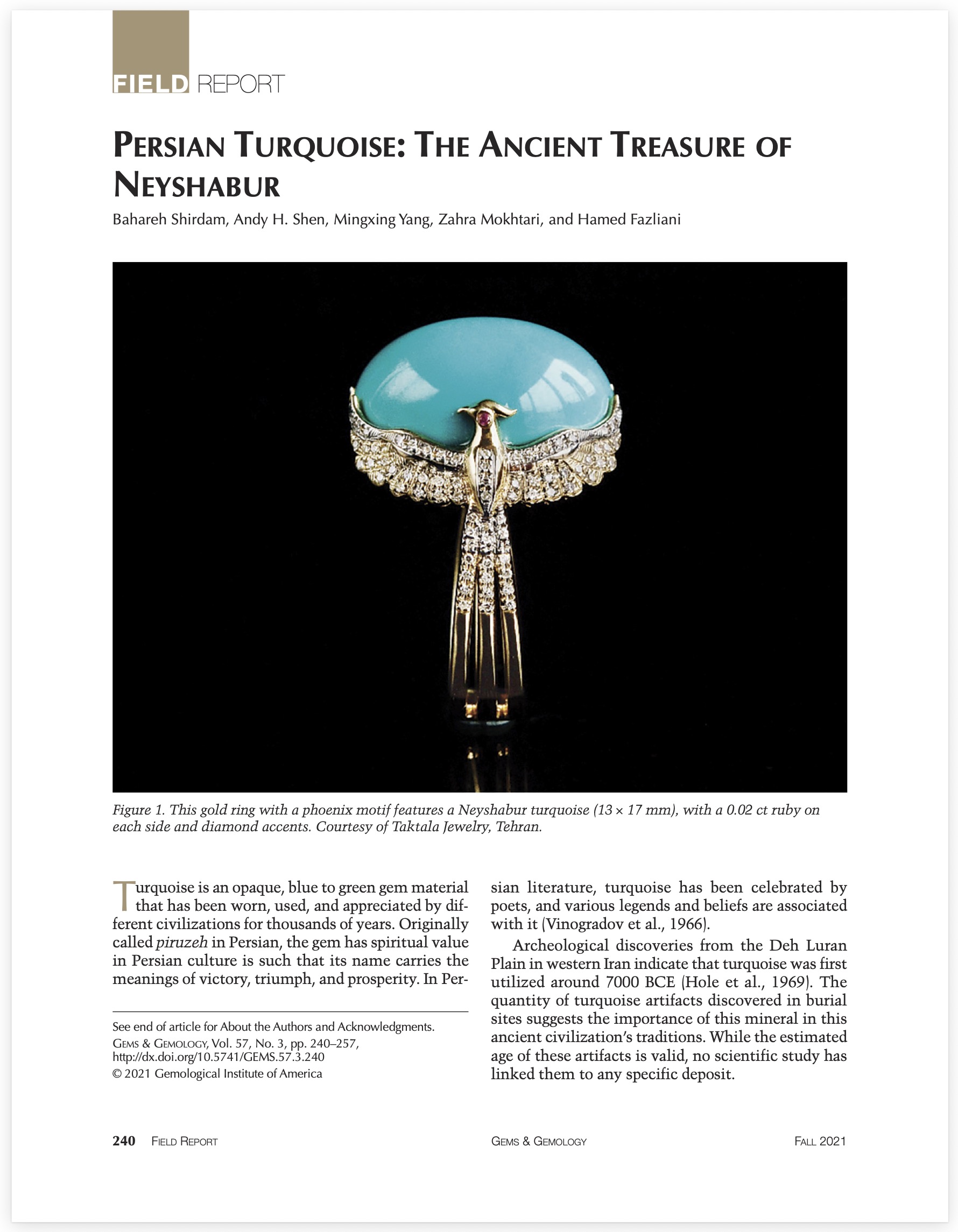
Turquoise is an opaque, blue-to-green gem material that has been worn, used, and appreciated by different civilizations for thousands of years. Originally called piruzeh in Persian, the gem has such spiritual value in Persian culture that its name carries the meanings of victory, triumph, and prosperity. In Persian literature, turquoise has been celebrated by poets, and various legends and beliefs are associated with it (Vinogradov et al., 1966). Archaeological discoveries from the Deh Luran Plain in western Iran indicate that turquoise was first utilized around 7000 BCE (Hole et al., 1969). The quantity of turquoise artifacts discovered in burial sites suggests the importance of this mineral in this ancient civilization’s traditions. While the estimated age of these artifacts is valid, no scientific study has linked them to any specific deposit. The Neyshabur (Latinized as Nishapur) deposit is known for yielding turquoise with unique color and quality. This production has historically been known as “Persian turquoise” (figure 1), yet Iran’s turquoise deposits were never limited to Neyshabur. Other important mines include the Baghu deposit in southern Semnan Province and the Shahr-i Babak deposit in western Kerman Province, the latter of which was mentioned in Marco Polo’s Book of the Wonders of the World between 1390 and 1430 (Weisgerber, 2004). Located in Razavi Khorasan Province of northeastern Iran, 53 km from the city of Neyshabur, the Neyshabur mine has produced the majority of Iranian turquoise for more than a millennium. Yet in recent decades there have been claims that the mine is on the verge of closure, that its turquoise quality has diminished, or that it is running out of material. Such claims often carry enormous weight with consumers. After visiting the Neyshabur turquoise mine in 2020, a report was conducted on the current state of the mine. This article seeks to uncover the facts and offer objective insight into the current state of the Neyshabur turquoise mine.