
Four Treasures Reference Database
Record No. 29091
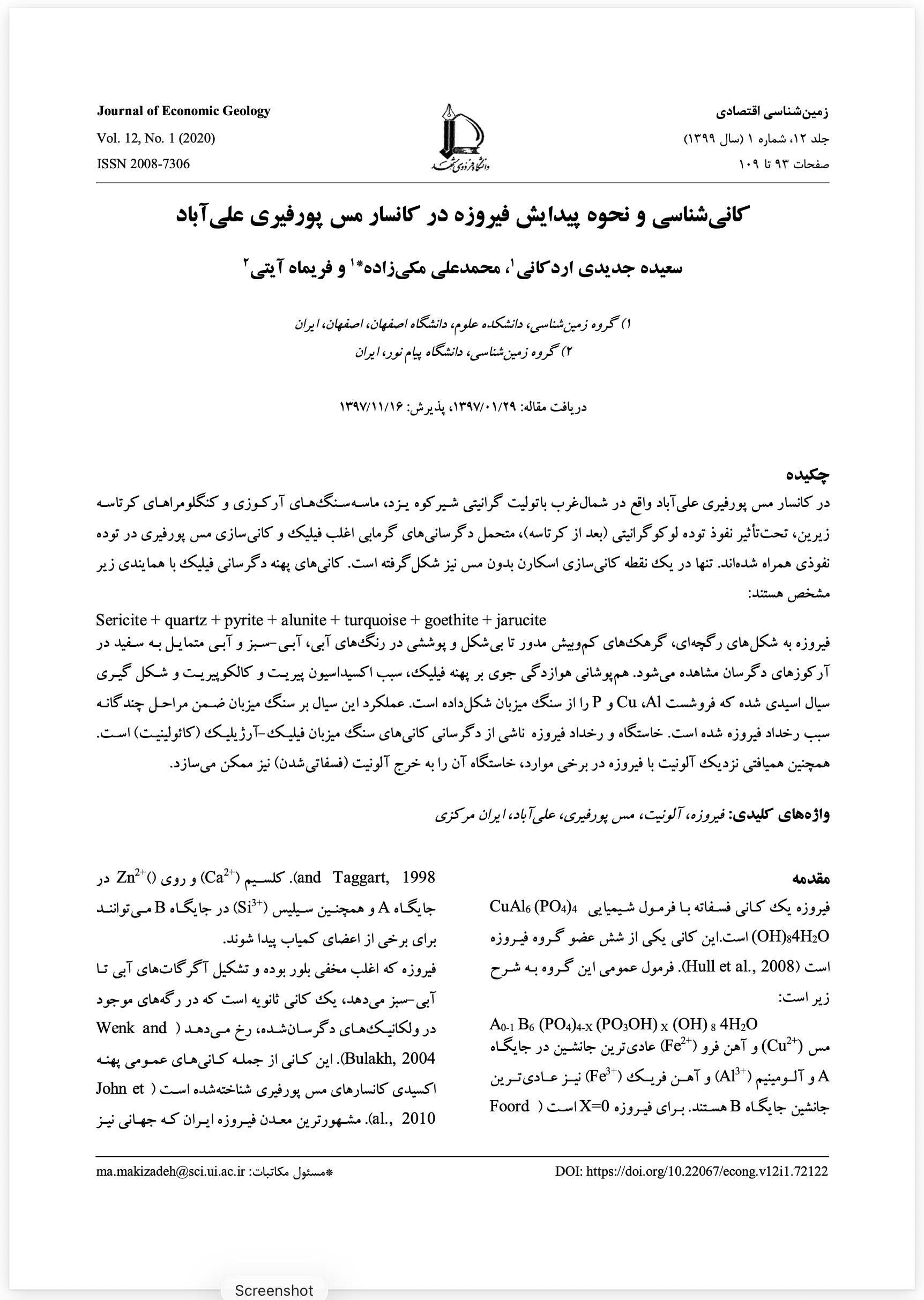
کانی شناسی و نحوه پیدایش فیروزه در کانسار مس پورفیری علی آباد
Mineralogy and Formation Conditions of Turquoise in Ali Abad Cu Porphyry Deposit
Journal Article
Jadidi Ardekani, S., Mackizadeh, M.A. and Ayati, F. (2020) کانی شناسی و نحوه پیدایش فیروزه در کانسار مس پورفیری علی آباد. [Mineralogy and Formation Conditions of Turquoise in Ali Abad Cu Porphyry Deposit] Journal of Economic Geology, Vol. 12, No. 1, pp. 93–109.
ISBN/ISSN: 2008-7306 | DOI: https://doi.org/10.22067/econg.v12i1.72122 | Sinkankas/Born No.: NIS/NIB | Language: in Arabic | RWHL
gems, turquoise, Iran, Alunite, cu-porphyry, Aliabad, Central Iran
In the Aliabad porphyry copper deposit, located northwest of the Shirkuh granite batholith in Yazd, Lower Cretaceous arkosic sandstones and conglomerates were affected by the intrusion of a leucogranitic body (post-Cretaceous), resulting predominantly in phyllic hydrothermal alteration and porphyry copper mineralization associated with the intrusive body. Skarn mineralization without copper developed at only one locality. The minerals of the phyllic alteration zone are characterized by the assemblage: sericite + quartz + pyrite + alunite + turquoise + goethite + jarosite. Turquoise occurs as veinlets, approximately rounded to irregular nodules, and coatings in blue, blue-green, and bluish-white colors within the altered arkoses. Supergene weathering overprinted the phyllic zone, causing oxidation of pyrite and chalcopyrite and the formation of acidic fluids that leached Al, Cu, and P from the host rocks. The action of these fluids on the host rocks through multiple stages resulted in the formation of turquoise. The origin and occurrence of the turquoise are attributed to alteration of minerals in the phyllic–argillic host rocks, particularly kaolinite. In addition, the close association of alunite with turquoise in some cases suggests that turquoise may also have formed through phosphatization of alunite.