
Four Treasures Reference Database
Record No. 29128
On the origin of the carat as the unit of weight for gemstones
Journal Article
Zhengzhang, T. (1991) On the origin of the carat as the unit of weight for gemstones. Chinese Journal of Geochemistry, Vol. 10, No. 3, pp. 288–293.
ISBN/ISSN: 1993-0364 | DOI: https://doi.org/10.1007/BF02843332 | Sinkankas/Born No.: NIS/NIB | RWHL*
gems, weights and measures, carat, weighing
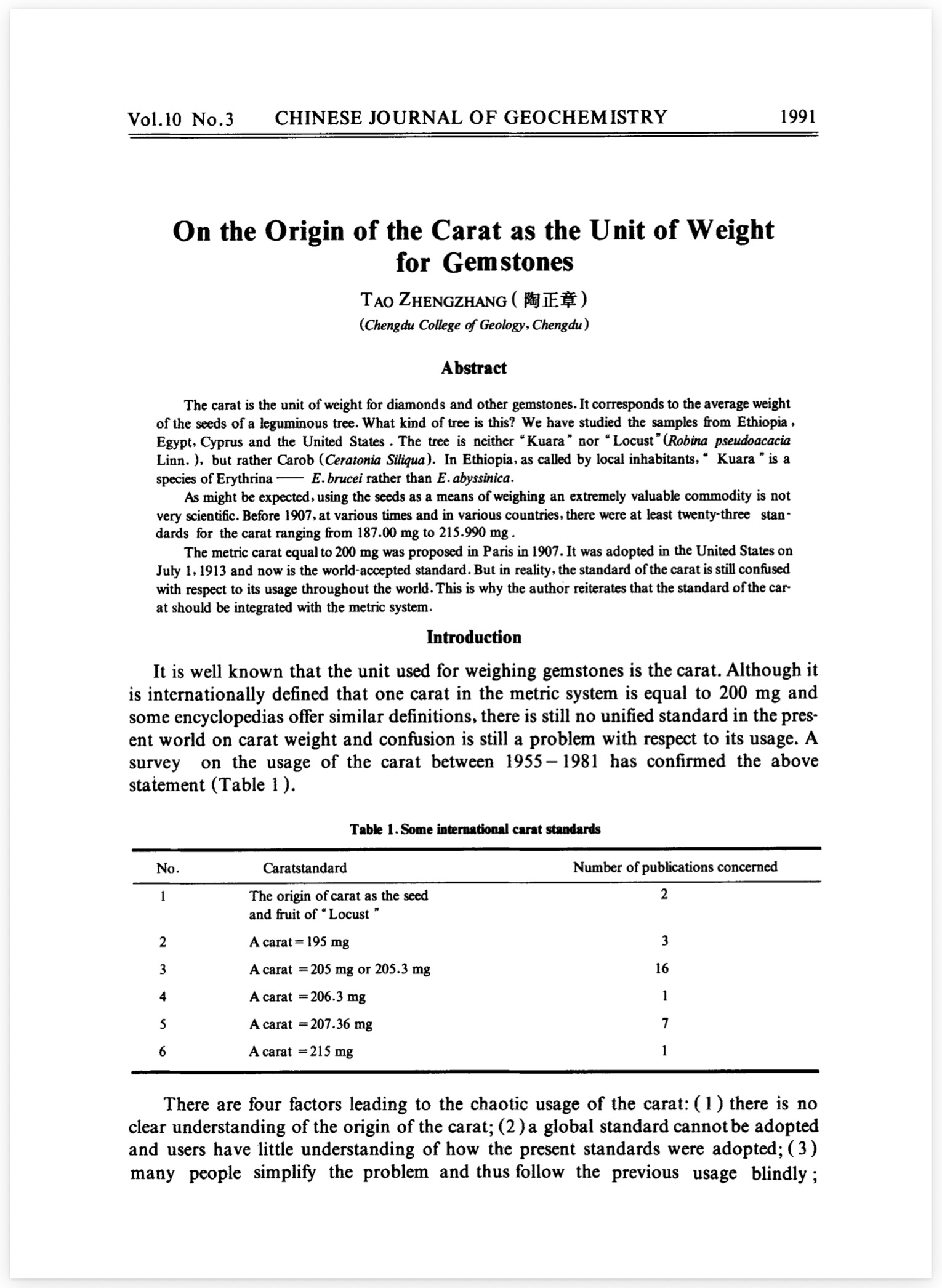
The carat is the unit of weight for diamonds and other gemstones. It corresponds to the average weight of the seeds of a leguminous tree. What kind of tree is this? We have studied the samples from Ethiopia, Egypt, Cyprus and the United States. The tree is neither “Kuara” nor “Locust” (Robinia pseudoacacia Linn.), but rather Carob (Ceratonia siliqua). In Ethiopia, as called by local inhabitants, “Kuara” is a species of Erythrina—E. brucei rather than E. abyssinica. As might be expected, using the seeds as a means of weighing an extremely valuable commodity is not very scientific. Before 1907, at various times and in various countries, there were at least twenty-three standards for the carat ranging from 187.00 mg to 215.990 mg. The metric carat equal to 200 mg was proposed in Paris in 1907. It was adopted in the United States on July 1, 1913 and now is the world-accepted standard. But in reality, the standard of the carat is still confused with respect to its usage throughout the world. This is why the author reiterates that the standard of the carat should be integrated with the metric system.