
Four Treasures Reference Database
Record No. 29146
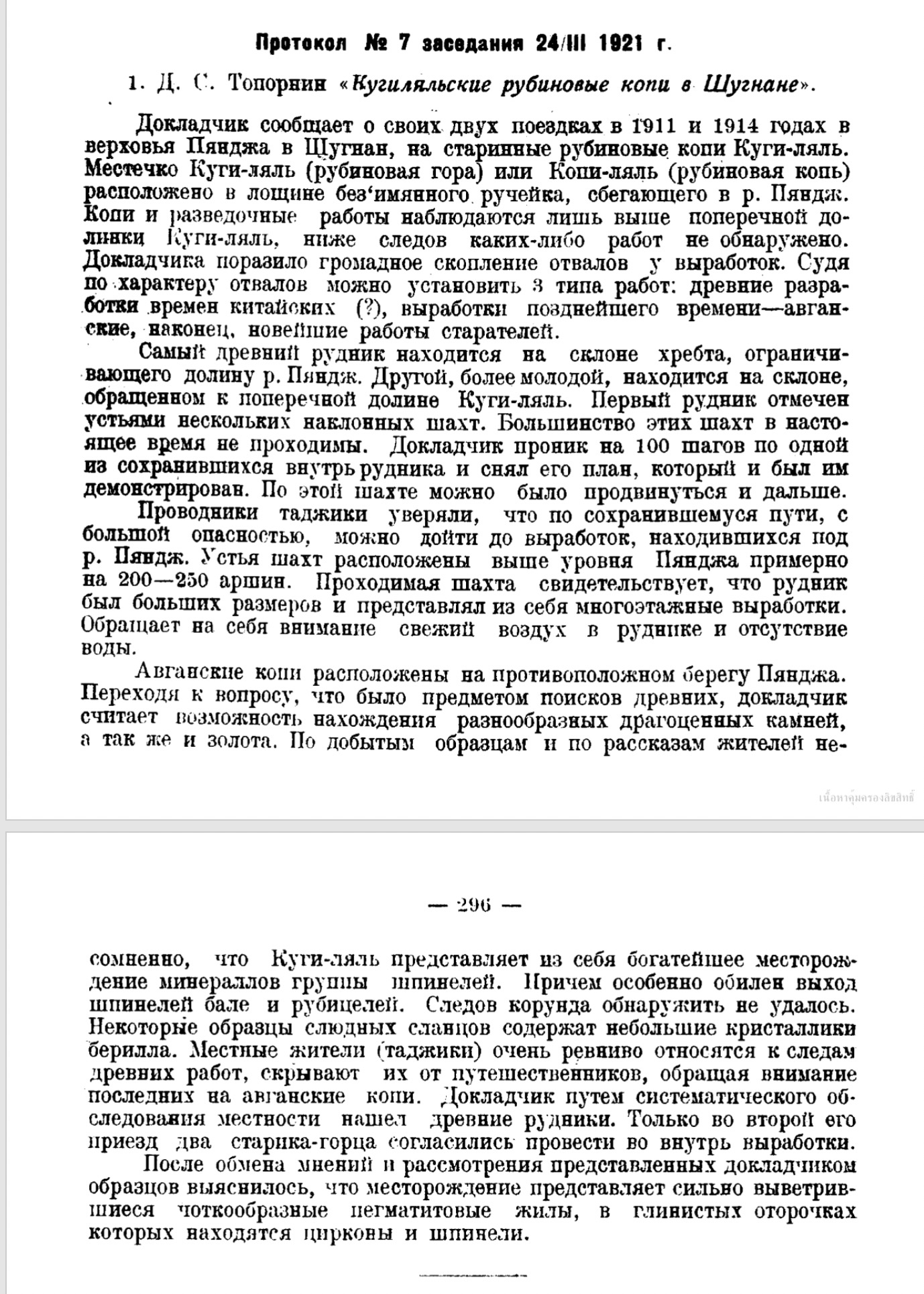
The Kugilal ruby mines in Shugnan
Кугилялские рубиновые копи в Шугнане
Journal Article
Topornin, D.S. (1921) The Kugilal ruby mines in Shugnan. [Кугилялские рубиновые копи в Шугнане] Proceedings of the Turkestan Scientific Society [Труды Туркестанского научного общества], Vol. 1, pp. 295–296.
Sinkankas/Born No.: NIS/NIB | Language: in Russian | RWHL*
gems, spinel, Afghanistan, Tajikistan, balas ruby, Kuh-i-Lal
Topornin reports on two visits, in 1911 and 1914, to the ancient ruby workings of Kugilal in Shugnan, situated in the upper reaches of the Panj River near the village of Lyandzh. The mines lie in two workings on opposite slopes bordering the Panj valley, the older on the slope facing the Kugilal settlement and a somewhat younger working on the opposite side. Topornin distinguishes three periods of mining from the character of the waste heaps: ancient workings using primitive tools, workings of comparatively recent Afghan origin, and the newest excavations made by prospectors. He entered one preserved internal working for about 100 paces and describes another shaft, at the second mine, extending roughly 200–250 arshins horizontally; the scale of the underground excavations indicates that the deposit was formerly worked extensively. The workings are dry and well ventilated. Afghan workings occur on the opposite bank of the Panj, and Topornin considers the ancient miners to have searched for precious stones and gold. From specimens collected and local accounts he concludes that Kugilal is an exceptionally rich occurrence of minerals of the spinel group, particularly spinel and rubicelle; some specimens of mica schist also contain small crystals of beryl. Local Tajiks carefully conceal evidence of the ancient workings, fearing renewed exploitation by outsiders, but during Topornin’s second visit two elderly miners agreed to guide him underground. Examination of collected specimens indicates that the deposit consists of strongly weathered mica-bearing pegmatitic veins, with garnets and spinels occurring in clayey cavities.