
Four Treasures Reference Database
Record No. 29218
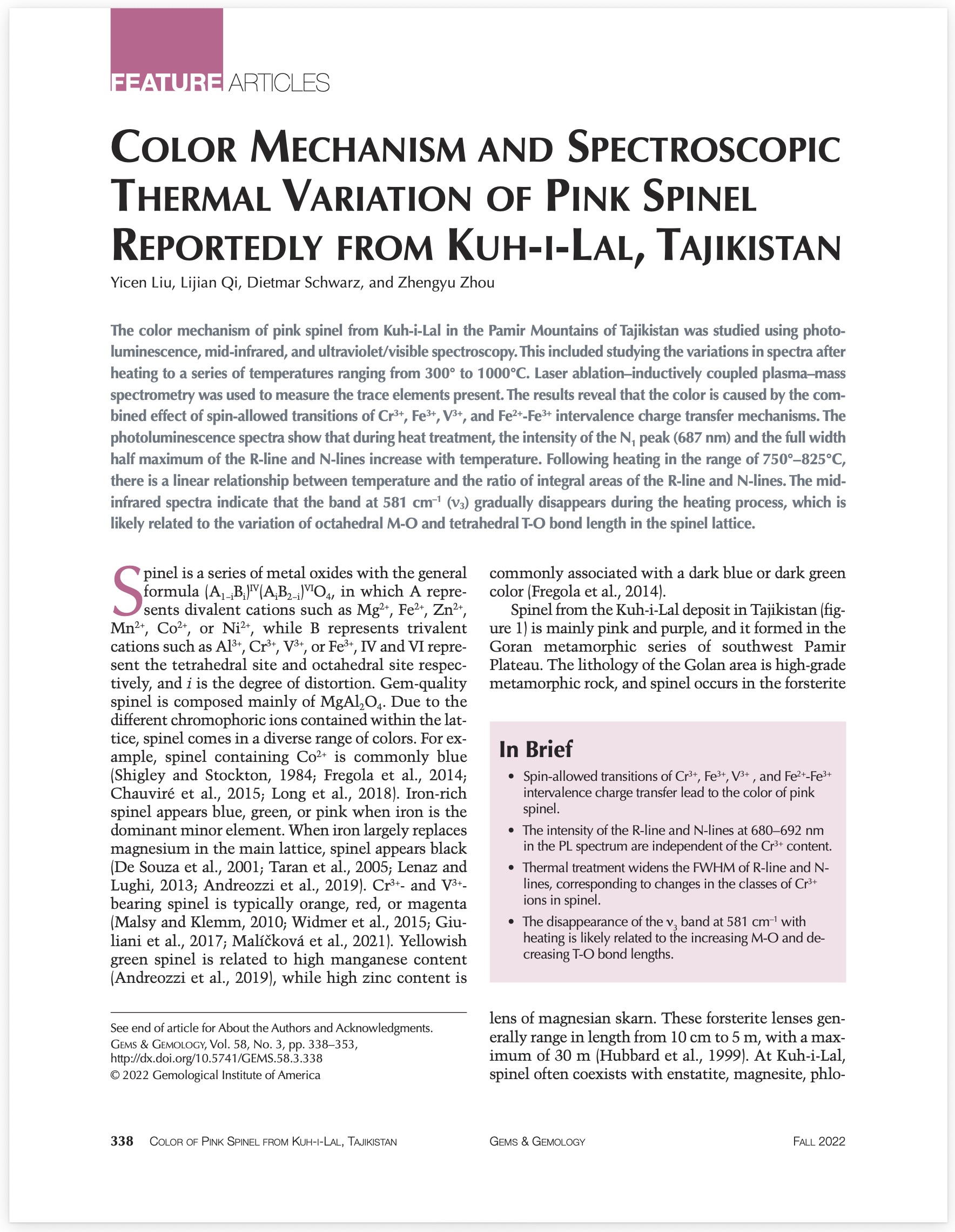
Color mechanism and spectroscopic thermal variation of pink spinel reportedly from Kuh-i-Lal, Tajikistan
Journal Article
Liu, Y., Qi, L., Schwarz, D. and Zhou, Z. (2022) Color mechanism and spectroscopic thermal variation of pink spinel reportedly from Kuh-i-Lal, Tajikistan. Gems & Gemology, Vol. 58, No. 3, Fall, pp. 338–353.
Sinkankas/Born No.: NIS/NIB | RWHL*
Close Abstract
Hide Keywords
Copy Reference
gems, spinel, Afghanistan, Tajikistan, balas ruby, Kuh-i-Lal, Pamir, geology, causes of color
The color mechanism of pink spinel from Kuh-i-Lal in the Pamir Mountains of Tajikistan was studied using photoluminescence, mid-infrared, and ultraviolet/visible spectroscopy. This included studying the variations in spectra after heating to a series of temperatures ranging from 300° to 1000°C. Laser ablation–inductively coupled plasma–mass spectrometry was used to measure the trace elements present. The results reveal that the color is caused by the combined effect of spin-allowed transitions of Cr³⁺, Fe³⁺, V³⁺, and Fe²⁺–Fe³⁺ intervalence charge transfer mechanisms. The photoluminescence spectra show that during heat treatment, the intensity of the N1 peak (687 nm) and the full width at half maximum of the R-line and N-lines increase with temperature. Following heating in the range of 750°–825°C, there is a linear relationship between temperature and the ratio of integral areas of the R-line and N-lines. The mid-infrared spectra indicate that the band at 581 cm⁻¹ (ν₃) gradually disappears during the heating process, which is likely related to the variation of octahedral M–O and tetrahedral T–O bond length in the spinel lattice.