
Four Treasures Reference Database
Record No. 29226
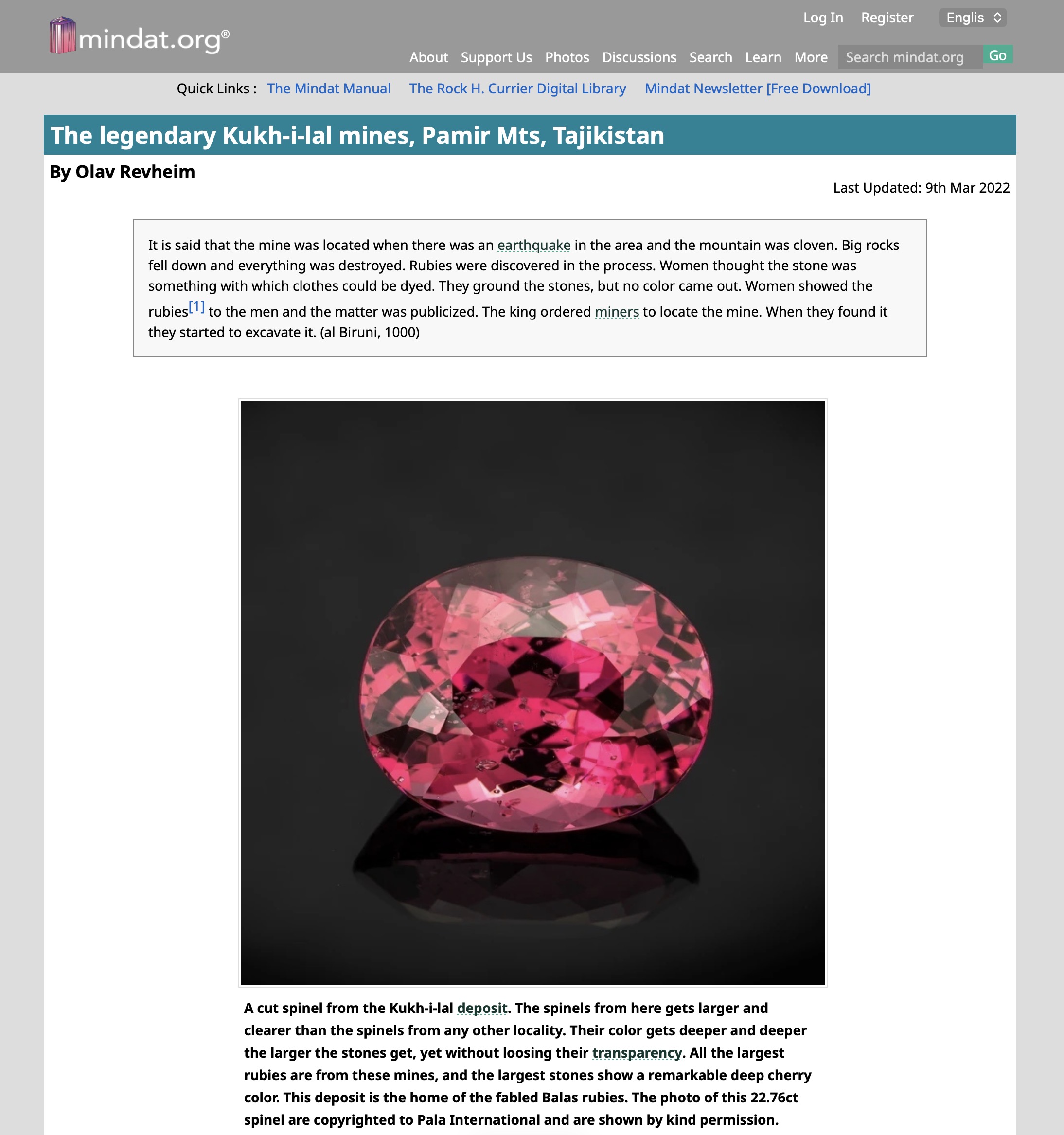
The legendary Kukh-i-lal mines, Pamir Mts, Tajikistan
Electronic Article
Revheim, O. (2022) The legendary Kukh-i-lal mines, Pamir Mts, Tajikistan. Mindat.org
Sinkankas/Born No.: NIS/NIB | RWHL*
Close Abstract
Hide Keywords
Copy Reference
gems, spinel, Afghanistan, Tajikistan, balas ruby, Kuh-i-Lal
The quote at the top is from Abu Rayhan al-Biruni (973–after 1050), taken from his The Book Most Comprehensive in Knowledge on Precious Stones. This book is a remarkable combination of scholarship, rumors and references to earlier authors, in addition to al-Biruni’s own experiences from his travels and scientific experiments. Al-Biruni’s description of the Kuh-i-Lal mines and their prominent placement in his book provide detailed insight into the geology, mines and operations that produced the magnificent rubies that have made these mines legendary. Timur’s Ruby, the Black Prince’s Ruby, the Samarian Ruby and Catherine the Great’s Ruby, and other magnificent stones in the British, Indian, Iranian, Russian, French and Turkish treasuries, all originate from here. It is believed that the term Balas ruby, which was extensively used in Europe from the Middle Ages up to near modern times, is derived from Badakhshan. Pardieu and Farkhodova (2019) address the historical importance of this locality in their article “Spinel from Tajikistan, The Gem That Made Famous the Word ‘Ruby’.” Following their reasoning, it was the spinel from Kuh-i-Lal, and not the corundum from Mogok, that made ruby a famous gemstone. It was not until the late 19th century that modern science found these mines (the Russian Pamir expedition in 1892–95). At that time, only small-scale mining took place. Serious scientific studies were later carried out by Soviet scientists, and papers on their history and geology were published (see Pardieu and Farkhodova, 2019, for a bibliography). Obviously, given the historical importance and potential value of the mine produce, combined with the geopolitical hotspot location, very little of this research was shared outside the USSR until after its breakup. One of the scientists who visited the mines was the Russian historian Mira Bubnova. She conducted archaeological investigations at the mines in the early 1970s. She found some evidence that the operations may have started as early as the 8th century, and she also confirmed that the most intensive exploitation of the mine took place from the 9th to the 12th centuries, meaning that al-Biruni’s text is a valuable contemporary account from the most prominent period of mining.