
Four Treasures Reference Database
Record No. 29270
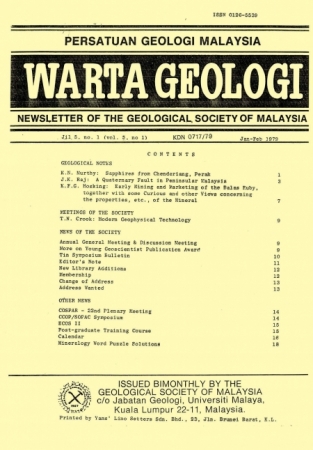
Early mining and marketing of the balas ruby, together with some curious and other views concerning the properties of the mineral
Journal Article
Hosking, K.F.G. (1979) Early mining and marketing of the balas ruby, together with some curious and other views concerning the properties of the mineral. Warta Geologi, Vol. 5, No. 1, pp. 7–8.
Sinkankas/Born No.: NIS/NIB | RWHL
gems, spinel, Afghanistan, Tajikistan, balas ruby, Kuh-i-Lal, Pamir, Marco Polo
Recently, when reading Latham's (1967) translation of the 13th century work 'Travels of Marco Polo', I came upon an account of the mining, marketing, etc., in Badakhshan, or Balashan, of what Latham terms balass rubies, and it is this account that is the basis of this note. Spencer (1937, p. 161) provides the information that the name 'balas ruby' is often applied to pale red spinel of inferior quality. He also notes that red spinel has long been known to occur with ruby in white marble near Jagdalek in Badakhshan, the ancient kingdom of Balascia, now in Afghanistan. He records that Marco Polo visited the mines in the 13th century and brought back gemstones (no doubt, both ruby and red spinel) under the name balascus. In my translation of the 'Travels' I can find nothing that proves that Marco Polo did, in fact, acquire rubies and spinels from Badakhshan, but apparently he did return with gems to Europe, and as he visited Badakhshan it is probable that he obtained at least some of them from there. The account of the mining, etc., of the balass rubies in Badakhshan which appears on page 76 of Latham's translation, and which is reproduced below is, in my view, particularly interesting because it provides yet another example of the fact that ancient mining groups were not only capable of operating sizeable underground mines efficiently, but that, in addition, they often knew how to make the best use, economically speaking, of the products of their mines. The King of Badakhshan had the balass ruby trade 'buttoned up' just about as effectively as is, say, the present South African diamond industry.