
Four Treasures Reference Database
Record No. 29298
Die farbgebende Substanz der natürlichen roten, blauen, braunen und violetten Spinelle von Ceylon
The colouring substance of natural red, blue, brown, and violet spinels from Ceylon
Journal Article
Schlossmacher, K. and Meyer, I. (1931) Die farbgebende Substanz der natürlichen roten, blauen, braunen und violetten Spinelle von Ceylon. [The colouring substance of natural red, blue, brown, and violet spinels from Ceylon] Zeitschrift für Kristallographie, Mineralogie und Petrographie, Vol. 76, No. 5, pp. 377–385.
DOI: https://doi.org/10.1524/zkri.1931.76.1.377 | Sinkankas/Born No.: NIS/NIB | Language: in German | RWHL
gems, spinel, red, blue, violet, Ceylon, Sri Lanka
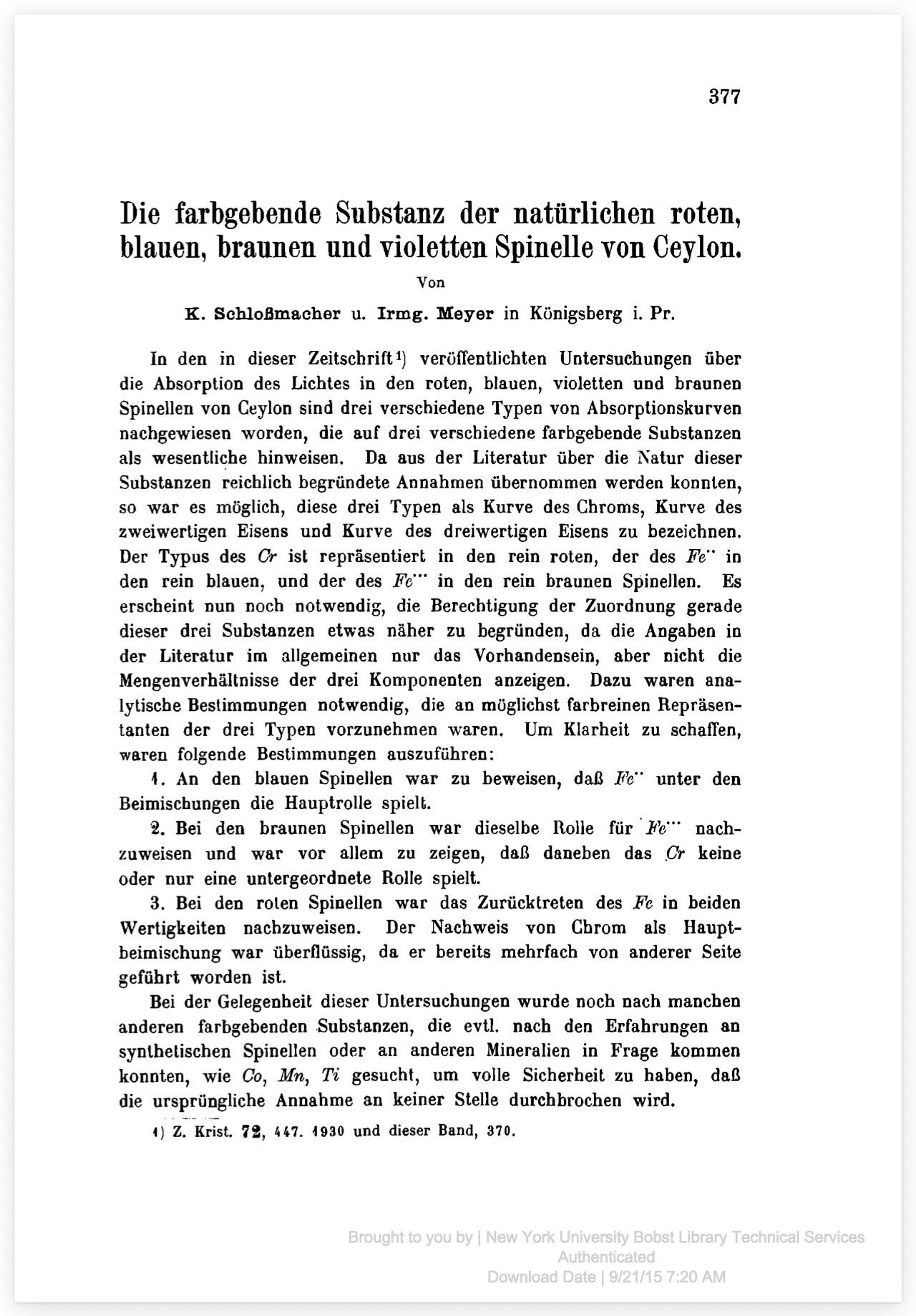
In the investigations published in this journal¹ on the absorption of light in red, blue, violet, and brown spinels from Ceylon, three different types of absorption curves were demonstrated, pointing to three different substances as the principal colouring agents. Since well-founded assumptions concerning the nature of these substances could be drawn from the literature, it was possible to designate these three types as the chromium curve, the divalent iron curve, and the trivalent iron curve. The Cr type is represented by the pure red spinels, the Fe²⁺ type by the pure blue spinels, and the Fe³⁺ type by the pure brown spinels. It now appears necessary to substantiate somewhat more fully the justification for assigning precisely these three substances, since the information in the literature generally indicates only their presence, but not the relative proportions of the three components. For this purpose analytical determinations were necessary, to be carried out on representatives of the three types having colours as pure as possible. To clarify the matter, the following determinations had to be made: 1. In the blue spinels it had to be demonstrated that Fe²⁺ plays the principal role among the impurities. 2. In the brown spinels the same role had to be demonstrated for Fe³⁺, and above all it had to be shown that Cr plays either no role or only a subordinate one alongside it. 3. In the red spinels it had to be demonstrated that Fe in both valence states is subordinate. Demonstration of chromium as the principal impurity was unnecessary, since this had already been established several times by other investigators.