
Four Treasures Reference Database
Record No. 29303
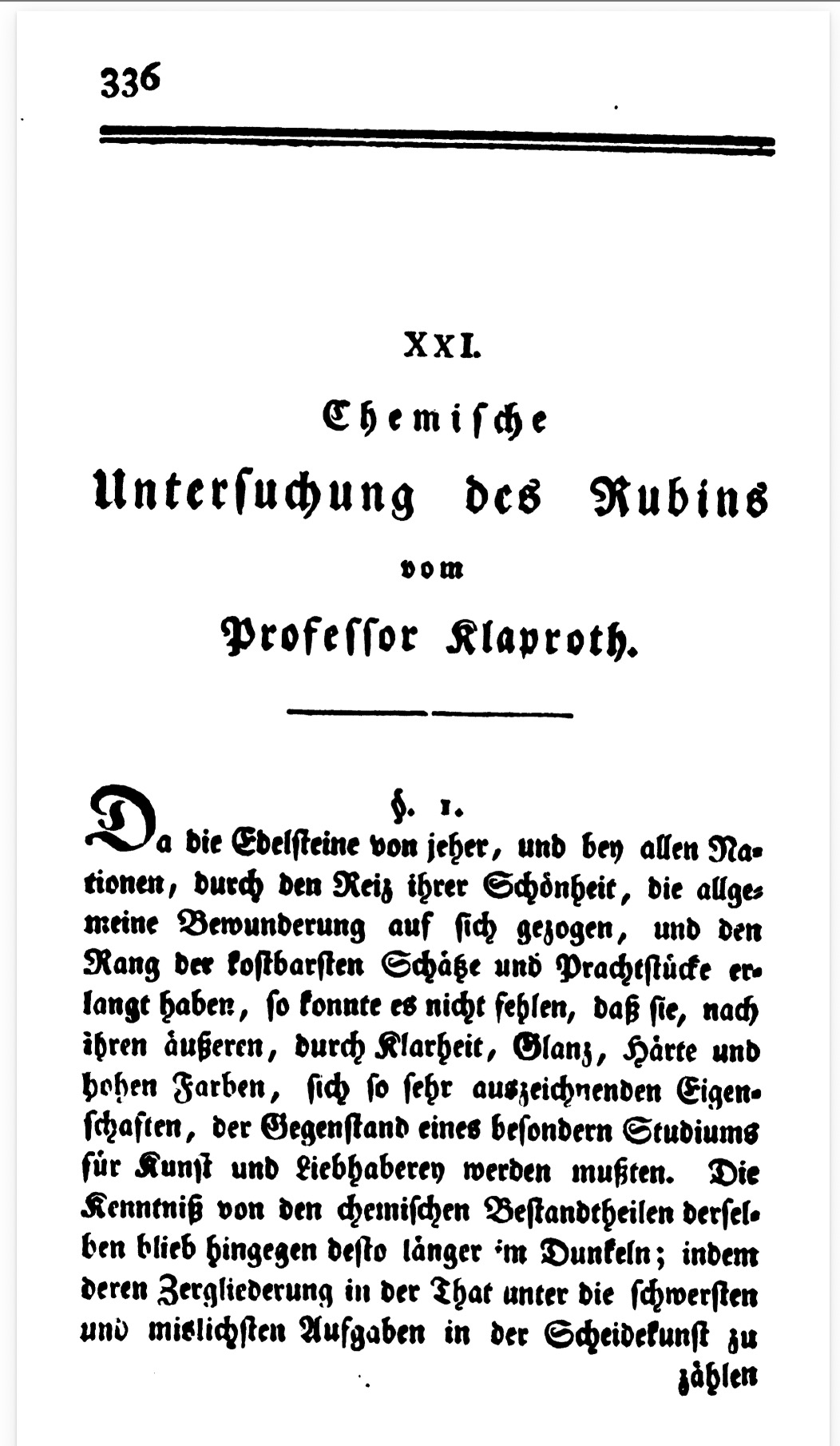
Chemische Untersuchung des Rubins
Chemical investigation of ruby
Journal Article
Klaproth, M.H. (1789) Chemische Untersuchung des Rubins. [Chemical investigation of ruby] Schriften der Gesellschaft Naturforschender Freunde zu Berlin, Vol. 9, pp. 336–350.
Sinkankas/Born No.: NIS/NIB | Language: in German | RWHL
Close Abstract
Hide Keywords
Copy Reference
gems, corundum, chemistry.2, ruby, spinel
Since precious stones have, from time immemorial and among all nations, attracted universal admiration through the charm of their beauty, and have attained the rank of the most costly treasures and objects of splendour, it was inevitable that their outward properties—so remarkably distinguished by clarity, lustre, hardness, and rich colours—should become the subject of special study both for science and for connoisseurship. Knowledge of their chemical constituents, however, remained obscure for much longer, since their analysis was in fact one of the most difficult and uncertain tasks in analytical chemistry, until Marggraf, the father of more rigorous analytical chemistry, opened the way; after him Bergmann, Scheele, and other celebrated men attempted to pursue it further. On the occasion of his analysis of topaz, he found that precious stones were not, as had previously been believed, simple natural products consisting solely of the most homogeneous and pure siliceous or quartz substance, but that their composition was more complex, and particularly that pure alumina constituted a considerable proportion of them. Bergmann confirmed this finding in his treatise on the earth of precious stones, published in 1777,* in which he gave an account particularly of the constituents found in ruby, sapphire, topaz, hyacinth, and emerald. Soon afterwards another celebrated chemist, Director Achard, published a treatise on the same subject,** whose account of the constituents of precious stones agreed entirely with Bergmann’s, differing only slightly in their proportions.