
Four Treasures Reference Database
Record No. 29376
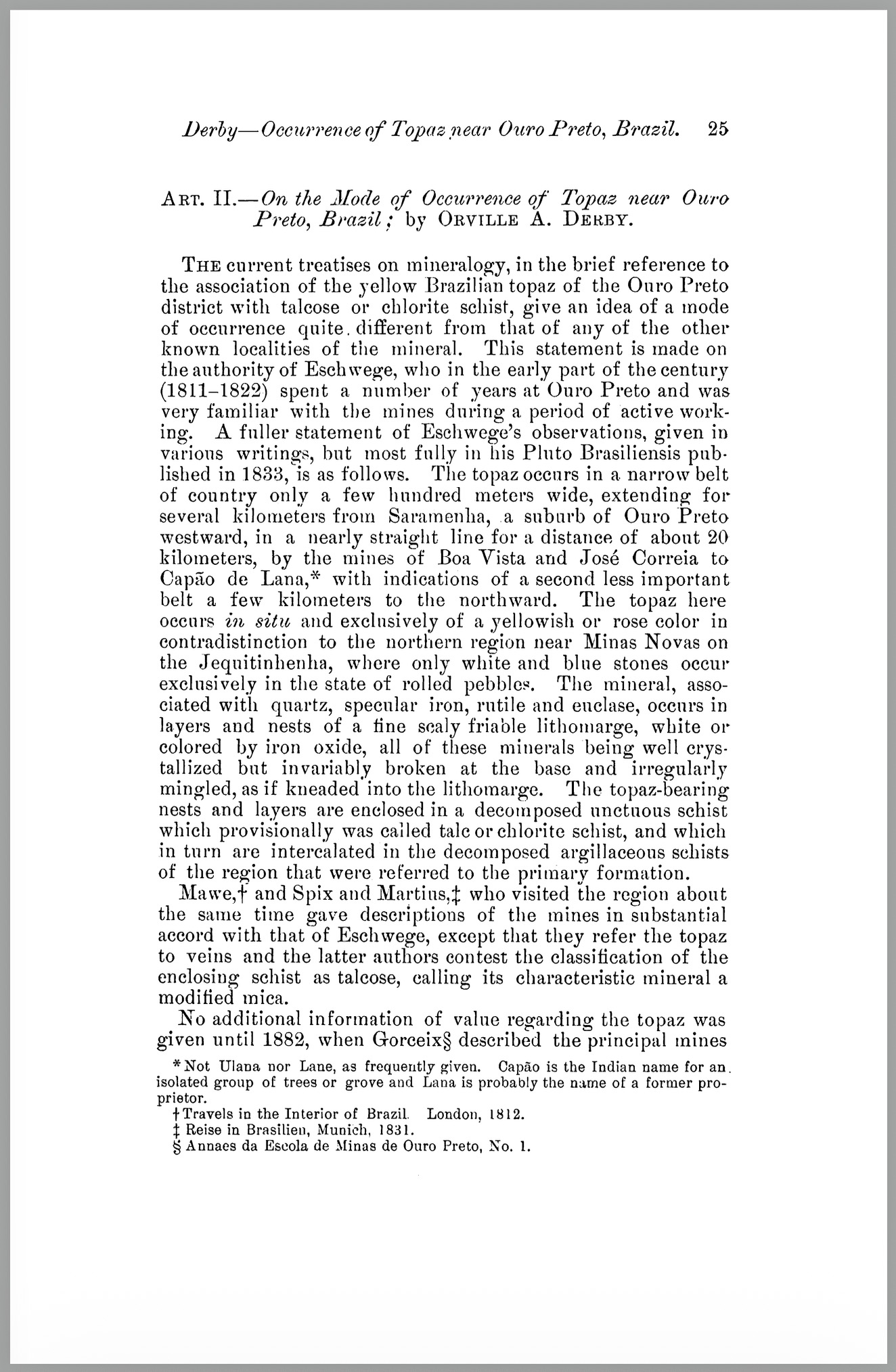
On the mode of occurrence of topaz near Ouro Preto, Brazil
Journal Article
Derby, O.A. (1901) On the mode of occurrence of topaz near Ouro Preto, Brazil. American Journal of Science, Vol. 161, No. 61, pp. 25–34.
Sinkankas/Born No.: 1655; NIB | RWHL
gems, Brazil, Ouro Preto, topaz, imperial topaz
The current treatises on mineralogy, in the brief reference to the association of the yellow Brazilian topaz of the Ouro Preto district with talcose or chlorite schist, give an idea of a mode of occurrence quite different from that of any of the other known localities of the mineral. This statement is made on the authority of Eschwege, who in the early part of the century (1811–1822) spent a number of years at Ouro Preto and was very familiar with the mines during a period of active working. A fuller statement of Eschwege’s observations, given in various writings, but most fully in his Pluto Brasiliensis, published in 1833, is as follows. The topaz occurs in a narrow belt of country only a few hundred meters wide, extending for several kilometers from Saramenha, a suburb of Ouro Preto, westward, in a nearly straight line for a distance of about 20 kilometers, by the mines of Boa Vista and José Correia to Capão de Lana,* with indications of a second less important [belt] a few kilometers to the northward. The topaz here occurs in situ and exclusively of a yellowish or rose color, in contradistinction to the northern region near Minas Novas on the Jequitinhonha, where only white and blue [topazes occur], exclusively in the state of rolled pebbles. The mineral, associated with quartz, specular iron, rutile and euclase, occurs in layers and [nests] of a fine scaly friable lithomarge, white or colored by iron oxide, all of these minerals being well crystallized but invariably broken at the base and irregularly mingled, as if kneaded into the lithomarge. The topaz-bearing nests and layers are enclosed in a decomposed unctuous schist which provisionally was called talc or chlorite schist, and which in turn is intercalated in the decomposed argillaceous schists of the region that were referred to the primary formation.