
Four Treasures Reference Database
Record No. 29510
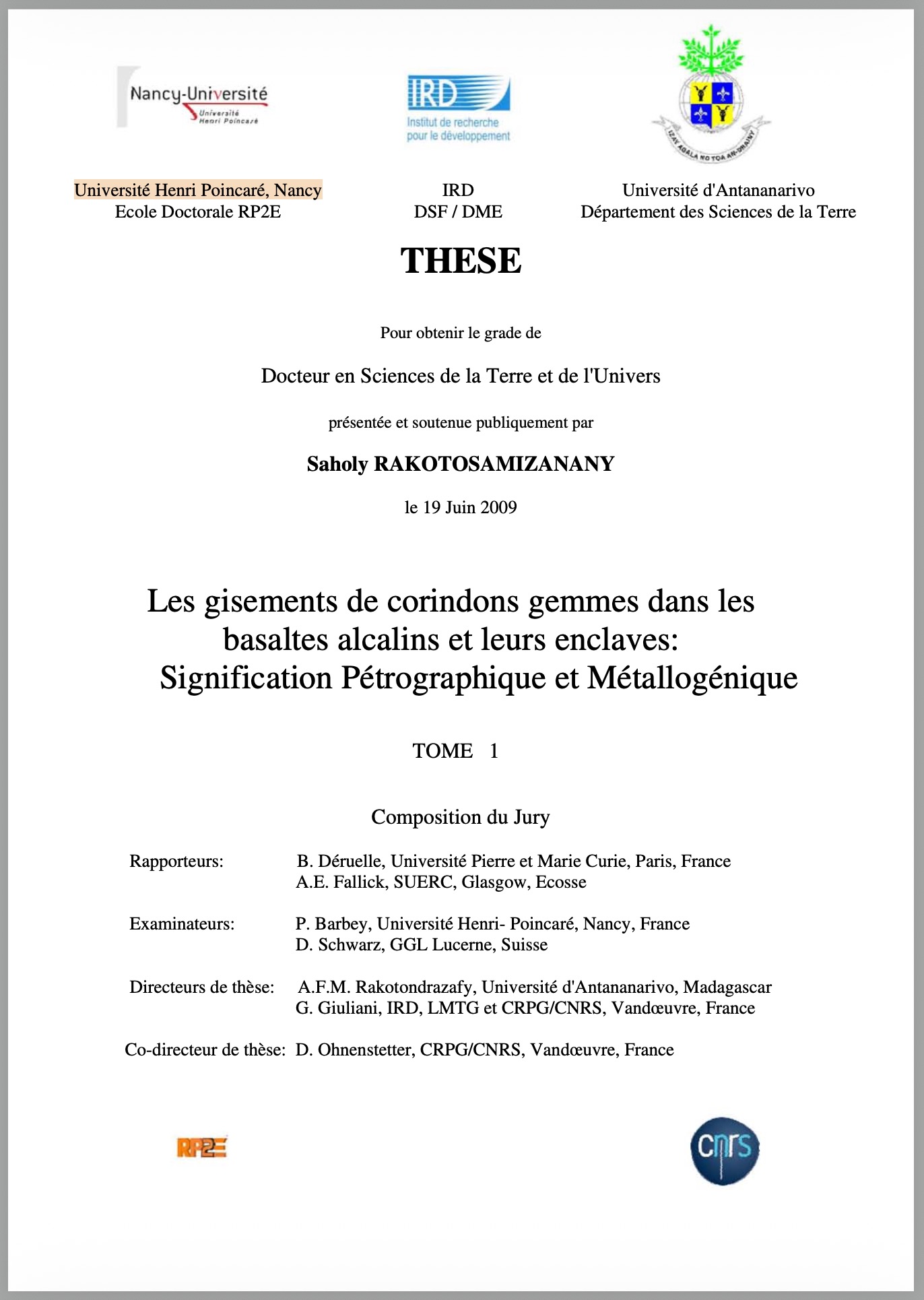
Les corindons gemmes dans les basaltes alcalins et à leurs enclaves à Madagascar: Signification pétrologique et métallogénique
Gem Corundums in Alkaline Basalts and Their Xenoliths in Madagascar: Petrological and Metallogenic Significance
Thesis
Rakotosamizanany, S. (2009) Les corindons gemmes dans les basaltes alcalins et à leurs enclaves à Madagascar: Signification pétrologique et métallogénique. [Gem Corundums in Alkaline Basalts and Their Xenoliths in Madagascar: Petrological and Metallogenic Significance]., Nancy: Université Henri Poincaré, 443 pp.
Sinkankas/Born No.: NIS/NIB | Language: in French with English abstract | RWHL
gems, corundum, Madagascar.12, basalt sapphire, Ambondromifehy
Madagascar is one of the principal producers of gem corundums recovered from continental basaltic fields. The main deposits are the secondary deposits of Ambondromifehy in the northern part of the country (sapphire-bearing palaeoplacer and placer), Soamiakatra–Mandrosohasina in the central part (primary ruby deposit, and ruby- and sapphire-bearing placer and palaeoplacer) and Vatomandry in the eastern part of the island (ruby- and sapphire-bearing palaeoplacer). Soamiakatra is the only known primary deposit where ruby is found in metagabbro and pyroxenite xenoliths, which were entrained and brought up to the upper crust by the Ankaratra volcanic event. Petrographic studies have demonstrated the existence of two different conditions of ruby formation at the boundary of the eclogite domain (HT ~ 1100°C, HP ~ 20 kbar) and granulite facies (HT ~ 1100°C, BP < 15 kbar). In contrast, the sapphires originated from alkaline mafic magmatic chambers at the lower continental crust–mantle boundary. They occur within or associated with syenite and anorthoclasite xenoliths in the basalts. These alkali basalts transported corundum to the surface; they are linked with asthenosphere upwelling and thinning of the lithosphere underneath the Ankaratra Plateau during the Oligocene–Quaternary, and to some E–W and N–S tectonic extension structures. Oxygen isotopic compositions of the rubies from placer deposits with δ¹⁸O = 3.1 ± 1.1‰ are typical of ruby in mafic and ultramafic rocks (1.25 < δ¹⁸O < 6.8‰). The sapphires from placer and palaeoplacer deposits have δ¹⁸O values of 4.5 ± 0.5‰, which coincides with the range in sapphire-bearing syenitic rocks (4.4 < δ¹⁸O < 8.3‰). Solid inclusions such as pyrochlore, samarskite, uraninite and anorthoclasite in the sapphires confirm their syenitic origin. Zircons associated with the sapphires gave U–Pb ages younger than 35 Ma, coeval with the volcanic event. The zircon inclusions in rubies of metamorphic origin associated with the mafic and ultramafic xenolith rocks gave a Pan-African U–Pb age around 750 Ma. Nevertheless, dating of zircon crystals in situ within the anorthoclasite xenoliths has revealed two different ages, 35 and 17 Ma, which are slightly older than or contemporaneous with the onset of the volcanic events. The characteristics of the corundum, their isotopic compositions as well as their ages demonstrate the existence of two distinct sources of corundum associated with basalts in Madagascar. On one hand, the rubies associated with metagabbros and garnet-bearing pyroxenites are linked to mafic and ultramafic complexes of eclogite facies in the lower crust, retrograded to granulite facies during the Pan-African event. On the other hand, the sapphires brought up to the upper crust during the Oligo-Plio-Quaternary are interpreted to be coeval with a volcanic event involving differentiated alkaline magma as revealed by their oxygen isotopic composition with syenitic signatures.