
Four Treasures Reference Database
Record No. 29547
Baroque-era rose cuts of colored stones: Highlights from the second half of the seventeenth century
Journal Article
Schmetzer, K. (2020) Baroque-era rose cuts of colored stones: Highlights from the second half of the seventeenth century. Gems & Gemology, Vol. 56, No. 4, Winter, pp. 458–482.
Sinkankas/Born No.: NIS/NIB | RWHL
gems, lapidary arts, faceting, rose cuts, history of gem cutting
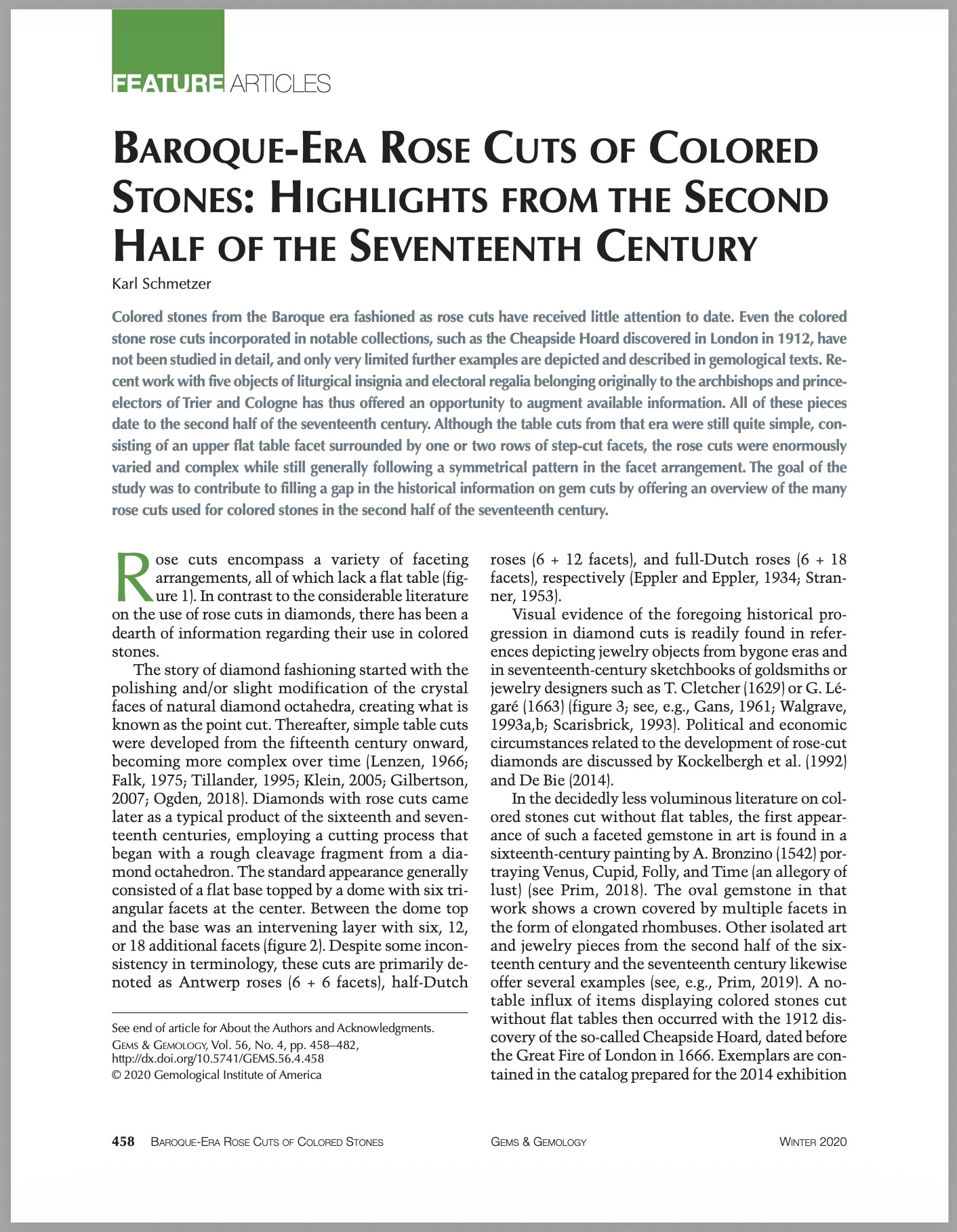
Colored stones from the Baroque era fashioned as rose cuts have received little attention to date. Even the colored stone rose cuts incorporated in notable collections, such as the Cheapside Hoard discovered in London in 1912, have not been studied in detail, and only very limited further examples are depicted and described in gemological texts. Recent work with five objects of liturgical insignia and electoral regalia belonging originally to the archbishops and prince-electors of Trier and Cologne has thus offered an opportunity to augment available information. All of these pieces date to the second half of the seventeenth century. Although the table cuts from that era were still quite simple, consisting of an upper flat table facet surrounded by one or two rows of step-cut facets, the rose cuts were enormously varied and complex while still generally following a symmetrical pattern in the facet arrangement. The goal of the study was to contribute to filling a gap in the historical information on gem cuts by offering an overview of the many rose cuts used for colored stones in the second half of the seventeenth century.