
Four Treasures Reference Database
Record No. 29709
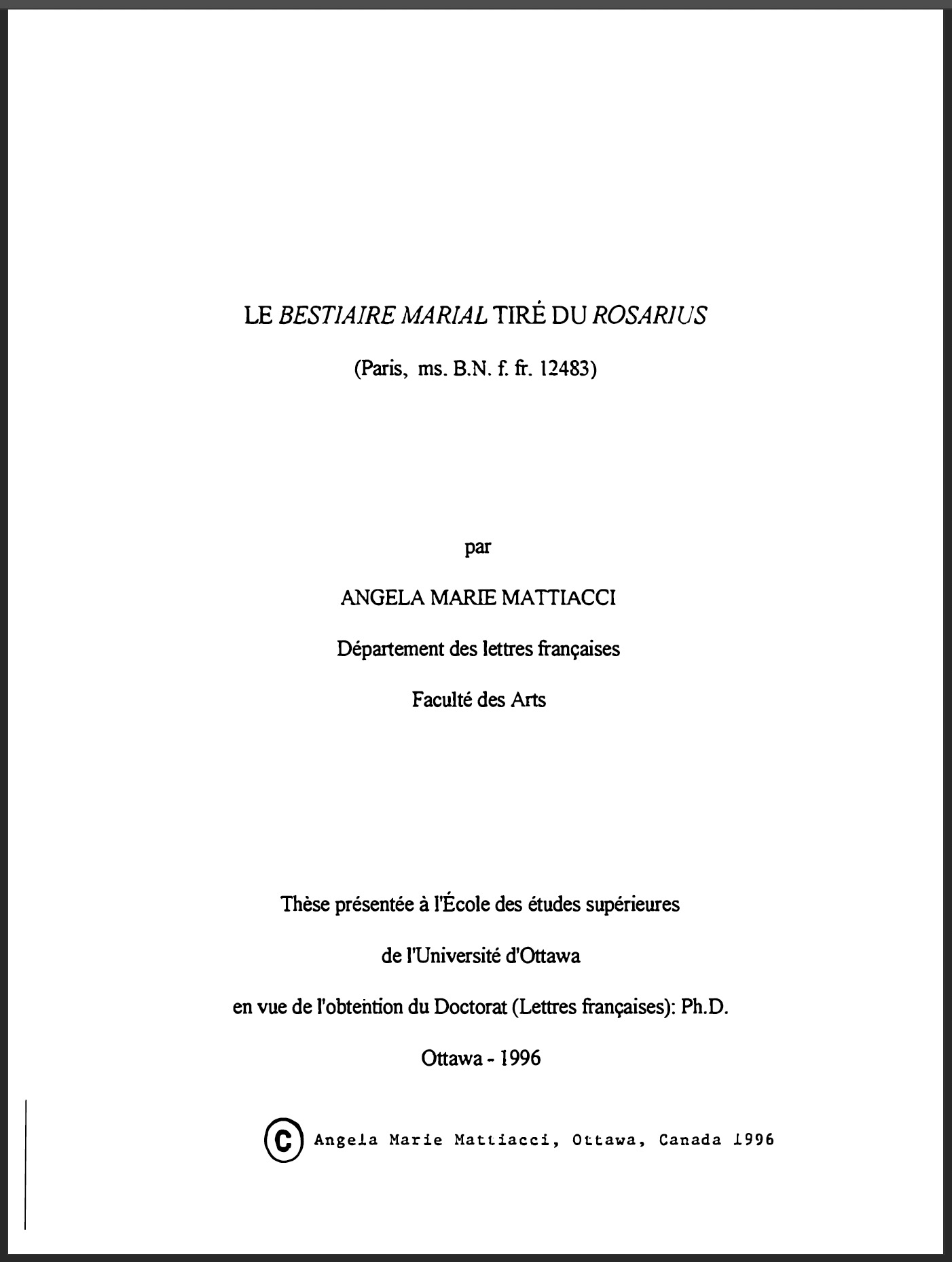
Le Bestiare Marial Tiré du Rosarius
The Marian Bestiary Drawn from the Rosarius
Thesis
Mattiacci, A.M. (1996) Le Bestiare Marial Tiré du Rosarius. [The Marian Bestiary Drawn from the Rosarius]., Ottawa: University of Ottawa, 387 pp.
Sinkankas/Born No.: NIS / NIB | Language: in French | RWHL
gems, ancient lapidaries, alchemy, history, history of gemology
This French doctoral dissertation presents the first critical edition of the Marian bestiary embedded in the Rosarius, an anonymous medieval devotional compilation preserved in the unique manuscript Paris, Bibliothèque nationale, fonds français 12483. Mattiacci situates its fourteen surviving animal sections within a larger collection of natural descriptions, Marian allegories, miracles, pious tales and songs, which also includes a plant book and a four-stone lapidary. The introduction examines the manuscript’s provenance, damaged condition, arrangement and previous scholarship, and argues for composition between 1328 and 1337 against proposals for a later fourteenth-century date. The anonymous compiler is identified as a Dominican associated with the Soissons region. Contrary to the view that his audience consisted exclusively of nuns, Mattiacci interprets his direct addresses to both men and women as evidence for a mixed religious community. Comparative study places the work in the tradition of the Greek and Latin Physiologus and the French bestiaries, examining parallels with Pliny, Isidore of Seville, the compilation attributed to Hugh of Saint Victor, and vernacular predecessors including Richard de Fournival. Its distinctive feature is the systematic application of animal properties to the Virgin Mary rather than principally to Christ. Brief accounts of animal nature introduce substantially longer moral and devotional interpretations, sometimes interrupted by songs, a sermon or a pious tale. The edited sections concern the panther, swallow, stork, sheep, whale, caladrius, salamander, bee, swan, nightingale, dove, tortoise, camel and falcon. Their allegories celebrate Mary’s purity, humility, obedience, protective power and intercession, while supporting exhortations and criticism of contemporary conduct among clergy and laity. Of particular interest to the history of stones is the swallow’s traditional association with two precious stones, one whitish and the other reddish, said to occur within its body. A linguistic study considers phonetics, morphology, syntax, wordplay and versification, noting Picard features and irregular syllable counts. Editorial procedures include expanding abbreviations, evaluating later manuscript corrections and restoring recoverable letters lost through trimming, with interventions documented in the apparatus. Critical notes, explanatory commentary, an index of proper names, an extensive glossary and a bibliography accompany the text, making the dissertation a resource for studying medieval animal lore, Marian devotion and the transmission of vernacular religious literature.