
Four Treasures Reference Database
Record No. 29715
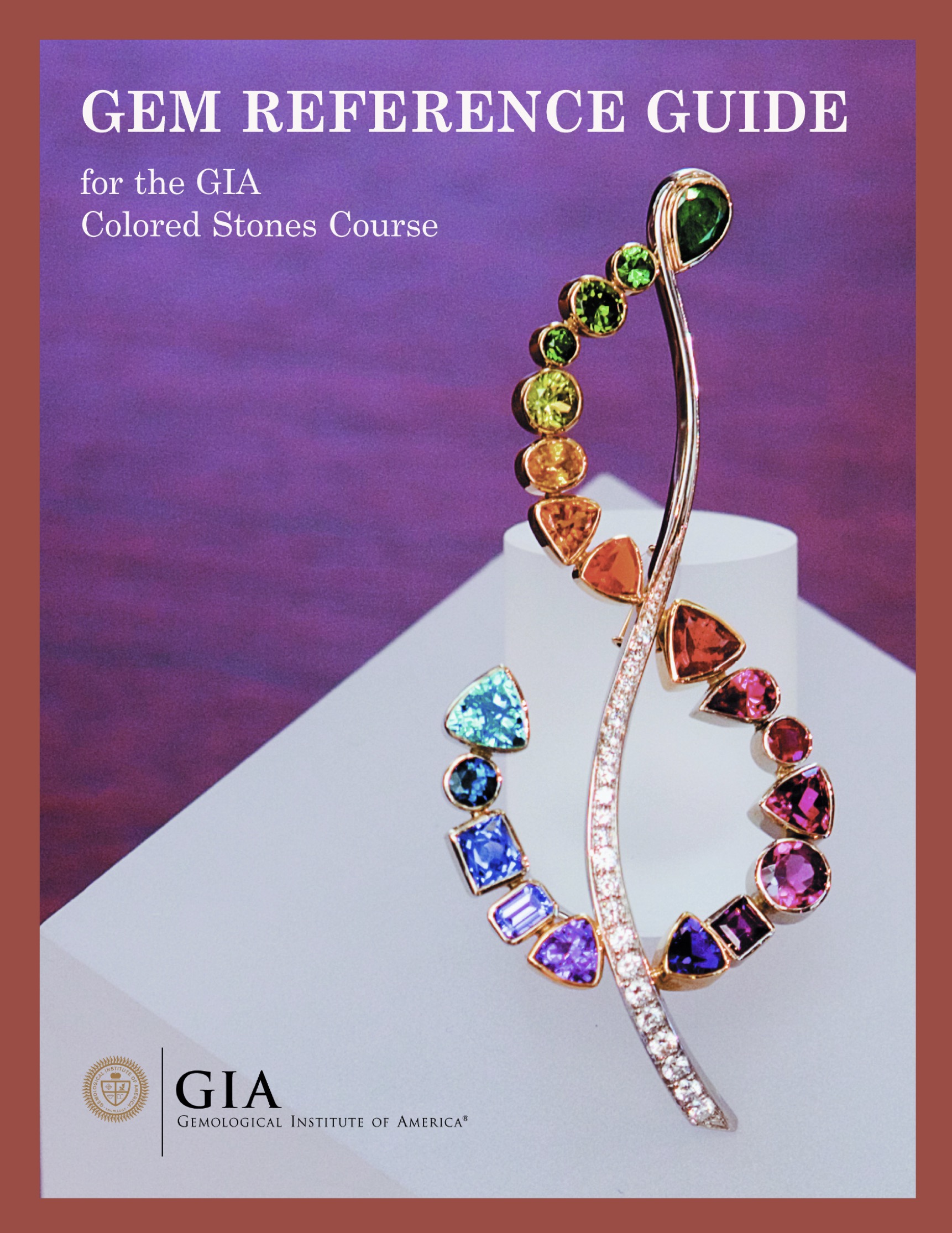
Gem Reference Guide for the GIA Colored Stones Course
Book
Gemological Institute of America (1995) Gem Reference Guide for the GIA Colored Stones Course. Santa Monica, Gemological Institute of America, 270 pp.
ISBN/ISSN: 0-87311-019-6 | Sinkankas/Born No.: NIS/NIB | RWHL
gems, gemology, gem identification, gem property tables, reference
The Gemological Institute of America’s Gem Reference Guide for the GIA Colored Stones Course, first published in 1995 and issued electronically in 2009, is an extensive illustrated reference designed to support the identification, grading, evaluation, and care of colored gemstones and related ornamental materials. Organized alphabetically by gem species, varieties, and commercial categories, the guide provides standardized information on natural gemstones, organic gem materials, synthetic stones, simulants, and assembled products. Each entry follows a consistent format covering chemical composition, crystal system, appearance, color range, transparency, optical properties, refractive index, birefringence, dispersion, pleochroism, ultraviolet fluorescence, absorption spectra, specific gravity, hardness, fracture, cleavage, characteristic inclusions, and crystal habit. Additional sections describe gemstone enhancements, diagnostic separations, durability, cleaning recommendations, commercial availability, geographic sources, and disclosure requirements. The introductory chapters explain GIA’s system for describing gemstone color through hue, tone, and saturation, supplemented by ColorMaster notations, and distinguish the different approaches required for grading transparent and translucent materials. Particularly useful are the numerous illustrated absorption spectra, crystal diagrams, gemstone photographs, and comparative identification tables that assist in separating visually similar materials. Corundum receives extensive treatment, with separate entries for ruby, blue sapphire, fancy sapphire, star ruby, star sapphire, and synthetic corundum. The guide documents diagnostic optical properties, typical inclusions, color mechanisms involving chromium, iron, and titanium, and the effects of heating, diffusion, irradiation, fracture filling, and other treatments. Ruby and sapphire deposits in Myanmar, Sri Lanka, Thailand, Cambodia, Australia, Kenya, Tanzania, and other countries are identified as important commercial sources. Emerald and other beryl varieties receive similarly detailed treatment, including characteristic inclusions, optical properties, geographic origins, oil impregnation, and the identification of synthetic emeralds produced by flux and hydrothermal methods. The garnet group is subdivided into almandine, andradite, grossular, hydrogrossular, malaia, pyrope, rhodolite, and spessartine, with particular attention to color variations, diagnostic spectra, and the separation of related species. Other substantial entries cover chrysoberyl, alexandrite, cat’s-eye chrysoberyl, spinel, tourmaline, topaz, zircon, quartz, opal, pearl, turquoise, and ornamental stones. The sections entitled “Jadeite Jade” and “Nephrite Jade” reflect the terminology employed by GIA in 1995. The former describes jadeite-bearing gem material, including commercially recognized color and quality varieties, while the latter concerns the felted tremolite–actinolite material known as nephrite. From a modern mineralogical standpoint, the jadeite-bearing gem rock is more appropriately termed fei cui, which may contain jadeite, omphacite, and kosmochlor in varying proportions. The guide also examines related ornamental materials such as maw-sit-sit, serpentine, hydrogrossular garnet, and saussurite, emphasizing their separation through refractive index, specific gravity, absorption spectra, and microscopic examination. Treatments discussed throughout the volume include heating, irradiation, dyeing, bleaching, impregnation, coating, diffusion, and fracture filling, with attention to treatment detection, stability, and consumer disclosure. Synthetic gemstones and diamond simulants are treated separately, including synthetic corundum, spinel, quartz, opal, emerald, cubic zirconia, synthetic rutile, YAG, and GGG. Organic materials such as amber, coral, ivory, shell, and natural and cultured pearls are also included. Although some nomenclature, locality information, treatment technology, and gemological interpretations have subsequently changed, the volume remains a useful historical reference for the identification practices, commercial terminology, and instructional standards employed by GIA during the mid-1990s.