
Four Treasures Reference Database
Record No. 29952
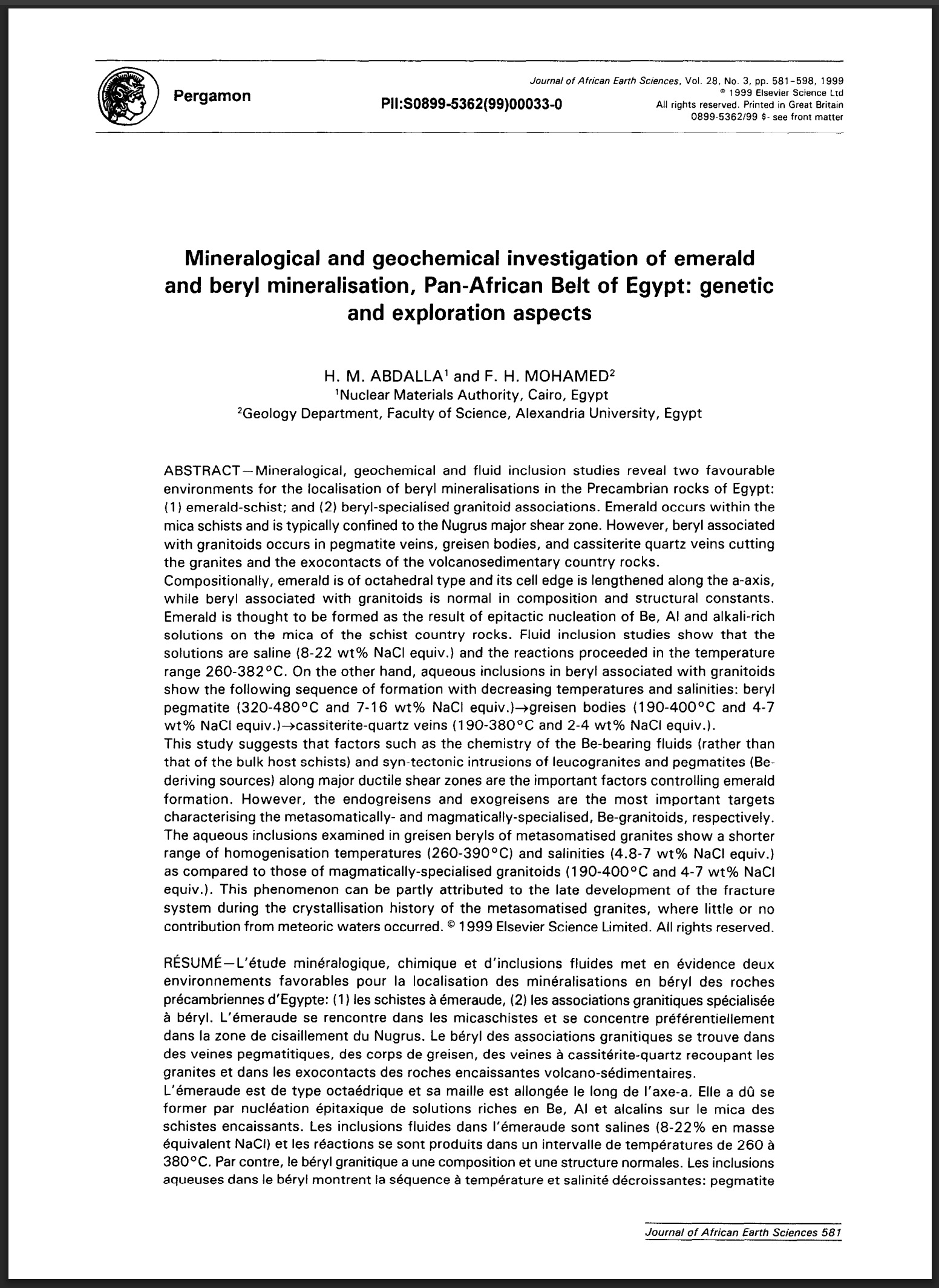
Mineralogical and geochemical investigation of emerald and beryl mineralisation, Pan-African belt of Egypt: genetic and exploration aspects
Journal Article
Abdalla, H.M. and Mohamed, F.H. (1999) Mineralogical and geochemical investigation of emerald and beryl mineralisation, Pan-African belt of Egypt: genetic and exploration aspects. Journal of African Earth Sciences, Vol. 28, No. 3, pp. 581–598.
ISBN/ISSN: 1464-343X | DOI: https://doi.org/10.1016/S0899-5362(99)00033-0 | Sinkankas/Born No.: NIS/NIB | RWHL
gems, beryl, emerald, Egypt, geology, chemistry
Mineralogical, geochemical and fluid inclusion studies reveal two favorable environments for the localisation of beryl mineralisations in the Precambrian rocks of Egypt: (1) emerald–schist; and (2) beryl-specialised granitoid associations. Emerald occurs within the mica schists and is typically confined to the Nugrus major shear zone. However, beryl associated with granitoids occurs in pegmatite veins, greisen bodies, and cassiterite–quartz veins cutting the granites and the exocontacts of the volcanosedimentary country rocks. Compositionally, emerald is of octahedral type and its cell edge is lengthened along the a-axis, while beryl associated with granitoids is normal in composition and structural constants. Emerald is thought to be formed as the result of epitactic nucleation of Be, Al and alkali-rich solutions on the mica of the schist country rocks. Fluid inclusion studies show that the solutions are saline (8–22 wt% NaCl equiv.) and the reactions proceeded in the temperature range 260–382 °C. On the other hand, aqueous inclusions in beryl associated with granitoids show the following sequence of formation with decreasing temperatures and salinities: beryl pegmatite (320–480 °C and 7–16 wt% NaCl equiv.) → greisen bodies (190–400 °C and 4–7 wt% NaCl equiv.) → cassiterite–quartz veins (190–380 °C and 2–4 wt% NaCl equiv.). This study suggests that factors such as the chemistry of the Be-bearing fluids (rather than that of the bulk host schists) and syn-tectonic intrusions of leucogranites and pegmatites (Be-deriving sources) along major ductile shear zones are the important factors controlling emerald formation. However, the endogreisens and exogreisens are the most important targets characterising the metasomatically- and magmatically-specialised, Be-granitoids, respectively. The aqueous inclusions examined in greisen beryls of metasomatised granites show a shorter range of homogenisation temperatures (260–390 °C) and salinities (4.8–7 wt% NaCl equiv.) as compared to those of magmatically-specialised granitoids (190–400 °C and 4–7 wt% NaCl equiv.). This phenomenon can be partly attributed to the late development of the fracture system during the crystallisation history of the metasomatised granites, where little or no contribution from meteoric waters occurred.