
Four Treasures Reference Database
Record No. 29953
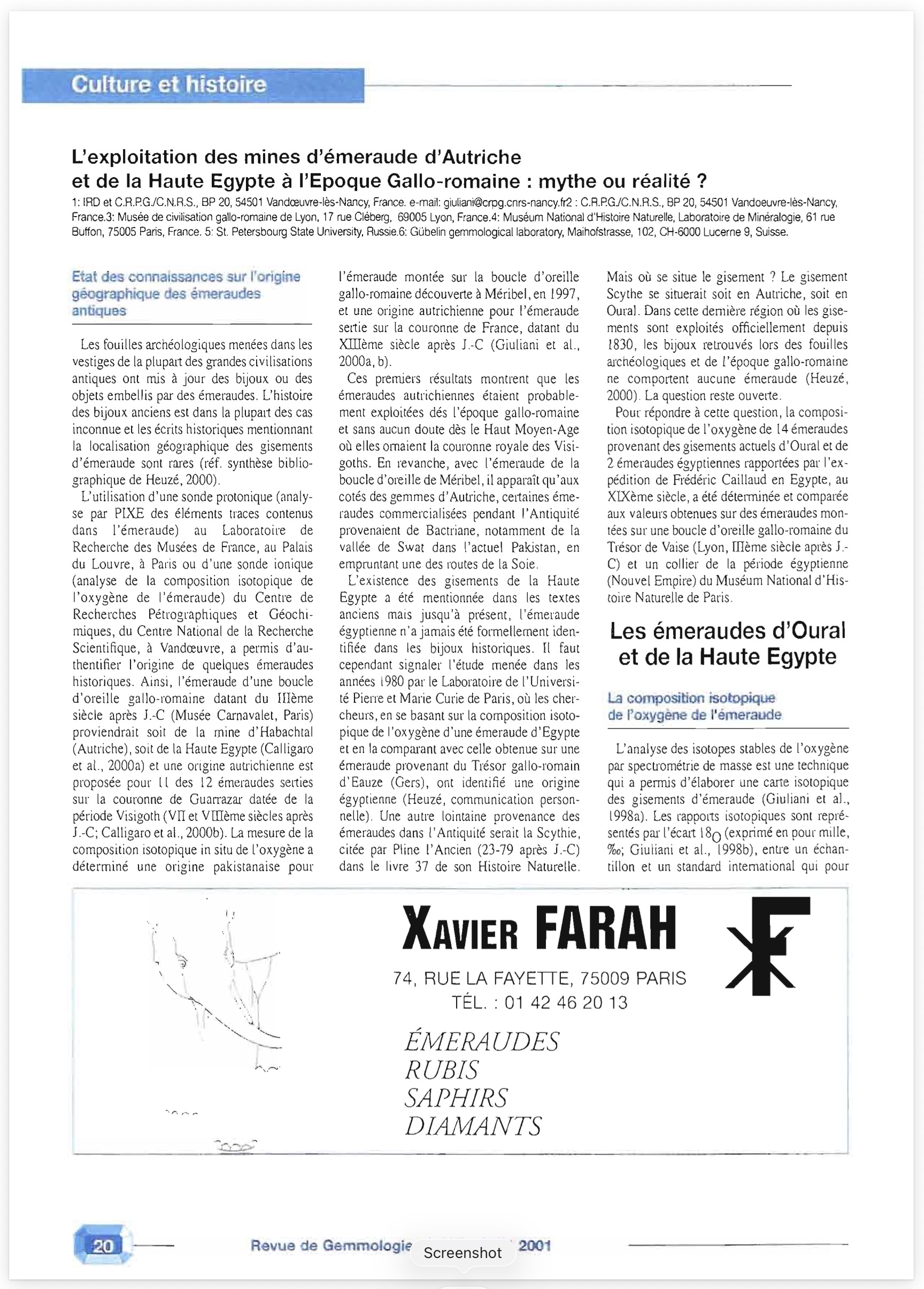
L’Exploitation des Mines d’Emeraude d’Autriche et de la Haute Egypte à l’Epoque Gallo-Romaine; Mythe ou Réalité?
The exploitation of the emerald mines of Austria and Upper Egypt in the Gallo-Roman period: Myth or reality?
Journal Article
Giuliani, G. (2001) L’Exploitation des Mines d’Emeraude d’Autriche et de la Haute Egypte à l’Epoque Gallo-Romaine; Mythe ou Réalité? [The exploitation of the emerald mines of Austria and Upper Egypt in the Gallo-Roman period: Myth or reality?] Revue de Gemmologie A.F.G., No. 143, pp. 20–24.
Sinkankas/Born No.: NIS/NIB | Language: in French | RWHL*
Close Abstract
Hide Keywords
Copy Reference
gems, beryl, emerald, Egypt, Sikait, Austria, Habachtal, archaeology, geology, ancient gem trade, chemistry, oxygen isotopes
Examines the ancient exploitation and trade of emeralds from Austria and Upper Egypt through oxygen-isotope analysis and inclusion studies of archaeological and historical specimens. Giuliani and co-authors compare emeralds from the Habachtal deposit in Austria, the Ural Mountains, and Egyptian deposits at Zabara, Sikait and Umm Kabo with emeralds from Gallo-Roman and Egyptian jewellery. Oxygen-isotope ratios, supplemented where necessary by the petrography of fluid inclusions, provide distinctive signatures capable of separating the principal ancient sources. An emerald from a third-century AD earring in the Vaise Treasure at Lyon yields an isotopic composition characteristic of Habachtal, demonstrating that Austrian emeralds were being exploited by the Gallo-Roman period. Four emeralds from an Egyptian necklace in the Muséum National d’Histoire Naturelle have isotope values consistent with Upper Egyptian material, while nineteenth-century specimens collected from the Egyptian mines confirm the restricted isotopic range of those deposits. The study also reviews earlier analyses indicating Austrian origins for emeralds in the Visigothic Guarrazar crown and the medieval French crown, an Egyptian origin for other Roman-period stones, and a Pakistani source for an emerald from a Gallo-Roman earring at Méribel. The results support the historical reality of active emerald mining in both Upper Egypt and Austria during Roman times and demonstrate that emeralds from more distant Asian sources also reached the Roman world through long-distance trade routes.