
Four Treasures Reference Database
Record No. 3525
Use of the terms greenstone, nephrite, bowenite, and jade
Journal Article
Reed, J.J. (1957) Use of the terms greenstone, nephrite, bowenite, and jade. The Journal of the Polynesian Society, Vol. 66, No. 2, pp. 204–205.
ISBN/ISSN: 324000 | Sinkankas/Born No.: NIS/NIB | RWHL
jade, jadeite, fei cui, nephrite, nomenclature, gems
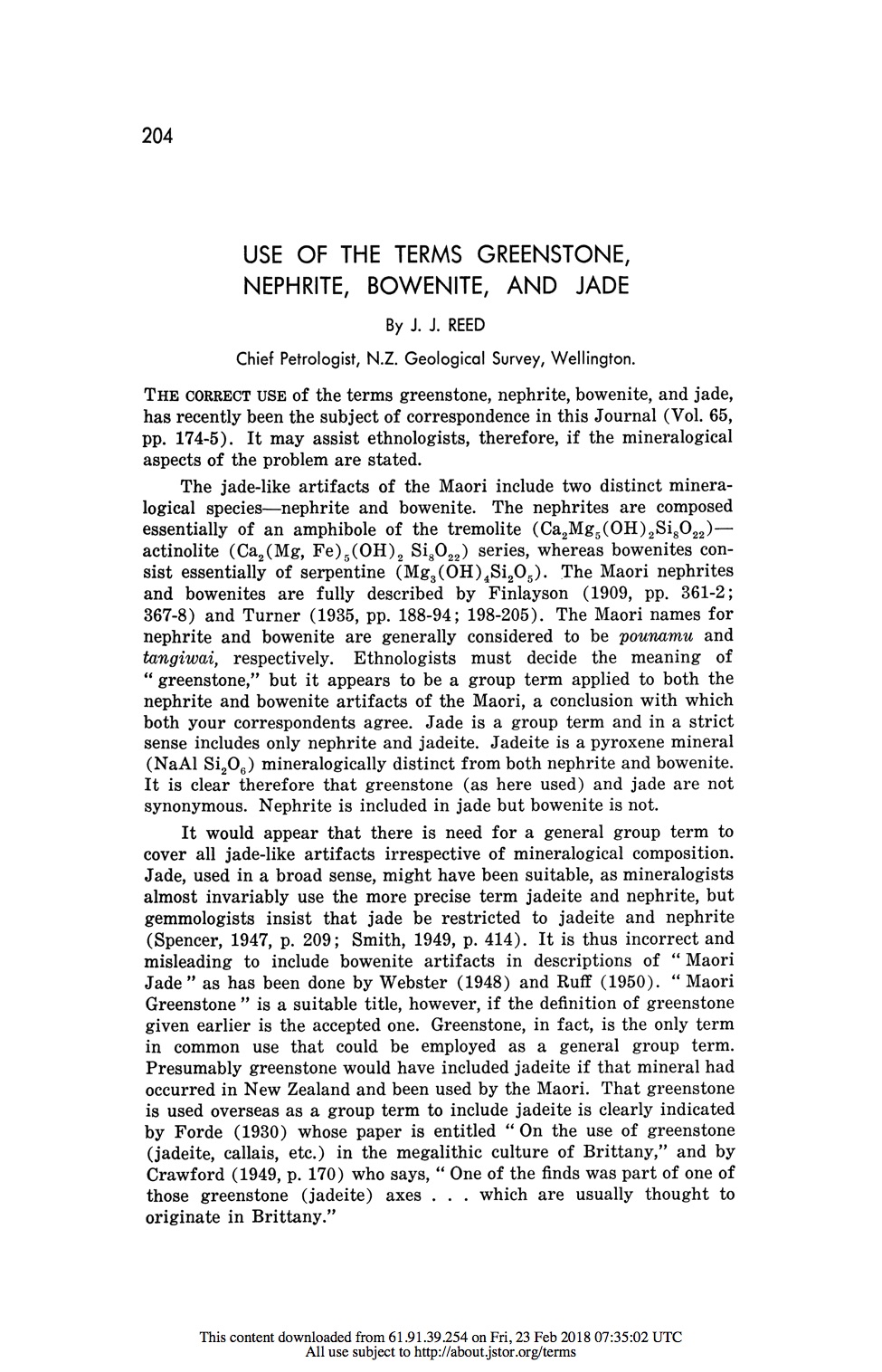
J.J. Reed clarifies the mineralogical distinctions underlying the terms greenstone, nephrite, bowenite, and jade, responding to uncertainty in their application to Māori artefacts. He explains that the materials commonly grouped together as Māori greenstone include two compositionally distinct substances. Nephrite consists essentially of amphibole belonging to the tremolite–actinolite series, whereas bowenite consists essentially of serpentine. Jadeite, a sodium aluminium pyroxene, is mineralogically distinct from both. These differences make the customary group terms unsuitable as substitutes for precise material identification. In strict gemmological usage, jade encompasses nephrite and jadeite alone; bowenite therefore falls outside its definition. Greenstone, as applied to Māori objects, covers both nephrite and bowenite, so the two collective terms overlap without being synonymous. Reed notes that pounamu and tangiwai are generally considered the Māori names for nephrite and bowenite, respectively, while leaving the interpretation and acceptance of broader ethnological terminology to ethnologists. He recognizes a practical need for a collective expression covering jadelike artefacts regardless of their mineralogical composition. Although a broader definition of jade might have served this purpose, its established restriction to nephrite and jadeite makes descriptions that include bowenite under “Māori jade” misleading. “Māori greenstone” offers a suitable alternative if greenstone is accepted in the inclusive sense proposed. Examples from European archaeological writing demonstrate that greenstone has also been used outside New Zealand for jadeite and other materials, supporting its potential as a general descriptive category rather than a designation confined to particular minerals. Reed suggests that the term would presumably have encompassed jadeite in New Zealand had that mineral occurred there and been used by Māori. His recommendation combines broad classification with explicit identification: scientific descriptions should employ nephrite, jadeite, or bowenite whenever the material is known, while an inclusive archaeological designation can retain the specific identification in parentheses, as in “greenstone (nephrite).” The note thus proposes a terminological framework that accommodates established ethnological usage while preserving the mineralogical distinctions necessary for accurate descriptions and comparisons of artefacts.