
Four Treasures Reference Database
Record No. 3741
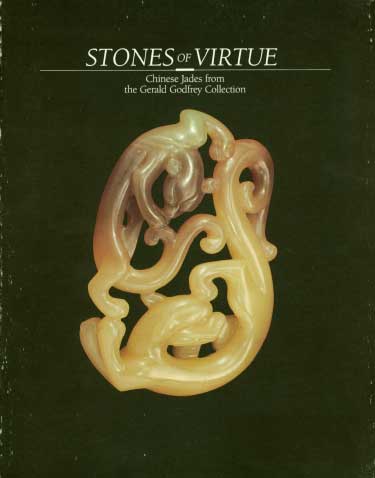
Stones of Virtue: Chinese Jades from the Gerald Godfrey Collection
Book
Kelley, C.W. (1989) Stones of Virtue: Chinese Jades from the Gerald Godfrey Collection. Dayton, OH, The Dayton Art Institute, 52 pp.
Sinkankas/Born No.: NIS / NIB | RWHL
gems, jade, nephrite, China, archaic jade, jadeite, fei cui, Burma
Clarence W. Kelley’s Stones of Virtue: Chinese Jades from the Gerald Godfrey Collection (1989) is an illustrated exhibition catalogue published by the Dayton Art Institute, Ohio, to accompany an exhibition held from January 21 to March 26, 1989. The volume presents selections from Gerald Godfrey’s important private collection of Chinese jade carvings, spanning the Neolithic period through the Qing dynasty. Illustrated with 30 colour plates, the catalogue documents the remarkable diversity of Chinese jade working across several millennia, encompassing ritual objects, ceremonial implements, personal ornaments, animal sculptures, and decorative carvings. The objects represented include bi discs, cong, ceremonial blades, pendants, belt buckles, plaques, rings, toggles, and figures of real and mythical animals. Neolithic and Bronze Age material is represented by objects associated with early Chinese ritual traditions, including a notched ceremonial disc (xuanji) with three deeply cut indentations and incised decoration, subsequently published in other studies of archaic Chinese jade. The collection also encompasses material attributed to the Shang, Zhou, Han, Tang, Song, Ming, and Qing dynasties, illustrating changes in carving techniques, ornamentation, and artistic preferences. Among the later pieces is a Ming dynasty carving of two recumbent geese in pale celadon jade with blackish-brown markings, published as catalogue number 169. Other documented examples include animal carvings and archaistic vessels, demonstrating the continuing importance of earlier Chinese forms as models for later craftsmen. The catalogue is particularly relevant to gemological studies because of its photographic documentation of carved jade objects, including differences in colour, translucency, surface appearance, and the use of natural markings within the stone. The collection provides examples of how Chinese lapidaries adapted the properties of their materials to produce objects ranging from relatively simple prehistoric ceremonial forms to highly elaborate imperial-period carvings. The title reflects the longstanding Chinese association of jade with moral qualities and cultivated virtue, although the historical meaning of Chinese yu encompasses a broader range of valued ornamental stones than the modern mineralogical definition of jade. The publication’s principal value lies in its visual record of an important private collection and its contribution to the chronology and typology of Chinese jade carving. Individual objects have subsequently appeared in international auction catalogues, where Kelley’s publication continues to be cited as a reference for their identification, exhibition history, and provenance.