
Four Treasures Reference Database
Record No. 3853
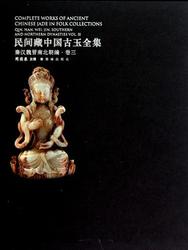
Complete Works of Ancient Chinese Yu in Folk Collections
民间藏中国古玉
Edited Book
Zhou, N., editor (2010) Complete Works of Ancient Chinese Yu in Folk Collections. [民间藏中国古玉]. Beijing, Forbidden City Press, Vol. 3: Qin, Han, Wei, Jin, Southern and Northern Dynasties [秦汉魏晋南北朝编(卷3)] , 347 pp..
ISBN/ISSN: 9787510000000 | Sinkankas/Born No.: NIS/NIB | Language: in Chinese | RWHL*
Close Abstract
Hide Keywords
Copy Reference
gems, jade, nephrite, Chinese jade carving, archaic jade
The Collection of Collected Chinese Ancient Jade Works covers the history of the entire jade culture. The collections cover various periods such as the Neolithic Age, Xia and Shang dynasties, Western Zhou Dynasty, Spring and Autumn Period, the Warring States period, the Qin and Han and Wei and the Southern and Northern Dynasties, the Sui and Tang dynasties and the Five Dynasties, the Song and Liao Jinyuan, and the Ming and Qing dynasties. Based on the number of collections, the number of rolls will be determined in a specific period of time to form an open structure. Each volume will include about 300 jade collections. In addition to the name, size, and other factors, the important collections will be accompanied by expert comments. In addition, each volume has its own monograph, and it thoroughly analyzes the features of the times and the key points for identification. It aims to systematically and comprehensively reflect the folk collection of ancient jade in China, guide and improve the ancient jade collection market in China, enrich and promote the development of *** and promote the traditional culture of the Chinese nation. This book contains nearly 300 artifacts of different types during the period of Qin and Han Weijin Southern and Northern Dynasties. Like tools, weapons, rituals, accessories, burial jade, utility utensils, musical instruments, characters and animals. The times, devices, and ornamentation of the artifacts are arranged in order, which shows people more intuitively the development and changes of different types of artifacts at different times. The artifacts included in this book all passed through the expert team composed of Jade experts Zhou Nanquan, Sun Xuehai, Wang Zongguo, Lei Congyun, and Hua Yiwu. They are very authoritative. The book has a unique perspective and content, and the selected objects have high historical value, cultural value, artistic value and research value. 2. Jade. Nine Thallium Complete Jade Nine Twelve A total of nine pieces, that is, a pair of jade eyes, a pair of jade nose plugs, a pair of jade ear plugs (also known as filling), a jade mouth, a jade plug, Jade feminine or male genitalia mask. When these artifacts are used, they are covered or stuffed in the dead nine to prevent the decay of the corpse. The ancient book Jade into the Nine Dragons to prevent immortality" refers to this device and its use. It is worth pointing out that the above-mentioned Nine Dragons were complete in the imperial tomb, but were often incomplete in some lower-level tombs. From the unearthed relics, there are many ears or stuffy noses, pimple inclusions, and less eye lids*. The appearance of such a situation seems to be related to the completeness or non-existence of different devices. The jade cymbals were popular in the Han and Wei Dynasties*. There were usually tombs in the nobility, one tomb, shaped like a cricket, but there were simplifications, many were not worn, and the size could just be used in the mouth of the deceased. In the Han Dynasty, Yuxi, also known as the tongue, or the rice cooker, meant that the deceased could be used to keep the deceased in the mouth. The deceased could always have food, and he hoped that the deceased would have a clear and graceful demeanor in the future. The newcomer changes and enters another better world of sublimation.. 3. Jade Grips Pigs and. jade pigs are usually held in the hands of the deceased when they are unearthed, commonly known as “grip-holding pigs”. The early shape is slightly abstract and deformed. Some people call it the jade tiger. Later, they were more realistic and realistic. When unearthed, there was a pair of tombs of the same size.. Its intention is presumably to show that wealth or the deceased had delicious food in the afterlife. Jade pigs are rare in the early and middle stages of the Western Han Dynasty, and some of them are used in the tombs of Liu Sheng of King Jing of Zhongshan. It was only in the middle and late period of the Han dynasty that it appeared in large numbers and continued into the Wei, Jin and Southern and Northern Dynasties. The above-mentioned various types of funeral jade, except for jade clothes and their matching jade pillows, were only available in the Han Dynasty. Others such as the jade garrison, the jade gripping pig and the jade crouching device were found in the Southern and Northern Dynasties from the Han to the Wei and Jin dynasties. Sooner or later, the form of the burial jade has changed, and the number of burial jades is different. Among them, the jade and jade wares are even rarer before and after this period."