
Four Treasures Reference Database
Record No. 4787
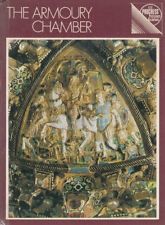
The Armoury Chamber: A Guidebook for the Tourist
Book
Goncharenko, V. and Narozhnaya, V. (1976) The Armoury Chamber: A Guidebook for the Tourist. Moscow, Progress Publishers, 181 pp.
Sinkankas/Born No.: NIS / NIB | RWHL
corundum, quality.10, gems
V. Goncharenko and V. Narozhnaya’s The Armoury Chamber: A Guidebook for the Tourist is an illustrated guide to the collections of the Armoury Chamber in the Moscow Kremlin, one of Russia’s principal repositories of imperial regalia, jewellery, precious-metal objects, ceremonial weapons, and decorative arts. Translated from Russian by Natalie Ward, the guide describes the museum’s nine exhibition halls, tracing the development of Russian craftsmanship from the medieval period through the early twentieth century, together with foreign treasures acquired through diplomatic gifts, trade, and royal patronage. Of particular gemological interest are the extensive collections of goldsmiths’ and jewellers’ work, including crowns, sceptres, orbs, thrones, ecclesiastical vessels, Gospel covers, jewellery, and ceremonial arms decorated with diamonds, rubies, sapphires, emeralds, turquoise, pearls, and other ornamental materials. The authors describe the principal techniques employed by Russian craftsmen, including filigree, cloisonné and painted enamel, niello, engraving, metal-chasing, and gemstone setting. A 1577 Gospel cover presented by Ivan the Terrible incorporates a prominent dark-blue sapphire, a gemstone the Tsar reportedly believed could expose treachery and protect against nightmares. A seventeenth-century icon cover commissioned by Patriarch Nikon is described as containing two emeralds, each weighing approximately 100 carats. Other noteworthy objects include a 1794 gold Gospel cover decorated with 3,417 gemstones, including diamonds, aquamarines, amethysts, and sapphires, and a snuffbox by the celebrated jeweller Jérémie Pauzié incorporating a 1.05-carat yellow diamond. The section devoted to Fabergé describes the firm’s sophisticated enamelling techniques and ornamental stone carvings, including an 1891 heliotrope Easter egg containing a miniature model of the cruiser Memory of Azov, and another egg enclosing a gold and platinum model of the Trans-Siberian railway, with a ruby headlight and rock-crystal windows. The museum’s collection of Byzantine cameos includes religious images carved in agate, jasper, lapis lazuli, soapstone, and chrysoprase. Foreign diplomatic gifts include Persian thrones and ceremonial saddles lavishly decorated with gemstones. Particularly remarkable is the seventeenth-century Persian “diamond throne,” ornamented with approximately 900 diamonds. The Cap of Monomakh, traditionally associated with Byzantine imperial authority, is discussed in relation to its probable Central Asian origins and its decoration with pearls and precious stones. The crown of Empress Anna Ivanovna is described as containing 2,500 diamonds and a large tourmaline. The guide also documents a Turkish ceremonial horse harness presented to Catherine II in 1775, whose forehead ornament contains 999 diamonds surrounding a large golden Brazilian topaz. Additional sections examine jewellery worn by Russian aristocrats, the symbolic properties traditionally attributed to gemstones, and the use of precious stones in diplomatic presentations and royal ceremonies. Numerous black-and-white photographs illustrate individual objects, decorative details, and exhibition arrangements. Although intended primarily as a visitor’s guide rather than a specialized gemological study, the volume provides valuable documentation of historic Russian and foreign jewellery, gemstone use, ornamental stone carving, and precious-metal craftsmanship preserved in the Kremlin collections.