
Four Treasures Reference Database
Record No. 5013
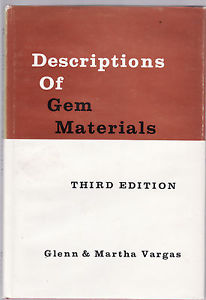
Descriptions of Gem Materials
Book
Vargas, G. and Vargas, M. (1972) Descriptions of Gem Materials. Thermal, CA, privately published, 155 pp.
Sinkankas/Born No.: 6824 | seen
corundum, fashioning.9, cutting, properties.3, gems
First published in 1972, Descriptions of Gem Materials brings together concise accounts of materials used in faceting and cabochon cutting, linking mineral identification with practical assessment of cutting behaviour. Glenn and Martha Vargas adopt an inclusive definition of gem material, covering familiar jewellery stones, uncommon collector minerals, ornamental rocks and manufactured products. The original edition described slightly more than 250 materials; the revised third edition expands this coverage to more than 550. Entries follow a consistent arrangement, separating physical properties from optical characteristics so that specimens can be compared readily. Data include chemical composition and formula, crystal system and habit, hardness, specific gravity, cleavage, fracture, streak and characteristic inclusions. Optical descriptions cover colour, refractive index, critical angle, birefringence, pleochroism, dispersion, transparency, lustre, optic character and, where applicable, the angle between optic axes. Pronunciation guides, name derivations, varieties, synonyms and misleading trade names assist readers in navigating gemstone terminology. Short commentaries connect these properties with the availability and suitability of rough, identifying promising sources and difficulties such as brittleness, cleavage, inclusions, softness or poor polishing response. The authors recognise that rarity alone may justify cutting a specimen for a collection, even when it lacks the durability or appearance expected of conventional jewellery gems. Natural materials and manufactured products occupy separate sections, with synthetic counterparts distinguished from products having no natural equivalent. The latter section also introduces production methods and the use of colouring additives. Identification tables arrange materials by increasing hardness, specific gravity and refractive index, allowing measured properties to narrow the possible identity of an unknown specimen. Introductory explanations and crystal drawings establish the terminology used throughout, while a glossary, an index of alternative and incorrect names, and a selected bibliography support consultation. The descriptions emphasise usual properties and acknowledge that uncommon variations require fuller mineralogical or gemmological references. Combining tabulated information with observations from cutting, teaching and consultation with specialists, the work serves as a practical bridge between descriptive gemmology and the handling of rough material.