
Four Treasures Reference Database
Record No. 5063
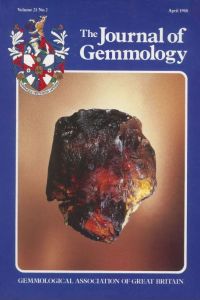
Notes on the inclusions in a greyish kyanite
Journal Article
Gübelin, E.J., Ghera, A. and Graziani, G. (1988) Notes on the inclusions in a greyish kyanite. Journal of Gemmology, Vol. 21, No. 2, April, pp. 83–87.
ISBN/ISSN: 221252 | Sinkankas/Born No.: NIS / NIB | RWHL
kyanite, gems
A greyish-blue kyanite measuring 12 × 9 × 3 mm is examined by optical microscopy, X-ray diffraction and electron microprobe analysis to identify its inclusions and investigate their relationship to the host’s physical properties and geological history. The specimen contains numerous transparent crystals, elongated aggregates, fibres, channels and occasional opaque particles. Its uneven greyish coloration forms broad, indistinct darker areas, while channels and fibrous inclusions aligned along the crystallographic c axis produce weak to moderate chatoyancy. The measured density, 3.670 ± 0.004 g/cm³, is appreciably below the value of 3.783 ± 0.004 g/cm³ calculated from the refined unit-cell parameters; this discrepancy is attributed to abundant inclusions of minerals less dense than kyanite, particularly andalusite, calcite and apatite. Euhedral prismatic inclusions, reaching approximately 0.70 × 0.40 mm and commonly oriented roughly parallel to the host’s c axis, have the same aluminium-to-silicon ratio as kyanite. Their morphology suggests andalusite, an identification confirmed by X-ray microdiffraction. They are interpreted as syngenetic inclusions. Other identified minerals include nearly pure calcite, apatite and minute zircon prisms. The apatite contains no detected fluorine and only a small amount of chlorine, suggesting carbonate apatite or hydroxyapatite, although its precise identity remains uncertain. Long, narrow channels contain minute andalusite crystals, transparent kyanite and yellow to reddish-brown material. Chemical analysis indicates that the coloured material consists of iron oxides or hydroxides. Yellow lamellae resemble lepidocrocite, whereas associated red platelets are tentatively assigned to hematite or maghemite. Tiny reddish needles associated with apatite may represent a titanium oxide, but are not conclusively identified. The coexistence of apparently syngenetic andalusite and kyanite is used to discuss formation conditions, with approximate upper limits of 4 kbar and 500°C. The authors stress that uncertainties in the coexistence relationships prevent precise pressure–temperature determination; the absence of pyrophyllite is taken to suggest lower limits around 350–400°C and 2.5–3.0 kbar. Iron-bearing material within the channels is interpreted as evidence of subsequent penetration by an iron-rich fluid. The red oxides may have formed through dehydration of lepidocrocite. The study thus relates the specimen’s appearance and anomalously low density to its inclusion population and distinguishes evidence of mineral growth from indications of later alteration.