
Four Treasures Reference Database
Record No. 5066
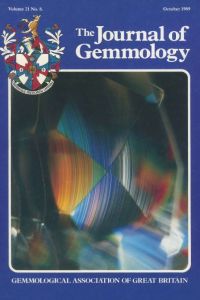
Star sapphire from Kenya
Journal Article
Gübelin, E.J., Barot, N.R., Flamini, A. and Graziani, G. (1989) Star sapphire from Kenya. Journal of Gemmology, Vol. 21, No. 8, October, pp. 467–473.
ISBN/ISSN: 221252 | Sinkankas/Born No.: NIS / NIB | RWHL
corundum, sapphire, Kenya.12, Turkana, asterism, inclusions.5, gems
Examines cabochon-cut sapphires from northwestern Kenya to characterise their inclusions, explain their asterism and distinguish them from synthetic star sapphires. Material entering the Kenyan market from mid-1987 was collected from superficial secondary deposits west of Lake Turkana, although its primary geological source remained unidentified. Ten cabochons, ranging from blue and greenish blue to greenish yellow and dark brown, were investigated using conventional gemmological testing, optical microscopy, electron-microprobe analysis and X-ray diffraction. Eight displayed six- or twelve-rayed asterism of varying quality, while two showed concentrated silky areas rather than a complete star. Some specimens produced exceptionally sharp, evenly developed six-rayed stars resembling those of Linde synthetic sapphires. Refractive-index measurements gave an approximate value of 1.765, and the stones were inert under long- and short-wave ultraviolet radiation. Visible absorption commonly showed iron-related features near 450, 460 and 470 nm. Microscopic examination documented cloudy areas, acicular structures, rutile silk, tubular cavities, transparent crystals, fluid feathers and healed fractures. The structures associated with asterism were separated into microstriae compositionally similar to the sapphire host and distinct needle-like inclusions interpreted as rutile or hematite. Their crystallographically controlled orientations and variable distribution were considered responsible for differences in star development. Rutile was supported by weak reflections in bulk X-ray diffraction patterns. Darker colours were associated with iron-rich inclusions, including hematite needles and iron oxide or hydroxide material occupying channels and healed fractures. Transparent, low-relief hexagonal crystals were assigned to corundum, while reddish-brown prismatic titanium-rich inclusions were interpreted as rutile. Straight-edged colour bands and angular growth zoning record successive growth episodes and changing chemical conditions. Together with the absorption spectrum, these features help distinguish the natural material from synthetic star sapphire despite similarities in the appearance of the stars. The authors reconstruct an initial history of crystal growth and inclusion formation followed by fluid penetration, fracture healing and deposition or transformation of iron compounds. They suggest that some iron hydroxides subsequently dehydrated to oxides as temperature increased. Mineral-equilibrium considerations are used to propose high-temperature, high-pressure growth, with maximum crystallisation temperatures exceeding approximately 500 °C. The study links the stones’ optical effects to their internal structures while leaving their precise primary occurrence unresolved.