
Four Treasures Reference Database
Record No. 5484
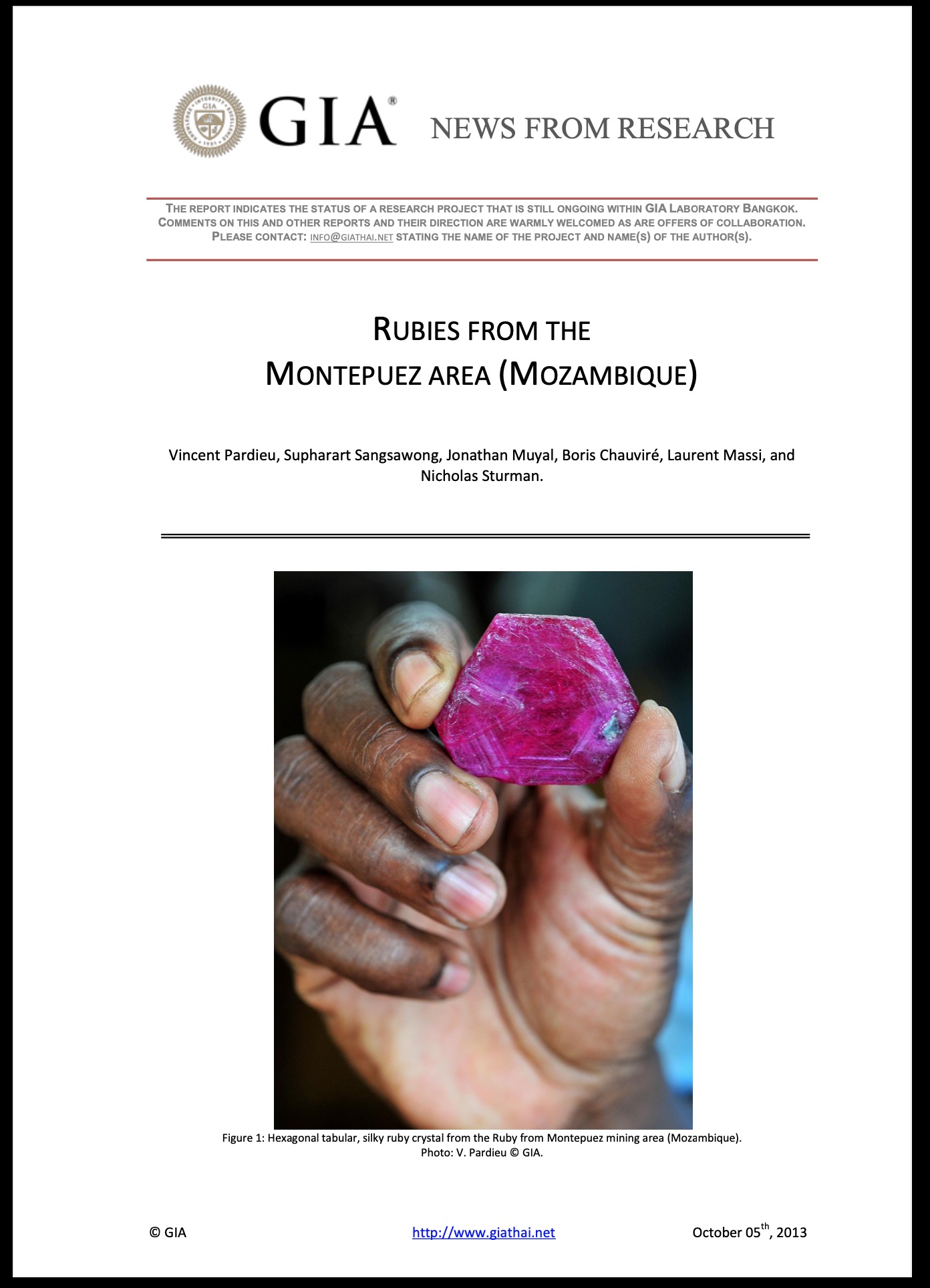
Rubies from the Montepuez area (Mozambique)
Report
Pardieu, V., Sangsawong, S., Muyal, J., Chauviré, B., Massi, L. and Sturman, N. (2013) Rubies from the Montepuez area (Mozambique). GIA: News from Research, Bangkok: Gemological Institute of America, 5-Oct, 84 pp.
RWHL*
Close Abstract
Hide Keywords
Copy Reference
corundum, inclusions.5, geology.11, Mozambique.12, gems
Rubies from Montepuez in northern Mozambique are particularly interesting as this new material rapidly dominated the ruby trade in Thailand, the world’s major ruby trading center, since the discovery of the deposit during the spring of 2009. This new material is quite different from rubies traditionally encountered in the market such as the marble type rubies, known for their strong fluorescent aspect related to their low iron content, like those from Mogok or Mong Hsu in Myanmar (Burma) or basalt related rubies, known for their low fluorescence due to higher iron content, from Thailand or Cambodia. Indeed the new deposit in Montepuez is not marble or basalt related but instead is an amphibole related deposit similar to the ruby deposits near Winza (Tanzania), M’Sawize (Mozambique) and probably the deposit near Didy (Madagascar), three other ruby deposits discovered fairly recently in Africa. Amphibole type rubies usually have higher iron content than those commonly found in marble related deposits but also usually exhibit lower iron content compared to those from basalt related deposits. It is interesting to note that these non-classic (i.e. amphibole type) metamorphic stones fill the gap, in relation to chemistry and appearance, between the highly fluorescent marble type rubies and the weakly fluorescent basalt related rubies familiar to the trade. For gemologists willing to find out where the gems they are studying come from, the fact that the rubies from Montepuez are coming from an amphibole related deposit is fascinating as the combination of the inclusion scene, the chemical fingerprint and the spectra associated with these stones will usually enable them to differentiate these gems quite easily from their cousins mined from marble or basalt related deposits. The data presented here, using GIA reference samples, should be very helpful in this regard.