
Four Treasures Reference Database
Record No. 5540
Low temperature" heat treatment of Mozambique ruby: Results report"
Report
Pardieu, V., Saeseaw, S., Detroyat, S., Raynaud, V., Sangsawong, S., Bhusrisom, T., Engniwat, S. and Muyal, J. (2015) Low temperature" heat treatment of Mozambique ruby: Results report". GIA News from Research, Bangkok: Gemological Institute of America, 16 April, 34 pp.
RWHL*
Close Abstract
Hide Keywords
Copy Reference
corundum, treatments.6, Mozambique.12, gems
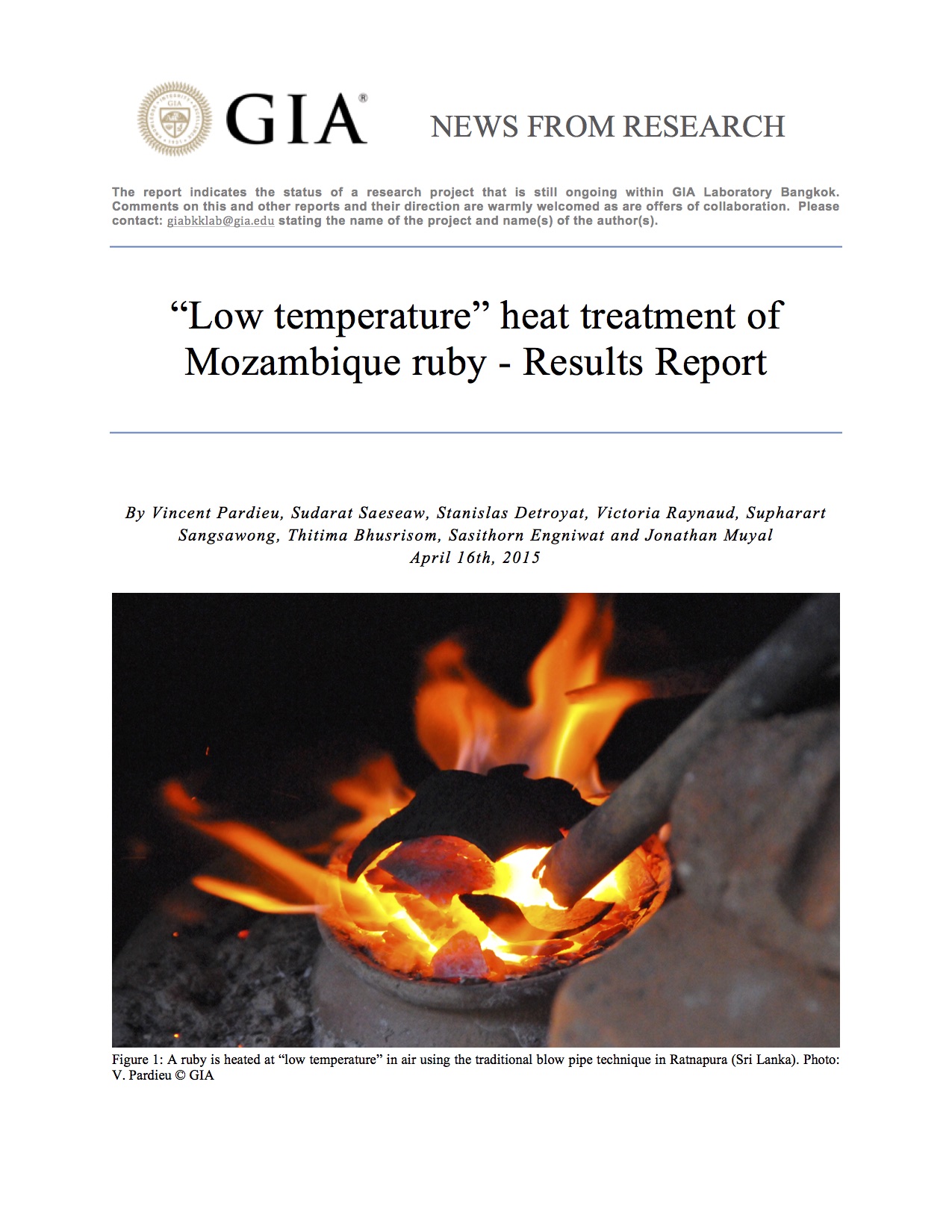
Heat treatment of corundum in Sri Lanka has likely been performed on gems for near 1000 years or more as Teifaschi, an Arab writer wrote the following in 1240 (Sersen, 1991): “In Serandib (Sri Lanka) and its environs, ruby is treated by fire. People take pebbles from the earth and crush and compress them into a mass with the aid of water. (This mixture) is daubed completely around a dry stone. Then, the whole thing is placed on a rock with other rocks set down around it. Dry firewood is thrown on the top, lit and blown upon (with bellows). The blowing is applied, along with more wood, till any black overtones on the ruby have disappeared. The amount of fire and the application of wood depends on the extent of the blackness present. People know this by experience. They heat-treat stones for at least one hour and, at most, twenty days and nights. Then, they carefully extract the ruby, its blackness having disappeared.” This description can be applied to the “blow pipe technique” we still can witness today in Sri Lanka (see Figure 1.) This technique is used is to remove or partially remove some blue components in rubies and sapphires to give in the case of rubies the appearance of a purer hue. In the past it was also used to turn light blue sapphires colorless. Another particularly interesting description of that treatment is also given by James Emerson Tennent, an English traveler who wrote “Ceylon an account of the Island” in 1859: “The blue tinge which detracts from the value of the pure ruby, whose colour should resemble “pigeon’s blood,” is removed by the Singhalese, by exposing the stone in the lime of a calcined shell and exposing it to high heat.” This reference is to the best knowledge of the authors also one of the earliest mention of “Pigeon’s Blood” in the English literature. A similar type of heat treatment of ruby to the ‘blow-pipe’ technique is also practiced in Vietnam and Thailand where a simple jeweler’s torch is used for few seconds or minutes and this is sometimes referred to as “snake bite” (see Figure 3 left). Usually only inclusion free stones are heated this way as included stones are likely to be damaged by the process. Generally the stone does not need to be repolished after this “snake bite” treatment.