
Four Treasures Reference Database
Record No. 555
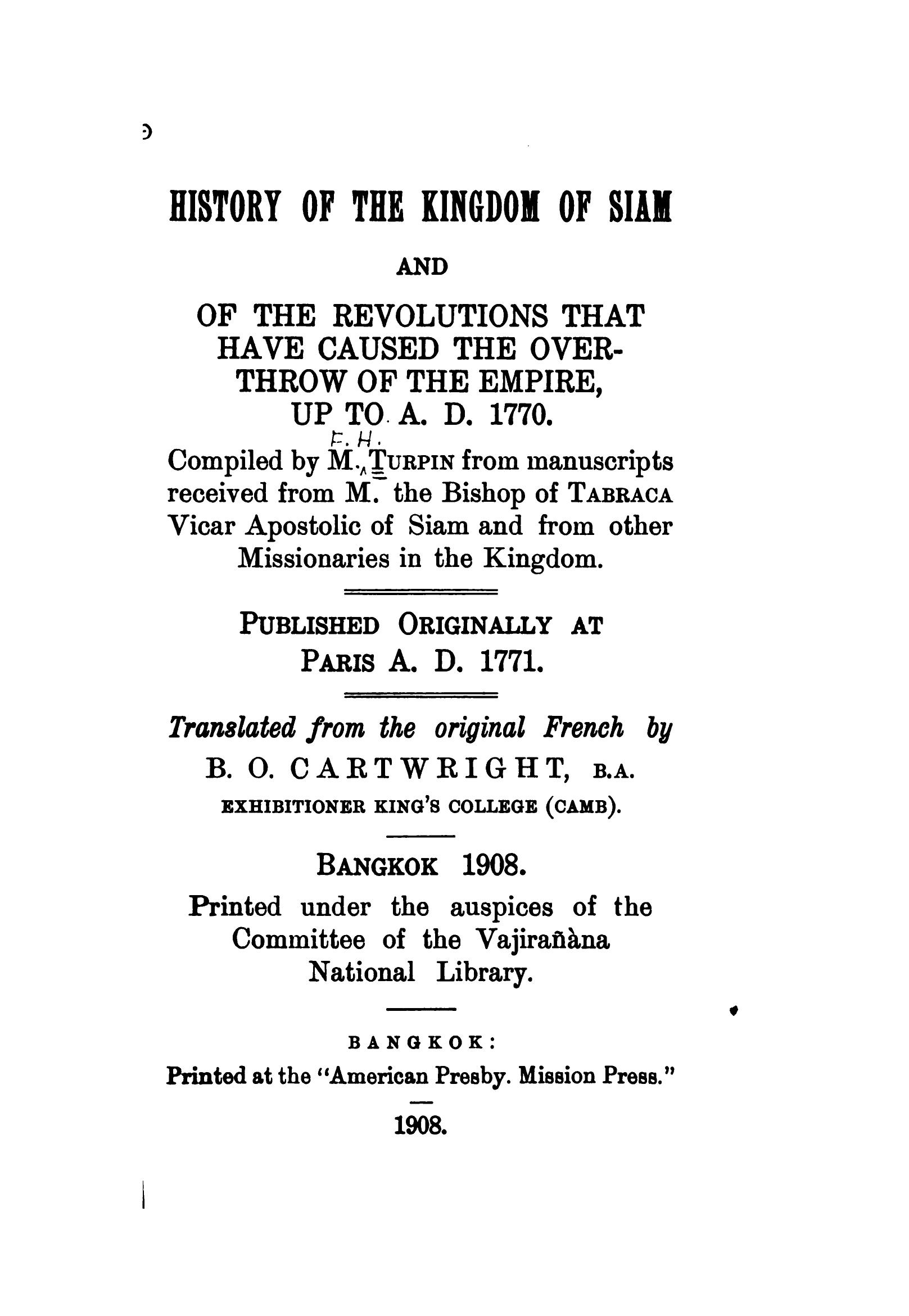
The History of the Kingdom of Siam
Book
Turpin, M. (1908) The History of the Kingdom of Siam. Bangkok, American Presbyterian Mission Press, 233 pp.
Sinkankas/Born No.: NIS/NIB | RWHL
Close Abstract
Hide Keywords
Copy Reference
corundum, ruby, sapphire, Thailand.12, Cambodia.12, gems
Turpin’s History of the Kingdom of Siam, originally published in French in 1771 and here translated by B.O. Cartwright, presents an eighteenth-century European account of Siam from its early kings through the destruction of Ayutthaya and the rise of Phya Tak (Taksin). Drawing largely upon reports of Catholic missionaries and earlier European writers, it gives particular attention to the reign of King Narai, Constantine Phaulkon, Siam’s relations with France under Louis XIV, the Macassar revolt, the overthrow of Phaulkon and expulsion of the French, and subsequent persecution of Christians. The most important later sections describe Burmese invasions, the capture and destruction of Ayutthaya in 1767, the sufferings of its inhabitants and European residents, and the political fragmentation and recovery that followed under Phya Tak. The final chapters broaden into descriptions of Siam’s neighboring kingdoms and an argument for renewed French commercial involvement in the region. Of gemological interest are numerous contemporary statements on mineral resources and the precious-stone trade. Burma and Ava are described as producing exceptionally fine rubies and sapphires, while Pegu exported gold, silver and precious stones, with “rubies” used broadly to include topaz, sapphire, amethyst and other gems. Laos is said to possess a mine yielding rubies and emeralds, including a celebrated royal emerald reputedly the size of an orange; Cambodia is credited with amethyst, ruby, topaz, chrysolite, agate and bloodstone; and Siam itself is reported to contain agate, diamonds and pearls. The work is valuable both as a near-contemporary European narrative of the political upheavals that ended the Ayutthaya kingdom and as a record of eighteenth-century European beliefs concerning the geography, commerce and gem resources of mainland Southeast Asia.