
Four Treasures Reference Database
Record No. 5554
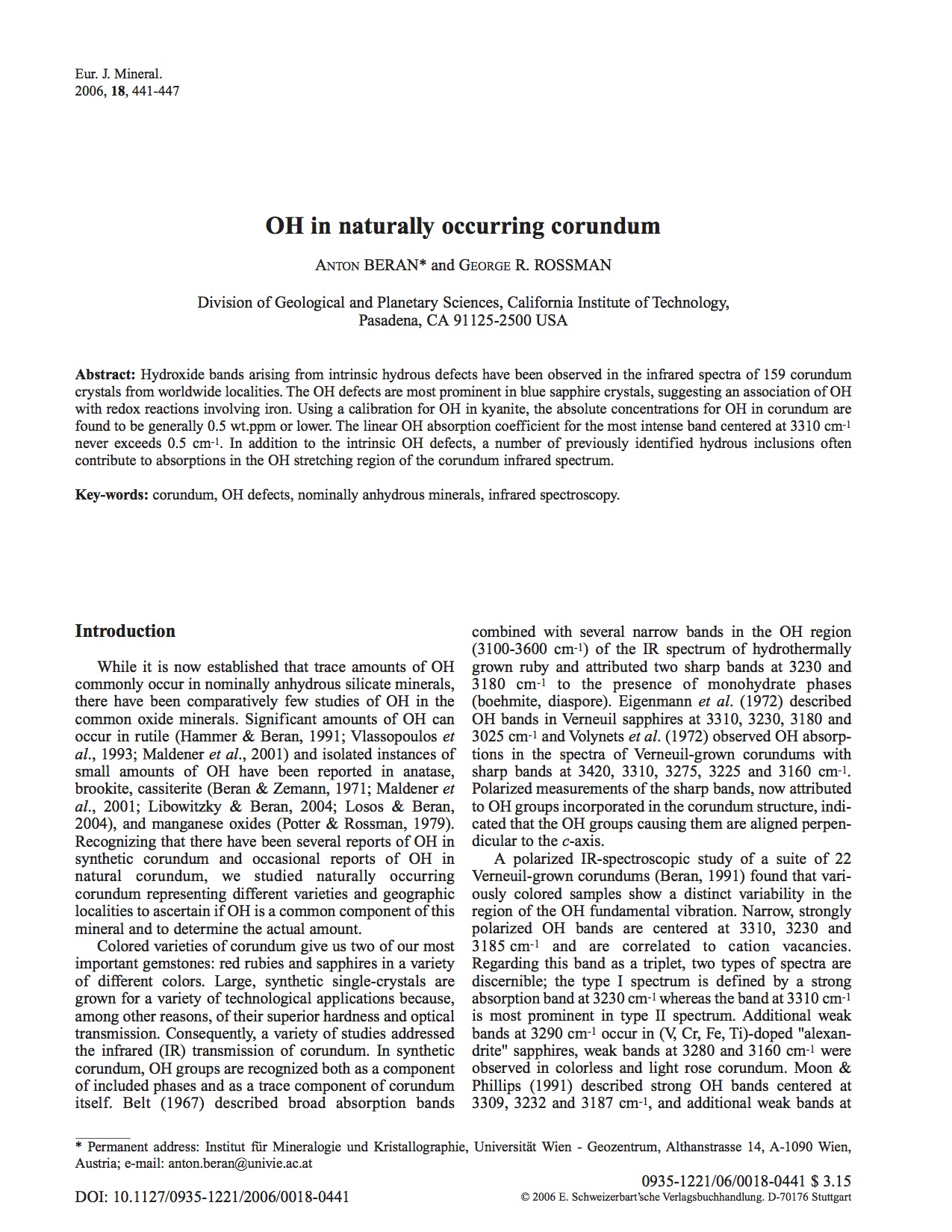
OH in naturally occurring corundum
Journal Article
Beran, A. and Rossman, G. (2006) OH in naturally occurring corundum. European Journal of Mineralogy, Vol. 18, pp. 441–447.
Close Abstract
Hide Keywords
Copy Reference
corundum, color.4, FTIR, gems
Infrared spectra of 159 corundum crystals from various global localities reveal hydroxide (OH) bands arising from intrinsic hydrous defects, with the strongest signals observed in blue sapphires. This suggests a link between OH defects and redox reactions involving iron. Applying a kyanite-based calibration, absolute OH concentrations in corundum are generally ≤ 0.5 wt. ppm. The strongest OH band at 3310 cm⁻¹ never exceeds a linear absorption coefficient of 0.5 cm⁻¹. Additionally, some of the OH absorptions originate from previously identified hydrous inclusions in the crystals.