
Four Treasures Reference Database
Record No. 5652
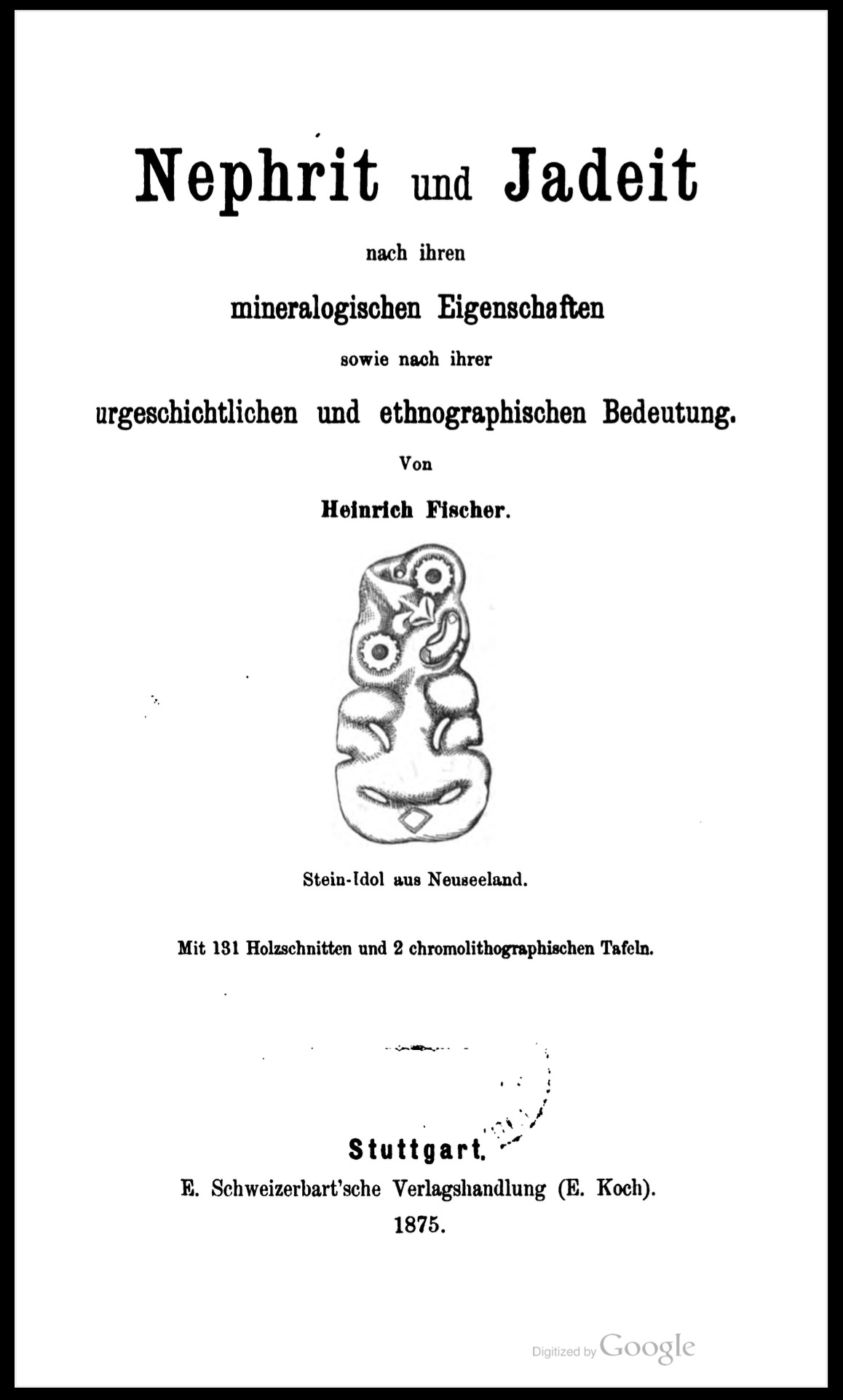
Nephrit und Jadeit
Nephrite and Jadeite
Book
Fischer, H. (1875) Nephrit und Jadeit. [Nephrite and Jadeite] Stuttgart, E. Schweizerbart'sche Verlagshandlung (E. Koch), 409 pp.
Sinkankas/Born No.: 2126, 2127 | Language: in German | RWHL**
Close Abstract
Hide Keywords
Copy Reference
jade, jadeite, fei cui, nephrite, gems, Fischer-Book
Sinkankas: Astounding work, both for its content involving an enormous amount of research into the literature, and its commentaries upon nephrite and jadeite jades as then known from all parts of the world and in all cultures. The first part, called the introduction, really consists of a potpourri of information on many aspects of jade and considers such topics as the ethnographic-archaeologic significance of jade, original and secondary jade deposits, jade deposits in various countries, nomenclatural problems, misidentifications, the literature on deposits, museums with jade collections, carved jades and their uses, curious lore of jade, etc. However, it is the second and by far the largest part, pp. 63–318, that surely must still be the most exhaustive survey of the cultural-historical-scientific literature pertaining in whole or part to jade that has ever been assembled within the covers of one book; it remains truly unique. The literature is dealt with chronologically according to this scheme: authors before Christ, and authors after Christ, the latter subdivided into annual periods of 1 to 100, 100–1200, 1200–1300 AD, and so on, by centuries, finally finishing with the period 1800 to 1875. In all, about 260 excerpts are taken from the authors and supplied with Fischer’s commentary; the name of the author and his work are given, brief bibliographical data, and the substance of the remarks (if a direct quotation is not supplied). Obviously Fischer examined almost all the works, apologizing in places for his inability to obtain copies in those few instances where he could not personally examine the book. All future students of jade, especially of jade in antiquity, must forever be grateful to Fischer for this convenient compilation. The third part is entitled “Special Natural Historical Part” and is no less interesting than the preceding matter, but like the first part, is a conglomerate of facts and further information on jade deposits, mineralogy, analyses, origin of jade, species of jade minerals, impurities in jade, and other topics, plus addenda to other text sections and remarks on the jadeite sculpture of Costa Rica and the largest known masses of nephrite. Preliminary to his description of two Meso-American jadeites, P. J. J. Valentini, “Two Mexican chalchihuites, etc.” (1881, which see), provides an excellent summary of Fischer’s treatise. He notes specially Fischer’s conviction that jades in America, “though they were dug from American soil, cannot possibly be considered indigenous to this continent,” thus adding fuel to the then raging “jade question,” or the theory that all jades came from Asia and were transported as worked objects or raw pieces across the Siberia–Aleutians route into the Americas. In general, while the work is a goldmine of information, it is poorly organized and the reader is well advised always to consult the index first before attempting to find any bit of data. The text drawings are simple outline type showing many kinds of objects and motifs thereon while the two color plates depict more or less faithfully the colors of jade specimens shown as rectangular bars; one bar is of amazonite, for comparison only. An extremely rare work; I have seen only one other copy for sale in 30 years.