
Four Treasures Reference Database
Record No. 5883
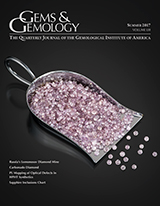
Big Sky Country sapphire: Visiting Montana’s alluvial deposits
Journal Article
Hsu, T., Lucas, A., Kane, R.E., McClure, S.F. and Renfro, N.D. (2017) Big Sky Country sapphire: Visiting Montana’s alluvial deposits. Gems & Gemology, Vol. 53, No. 2, Summer, pp. 215–227.
ISBN/ISSN: 0016626X | RWHL*
gems, corundum, Montana.12, USA.12
Sapphire has been mined in the western U.S. state of Montana for more than a century and a half. Historically, gem-quality sapphires have been mined commercially in four main areas in southwestern Montana, shown in figure 1: the upper Missouri River gravel bars (1865), Dry Cottonwood Creek (1889), Rock Creek (1892), and Yogo Gulch (1895). Today, the first two areas remain quite active, while operations in Yogo Gulch and Dry Cottonwood Creek have been suspended for many years. To better understand the characteristics of Montana sapphire and record current mining and commercial activities, GIA sent a team to visit the placer deposits at the upper Missouri River and Rock Creek areas in Au-gust 2015. Since the latter half of the 19th century, Montana’s history has been intertwined with gold, silver, and copper mining. Corundum was discovered dur-ing the course of gold mining activities in southwestern Montana. Before the 1940s, the state’s alluvial sapphire deposits were exploited mainly to supply the watch industry, but production fell dramatically with the use of synthetic sapphire in watch bearings (Emmett and Douthit, 1993). Among Montana’s secondary deposits, Rock Creek (figure 2) is the only area mined specifically for sapphire from its discovery in 1892 until World War II (Clabaugh, 1952). While Yogo Gulch is a primary deposit, the placer deposits at Rock Creek, Dry Cottonwood Creek, and the upper Missouri River near Helena have been a matter of speculation among researchers trying to work out the origin of these sapphire crystals. Research indicates that they were carried to the surface by volcanic activity, but their ultimate origin is still an open question, even after about 125 years of searching (e.g., Pratt, 1906; Clabaugh, 1952; Garland, 2002; Berg and Dahy, 2002; Berg, 2014; Zwaan et al., 2015). Due to the lack of significant sapphire bearing host rock outcrops in these areas, the search and discussion continue. The glamour of the sapphires, the mysteries of their origin, the area’s mining history, and the natural beauty of Big Sky country are an intriguing combination (figure 3).