
Four Treasures Reference Database
Record No. 5979
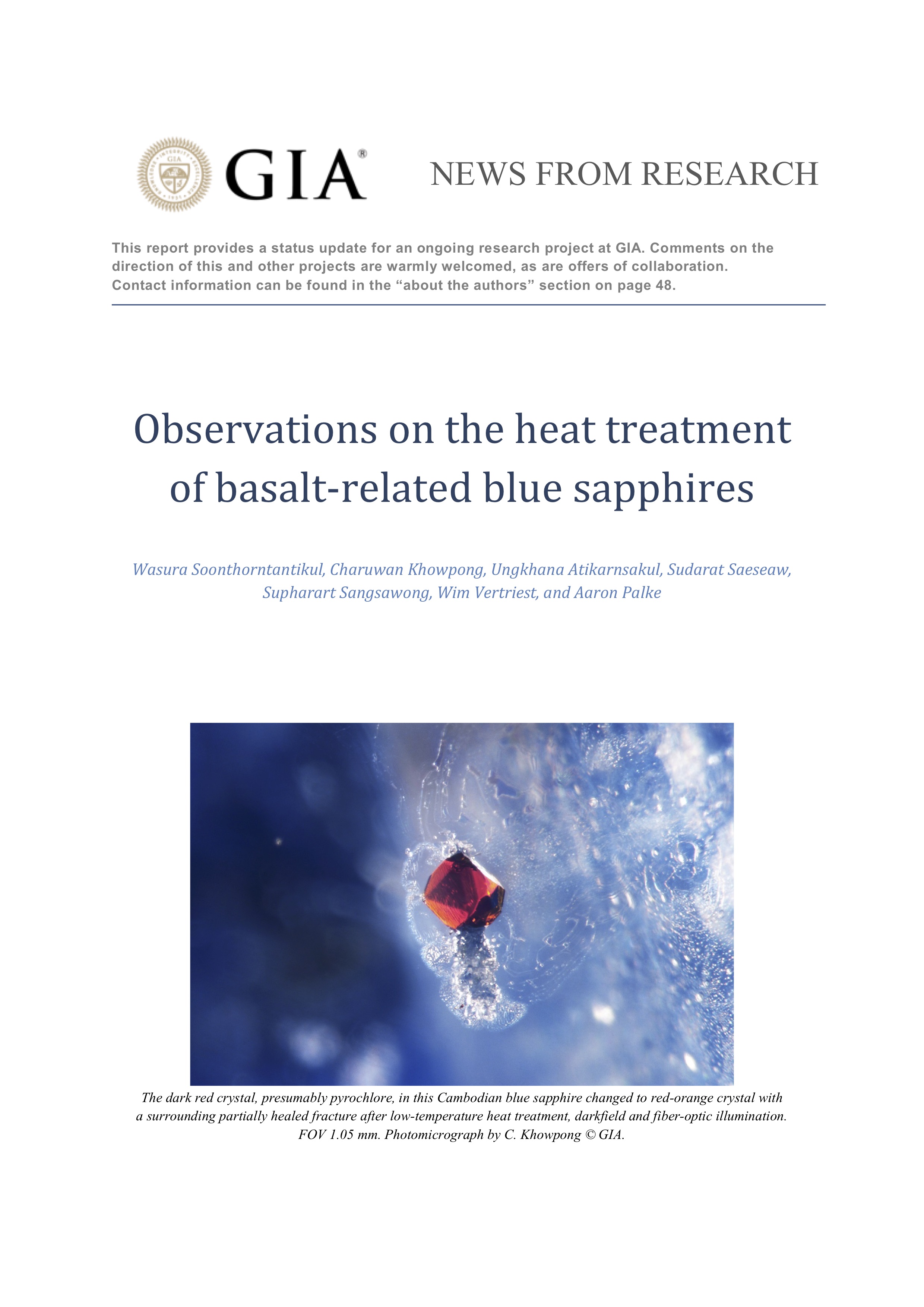
Observations on the heat treatment of basalt-related blue sapphires
Report
Soonthorntanikul, W., Khowpong, C., Atikarnsakul, U., Saeseaw, S., Sangsawong, S., Vertriest, W. and Palke, A. (2019) Observations on the heat treatment of basalt-related blue sapphires. GIA News From Research, no city: Gemological Institute of America, 60 pp.
RWHL*
Close Abstract
Hide Keywords
Copy Reference
gems, corundum, Australia.12, Cambodia.12, China.12, Thailand.12, Nigeria.12, inclusions.5, treatments.6, basalt, sapphire
Basalt-related blue sapphires typically have an oversaturated blue color causing the stones to be too dark when faceted. Low-temperature heat treatment can lighten dark material. However, it is difficult to identify this treatment using standard gemological testing and microscopic examination. For instance, unheated sapphires are transported to the earth’s surface by hot, basaltic magma which may have thermally altered their inclusions, causing them to look similar to those seen in artificially heated material. In this study, 50 basalt-related blue sapphires were heat treated in air (oxidizing atmosphere). Changes in color appearance, UV fluorescence, internal features, and spectroscopic properties post treatment were compared with the results before treatment to find suitable approaches for detecting heat treatment on blue sapphires from basalt-related deposits. The main factors affecting the sapphires’ response to heat treatment include the temperatures employed and the duration of the treatment process. Initial experiments at temperatures of 500–1500 °C for 7 hours showed that the blue color appears to lighten at 700 °C and higher. Temperatures ranging from 700 to 1050 °C were then selected for a more in-depth study on the effect of heating time with durations of 1.75, 7, and 28 hours. The results showed negligible change to a slight lightening of the blue color after treatment at 700 °C, while an obvious lightening of the blue color occurred at 900 and 1050 °C. Some mineral inclusions, iron stains, and partially healed fractures showed signs of alteration during these heating experiments, while needles and minute particles did not show any signs of change. All unheated samples studied were inert to short-wave ultraviolet radiation. After heating, most remained inert under short-wave UV, but a few samples exhibited a very weak chalky green fluorescence. FTIR spectra obtained from the samples varied considerably, with differences in peak intensities before and after heating. Differences were also seen as the duration of heating was changed. In most cases, unheated blue sapphires from basalt-related deposits revealed the characteristic 3309 cm⁻¹ series (sharp peaks at 3309, 3232 and 3186 cm⁻¹) in the FTIR spectrum with the intensity of 3232 cm⁻¹ being much lower than that of 3309 cm⁻¹. After heating at 700 °C and 900 °C, the intensity of the 3309 cm⁻¹ peak decreased and the 3232 cm⁻¹ peak increased, respectively. However, in most cases, some samples that initially showed a relatively intense 3232 cm⁻¹ peak before treatment exhibited a more intense 3309 cm⁻¹ peak and a less intense 3232 cm⁻¹ peak post treatment. After heating at 1050 °C for 1.75 hours, we recorded a decrease in the intensity of the 3309 cm⁻¹ peak and an increase in the 3232 cm⁻¹ peak, to the point where they were of almost comparable intensity. When subsequently heated for 7 and 28 hours, the intensity of the 3309 cm⁻¹ peak increased and that of the 3232 cm⁻¹ peak decreased. UV-Vis-NIR spectra obtained from the samples heated at 900 °C and 1050 °C for 1.75, 7, and 28 hours showed a reduction in the height/intensity of the broad band centered at 580 nm related to an Fe²⁺–Ti⁴⁺ intervalence charge transfer. This reduction is the root cause of the lighter color after heat treatment. The results of this study showed that even with advanced testing, it is very challenging to separate basalt-related sapphires that have been artificially heated from natural unheated stones, owing to the variable results associated with the experimental temperatures and durations used. Inclusion studies may provide sufficient evidence in some cases, but even when comparing the inclusions seen before and after treatment, separation often remains challenging.