
Four Treasures Reference Database
Record No. 6087
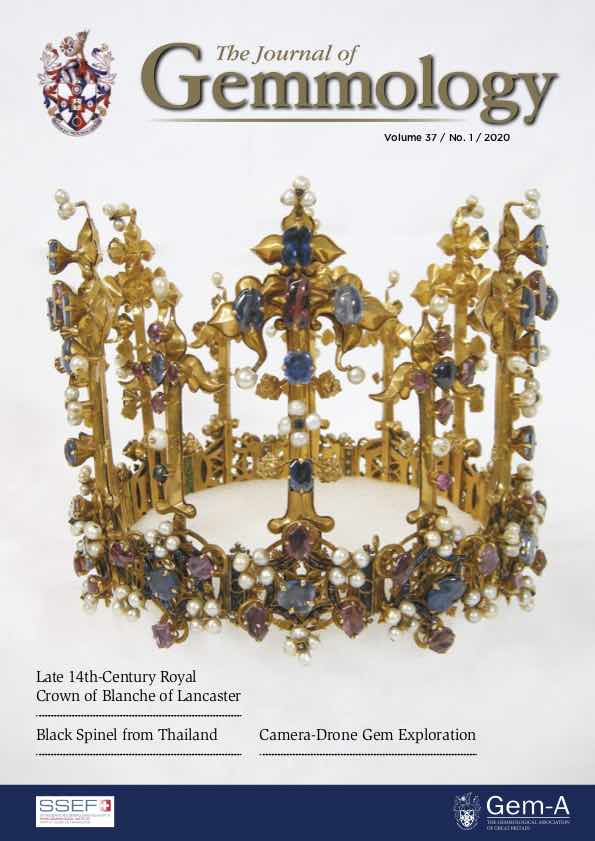
The late 14th-century royal crown of Blanch of Lancaster—History and gem materials
Journal Article
Schmetzer, K. and Gilg, H.A. (2020) The late 14th-century royal crown of Blanch of Lancaster—History and gem materials. Journal of Gemmology, Vol. 37, No. 1, pp. 26–64.
Close Abstract
Hide Keywords
Copy Reference
gems, corundum, history.1, sapphire, spinel, ruby
The richly bejewelled crown preserved in the Treasury of the Munich Residence offers a window into both European dynastic history and contemporaneous decorative practices and gem use. The crown’s history can be traced from the late 14th-century court of Richard II and his wife Anne of Bohemia in London; through its role as part of the dowry in 1402 of Blanche of Lancaster, bride of future Elector Palatine Louis III in Germany; to its later decades in Heidelberg, Mannheim and finally Munich by the late 18th century. In this study, all gem materials currently decorating the piece—one of few extant examples of Late Middle Ages royal regalia—were identified by a combination of microscopy, EDXRF analysis and Raman spectroscopy, using mobile instru- ments on site at the museum. The gems included blue and pink sapphires, pink spinels, garnets, emeralds, diamond octahedra and pearls. Various imitations were also present, including black- coated gold pyramids (substituting for diamonds) and green and pink lead glass. The forms of the gems reflect a progression from use of merely irregularly shaped polished pebbles, to rudimentary shaping or preforming without sharp edges, to sharply faceted regular shapes, thereby demon- strating the transition in gemstone fashioning as the Late Middle Ages gave way to the Renaissance.