
Four Treasures Reference Database
Record No. 6099
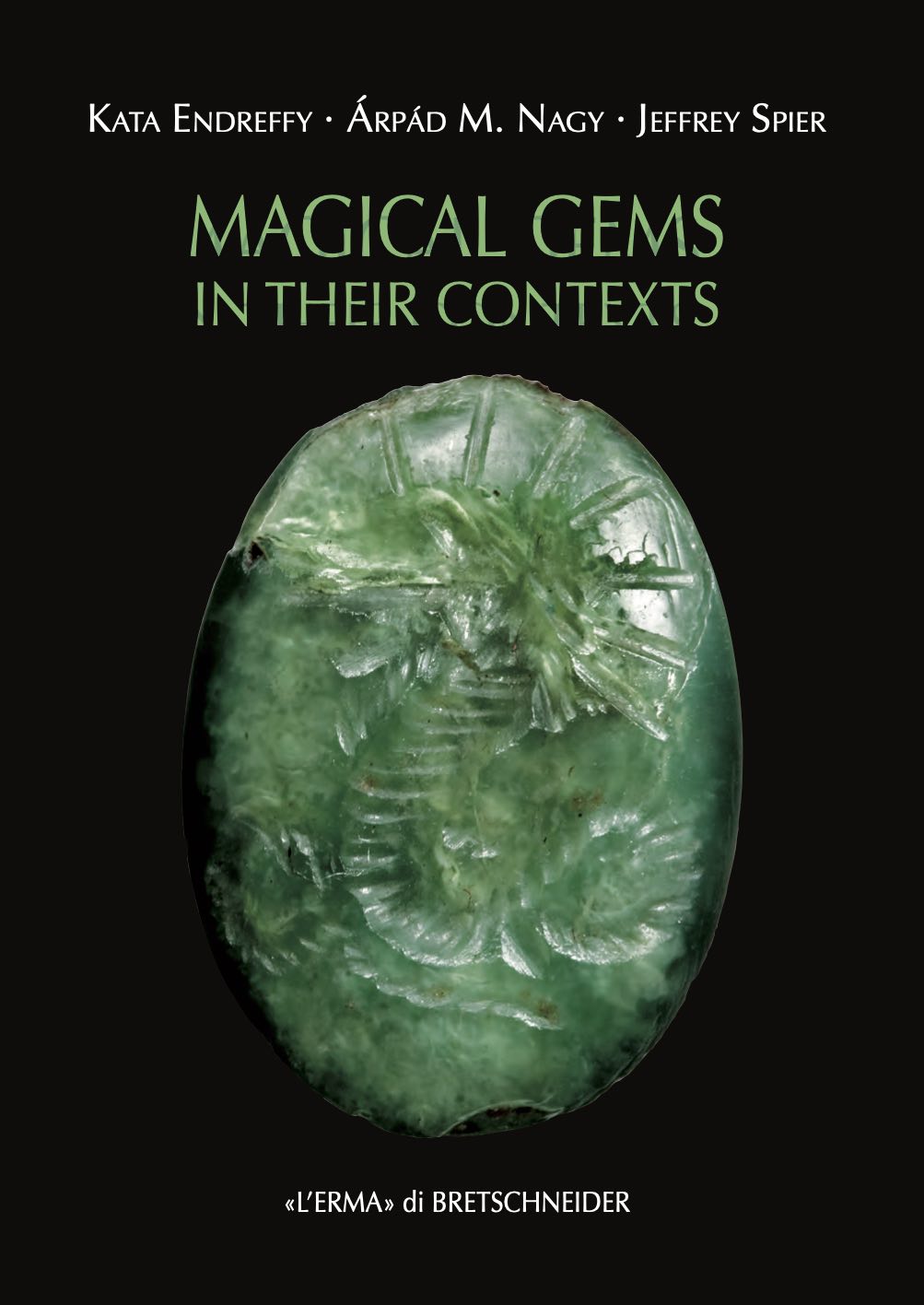
Magical Gems in Their Contexts
Edited Book
Endreffy, K., Nagy, Á.M. and Spier, J., editor (2019) Magical Gems in Their Contexts.. Rome, «L'ERMA» di Bretschneider, 382 pp..
ISBN/ISSN: 9788890000000 | Sinkankas/Born No.: NIS/NIB | RWHL*
Close Abstract
Hide Keywords
Copy Reference
gems, ancient gemology, ancient jewelry, early metallurgy, glyptic, engraved gems, magical gems, amulets
The papers in this book derive from a workshop held at the Museum of Fine Arts, Budapest between 16–18 February 2012. It has taken unusually long to publish the proceedings of the conference – the various reasons are irrelevant and the responsibility of the editors. The delay, however, has given the authors the opportunity to update their findings before publication, which might perhaps make up for the loss caused by the lengthiness of the process. The Budapest workshop was the second conference solely dedicated to research on magical gems. It is worth putting this in context and giving an overview of the achievements that took place in the period between these two events. During these years, there has been a radical change in the scope of our knowledge on magical gems. It has been noted before that magical gems occupy a unique place among the material remains of classical antiquity. Through much of the history of classical studies magical gems have been relegated to the things not worthy of knowing – an approach encountered in all of the disciplines involved. Despite this, there has been some exceptional scholarship on magical gems, notably the work of three scholars: Armand Delatte, Alphonse A. Barb, and, most importantly, Campbell Bonner, the author of the still fundamental monograph. It is quite telling that in the two decades following the publication of the first catalogue of magical gems in the Cabinet des Médailles in Paris in 1964 only a few studies were written on the subject. The change came in the mid-1980s, heralded by the catalogue of the Berlin gems by Hanna Philipp (1986), which was the first monograph to describe a collection of magical gems using the tools of classical archaeology. The past decades have seen the publication of works that will define research on magical gems for a long time to come. Catalogues of the largest museum collections have been compiled, enlarging the known corpus of magical gems to an enormous extent. Studies written with never before seen thoroughness focused on individual pieces and iconographical types. Comprehensive works have also appeared, the most momentous being Simone Michel’s 2004 overview, the second monograph after Bonner’s to include all the gems known at the time, 2800 items (to compare: Bonner’s book was based on a catalogue of 389 pieces). Importantly, this period has also been characterised by a shift in the scope of research beyond ancient gems, thus creating the necessary conditions for studying the post-antique chapters in the long history of magical gems. Two new aims in the research on magical gems have also been formulated during this period: the organisation of an international exhibition of amulets, and the creation of an online database of magical gems. The first is yet to be accomplished, although it has come close to realization on four occasions since 2000, and Simone Michel has successfully organized two exhibitions on a smaller scale, relying on the collection of Wolfgang Skoluda and the material kept in German museums. Her achievements are a clear indication of the potentials of the concept. The second objective was met with success in Budapest, where the Campbell Bonner Magical Gems Database (CBd) is now maintained by the Collection of Classical Antiquities of the Museum of Fine Arts. Since its launch in 2010, the database has made more than 2700 amulets from over seventy collections worldwide openly accessible, and is continuously expanding.