
Four Treasures Reference Database
Record No. 6126
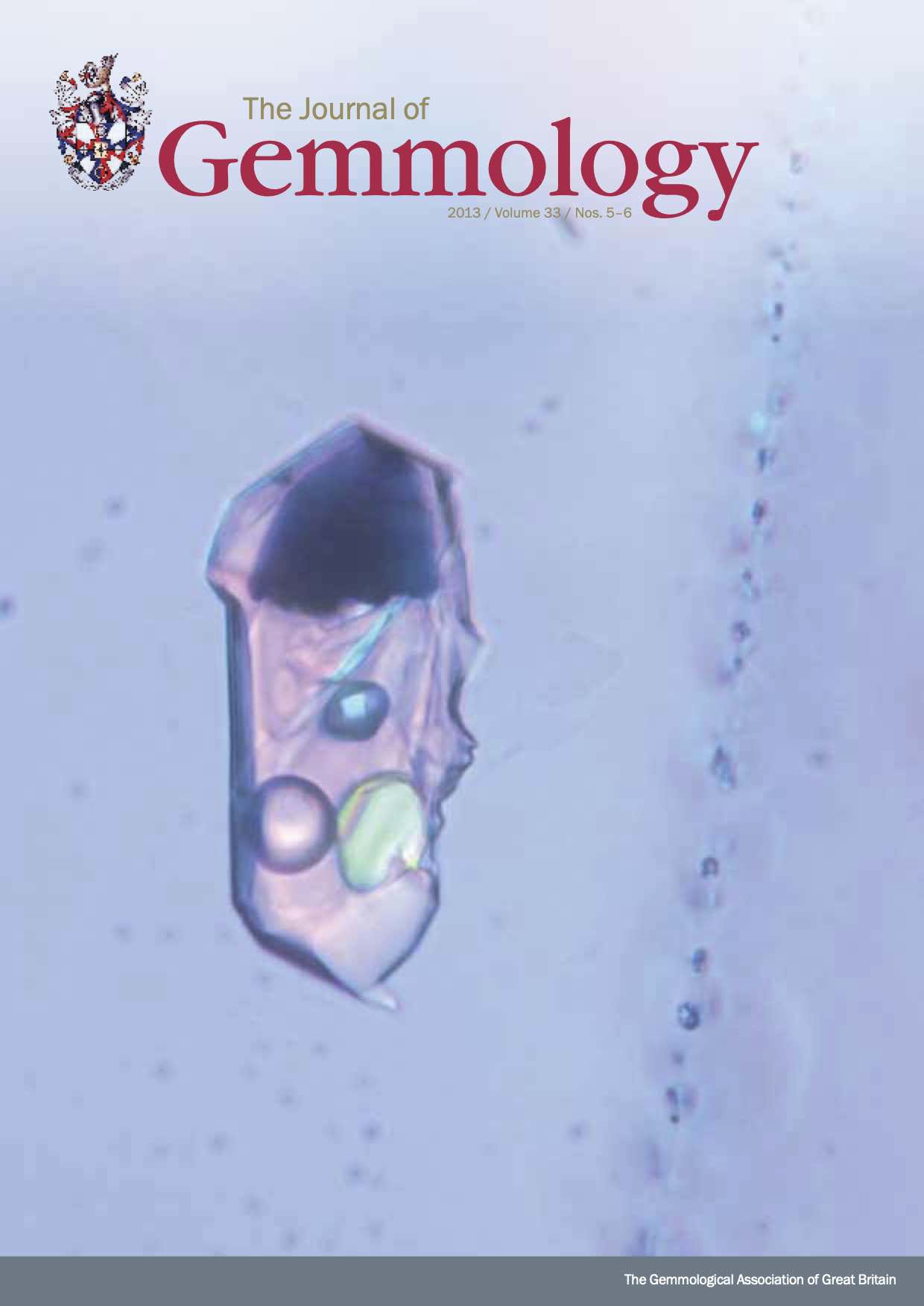
Synthetic alexandrites grown by the HOC method in Russia: Internal features related to the growth technique and colorimetric investigation
Journal Article
Schmetzer, K., Bernhardt, H.-J., Balmer, W. and Hainschwang, T. (2013) Synthetic alexandrites grown by the HOC method in Russia: Internal features related to the growth technique and colorimetric investigation. Journal of Gemmology, Vol. 33, No. 5–6, pp. 113–129.
ISBN/ISSN: 221252 | RWHL*
Close Abstract
Hide Keywords
Copy Reference
gems, synthetic chrysoberyl, Russia, horizontally oriented crystallization
Mineralogical and gemmological properties of synthetic alexandrites grown by the horizontally oriented crystallization (HOC) method are described. The method is used to grow crystal plates weighing up to 450 g. The morphology of the rough crystals is dependent on the form of the molybdenum boat used as a container for crystal growth. The most significant inclusions for gem identification are curved growth striations and flat, irregularly- shaped somewhat elongated cavities. Microprobe analyses revealed distinct amounts of chromium and vanadium but extremely low iron contents. Spectra in the UV-Vis range are consistent with published work. Six differently sized cubes were cut from an HOC alexandrite crystal and used to show pleochroism in combination with two optical phenomena: the alexandrite effect and the Usambara effect. Colorimetric parameters were calculated from the spectra of the cubes and plotted in the CIELAB colour space to demonstrate the alexandrite and Usambara effects graphically for different directions of view. The absorption bands in the infrared are polarized and assigned to structural OH-groups.