
Four Treasures Reference Database
Record No. 6222
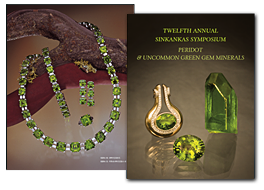
Archaeogemology of peridot
Conference Paper
Thoresen, L. and Harrell, J.A. (2014) Archaeogemology of peridot. Twelfth Annual Sinkankas Symposium • Peridot and Uncommon Green Gem Materials, 5-Apr-14, Carlsbad, CA: Pala International, pp. 31–51.
Sinkankas/Born No.: NIS/NIB | RWHL*
Close Abstract
Hide Keywords
Copy Reference
gems, peridot, beryl, emerald, Red Sea, Egypt, Zabargad Island
Peridot is the name for gem olivine, an iron-magnesium silicate ([Mg,Fe]₂SiO₄) in solid solution series with end members forsterite (Mg₂SiO₄) and fayalite (Fe₂SiO₄) (see: W. Simmons, p. 12 in this volume). Its color, density, and refractive index are related to the relative proportions of magnesium-rich forsterite and iron-rich fayalite. High-quality gem peridot is transparent with a green to yellowish-green color, but it can be translucent and with increasing Fe-content it tends toward a more brownish color. Measuring 6.5–7 on the Mohs hardness scale, peridot is easily abraded and is susceptible to etching by body oils. A selected bibliography of literature on peridot and its sources is given by J. Shigley in this volume (p. 120) and a world map of gem peridot localities is shown on p. 66.